


Ventricular refractory periods
Content
General information
Any event detected or stimulated in the ventricle triggers a ventricular blanking period.
This ventricular refractory period (VRP) is designed to prevent double counting of the R wave and/or detection of the T wave.
Ventricular blanking after atrial stimulation
This programmable ventricular blanking period is triggered after an atrial stimulus.
This period is designed to avoid detection of the atrial stimulus by the ventricular sensing chain, which would lead to ventricular inhibition.
The ventricular blanking period following atrial stimulation is programmable (depending on the company) when the stimulator is operating in DDD, DDI and DVI modes.
A ventricular signal occurring during ventricular blanking after atrial pacing is not detected with ventricular pacing at the end of the programmed AV delay.
This blanking is usually programmed to be relatively short (between 20 and 40 ms).
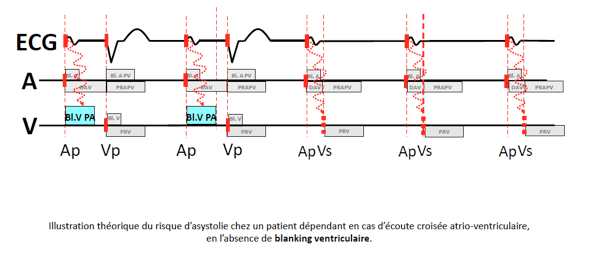
The safety window
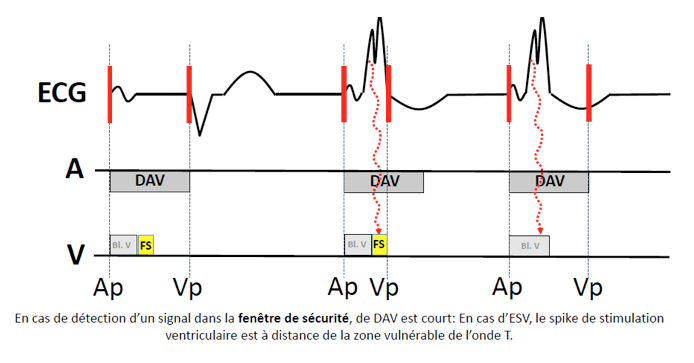
The safety window is a ventricular detection period complementary to post-atrial ventricular blanking. It is activated (depending on the manufacturer) only after atrial stimulation and is designed to prevent ventricular asystole due to inappropriate inhibition of ventricular stimulation by stimulus detection or atrial depolarization.
The function is available when the stimulator is operating in DDD, DDI and DVI modes.
Ventricular detection within a manufacturer-variable delay after atrial pacing is considered non-physiological and results in ventricular pacing at the end of the safety window.
The appearance of a short AV delay means that safety window pacing can be recognized on the electrocardiogram.
If the event detected in the safety window is the result of cross-tapping or over-detected noise, the pacing pulse enables effective ventricular capture at the end of the safety window.
If the event detected in the safety window corresponds to late ventricular extrasystole or atrio-ventricular conduction, pacing at the end of the safety window occurs early enough in the absolute myocardial ventricular refractory period to avoid pacing on the peak of the T wave.
Brand specific information
1. Blanking and the post-ventricular ventricular refractory periods
Abbott
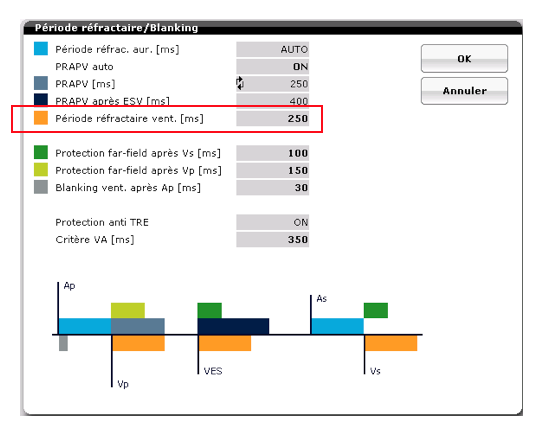
After ventricular stimulation, there is a programmable ventricular refractory period (between 125 and 470 ms, nominal value 250 ms).
Similarly, there is a programmable post-detection ventricular refractory period (between 125 and 500 ms, nominal value 250 ms).
Biotronik
Any event detected (Vs or extrasystole) or stimulated in the ventricle triggers a programmable ventricular refractory period (VRP).
Boston Scientific
After ventricular detection: any event detected in the ventricle triggers a 135 ms ventricular refractory period broken down into a 50 ms absolute refractory period, a 40 ms noise window and a 45 ms absolute refractory period.
After ventricular stimulation: a stimulated event in the ventricle triggers a ventricular refractory period broken down into a fixed refractory period followed by a 40 ms noise window. This parameter can be set to dynamic (decrease in fixed refractory period in relation to an increase in heart rate).
Medtronic
On older pacemakers (up to Adapta)
Any event detected or stimulated in the ventricle triggers an absolute, non-programmable blanking period. The actual duration of this blanking period is determined dynamically by the stimulator, depending on signal amplitude and duration (50 to 100 ms). Each event detected or stimulated in the ventricle also triggers a relative refractory period. This is programmable (150 to 500 ms; 230 ms nominal).
On more recent stimulators (Ensura, Advisa and others)
There is programmable ventricular blanking after ventricular pacing (150 to 320 ms; 200 ms nominal) and ventricular blanking after ventricular detection (120 to 320 ms; 120 ms nominal).
Microport
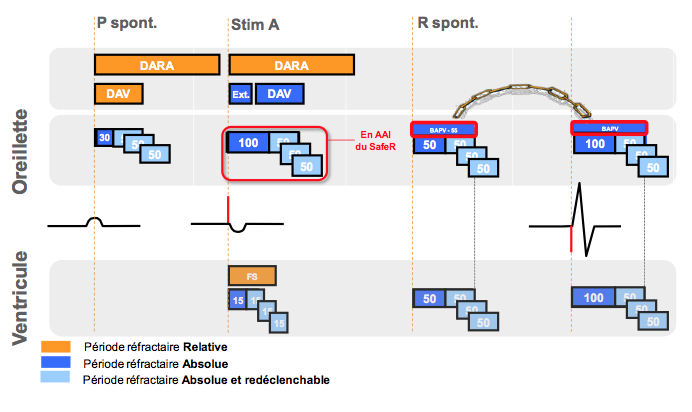
Following ventricular detection, a refractory period of 100 ms is triggered at the ventricular stage. The first 50 ms is an absolute refractory period, and the following 50 ms can be automatically retriggered. The value of this period is not programmable.
Following ventricular pacing, a refractory period of 150 ms is triggered at the ventricular stage. The first 100 ms is an absolute refractory period, and the following 50 ms can be automatically retriggered. The value of this period is not programmable.
2. Post-stimulation ventricular refractory periods
- Ventricular blanking after atrial pacing is not programmable for Medtronic and Microport CRM-Sorin pacemakers.
- Ventricular blanking after atrial pacing is programmable for Biotronik, Boston Scientific and Abbott pacemakers.
- There is no safety window on Boston Scientific pacemakers (protection provided by a retriggerable noise window: if detected in the noise window, no inhibition and pacing at the end of the programmed AV delay).
- The safety window is short for Abbott pacemakers (64 ms after atrial pacing, but if detection within this window, pacing after 120 ms).
- The safety window lasts between 95 and 110 ms for Biotronik (100 ms), Medtronic (110 ms) and Microport CRM-Sorin (95 ms) pacemakers, with pacing at the end of the window if detected.
Abbott
Ventricular blanking after atrial pacing
This blanking is programmable to AUTO (from the Accent platform in nominal value) or to a fixed value between 12 and 52 ms. When AUTO is selected, if a ventricular signal is detected during blanking, blanking is automatically extended until no signal is detected, or until the 52 ms limit is reached.
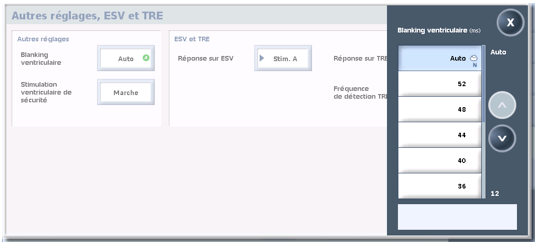
Safety ventricular pacing
The safety window can be programmed on or off (nominal value on). If a ventricular signal is detected within the safety window (starting after ventricular blanking post atrial pacing and ending 64 ms after atrial pacing), ventricular pacing is triggered 120 ms after atrial pacing.
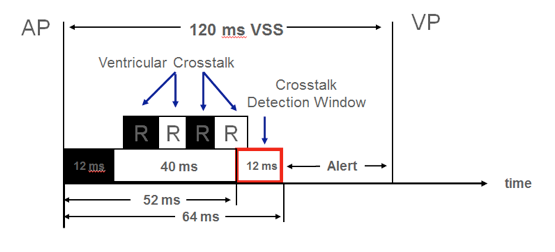
If ventricular blanking after atrial stimulation is set to “Auto”:
- if a ventricular signal is detected during the initial 12 ms blanking (possible cross-listening), further retriggerable 12 ms blanking periods follow until detection stops, without exceeding a limit set at 52 ms;
- if ventricular detection ends before this 52 ms limit, the cross-listening window is interrupted; if ventricular detection occurs before the end of the AV delay, ventricular pacing is inhibited; if no detection occurs, ventricular pacing occurs at the end of the AV delay;
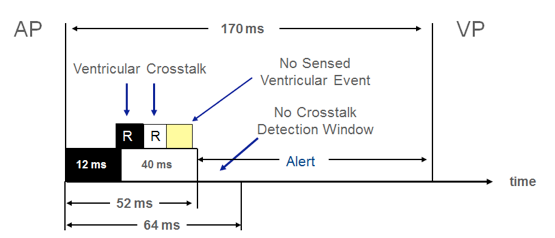
- if ventricular detection continues beyond this 52 ms limit (start of the safety window), ventricular pacing is delivered 120 ms after atrial pacing;
Biotronik
Ventricular blanking after atrial stimulation
This blanking is programmable between 30 and 70 ms (nominal value 30 ms).
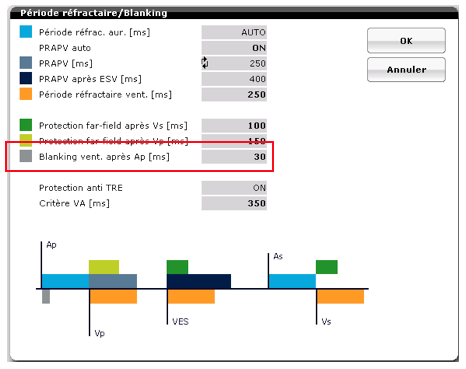
The safety window
After atrial pacing and the ventricular blanking period (programmable between 30 and 70 ms), the non-programmable safety window begins (lasting from the end of ventricular blanking to 100 ms after atrial pacing). Ventricular detection within this safety window triggers ventricular pacing at the end of the window (100 ms after atrial pacing).
Boston Scientific
Ventricular blanking after atrial pacing
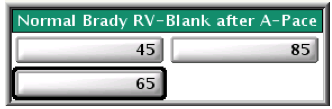
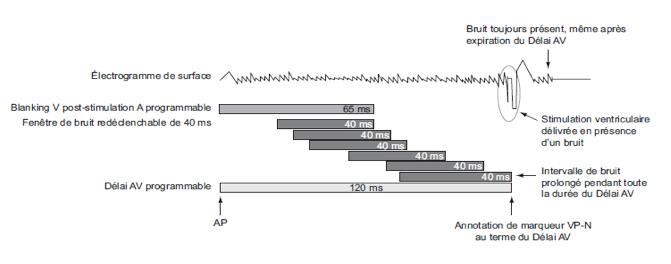
This blanking is programmable between 45 and 85 ms (nominal value 65 ms, with the last 40 milliseconds being the noise window).
Safety window and noise window
There is no safety window on Boston Scientific pacemakers.
There is, however, a noise window which constitutes a portion of the various blankings or refractory periods. When a signal falls within the noise window, it is not used for detection and does not recycle the escape intervals.
If the signal is detected continuously, this noise window is systematically retriggered (re-triggered) for as long as the signal is present (or until the next stimulation).
This blanking is programmable between 45 and 85 ms (nominal value 65 ms, the last 40 milliseconds being the noise window).
Medtronic
Ventricular blanking after atrial pacing
This blanking is non-programmable (30 ms for bipolar atrial pacing and 40 ms for unipolar pacing).
The safety window
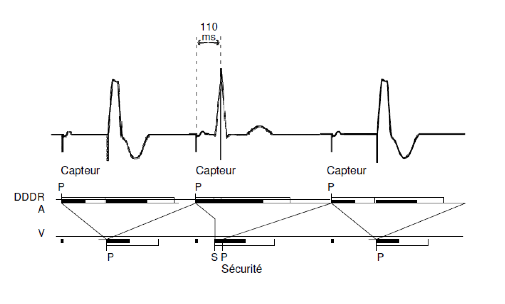
Ventricular detection within 110 ms of pacing triggers ventricular pacing at 110 ms or at the end of the paced AV delay, if less than 110 ms.
The 2 annotations VP and VS appear on the real-time rhythm monitor, on frozen tracings and on printed frozen tracings.
Microport
Ventricular blanking after atrial pacing
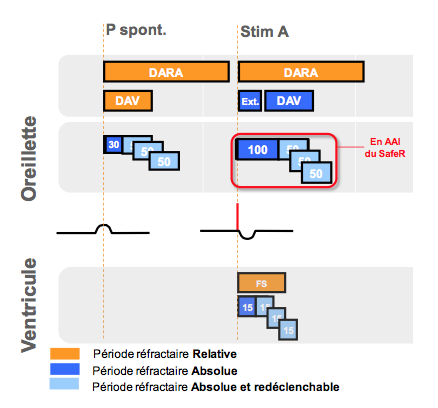
Following atrial pacing, an absolute refractory period of 30 ms is triggered at the ventricular stage. The first 15 ms are an absolute refractory period, and the following 15 ms are automatically retriggered in the event of detection. The value of this period is not programmable.
The safety window
Following atrial pacing, a relative refractory period of 95 ms is triggered at the ventricular stage. The value of this period is not programmable. It becomes effective only after the end of ventricular blanking after atrial stimulation. If ventricular detection occurs between the end of blanking (ventricular post atrial pacing) and the end of the safety window, ventricular pacing is delivered at the end of the safety window.
When the SafeR dual-chamber pacing mode is programmed and operates in “AAI” (more precisely, in ADI), the refractory periods are those of a dual-chamber pacemaker. Ventricular detections of AV cross-talk or PVC in the safety window may occur. There will be no ventricular pacing at the end of the safety window. In this situation, the SafeR algorithm considers these safety-window detections as blocked A-stimulations (switching to DDD based on AVB III criteria). SafeR mode is explained in detail on the Microport webpage Pacing modes.