

Atrial refractory periods
Content
General information
Blanking and the post-atrial atrial refractory period
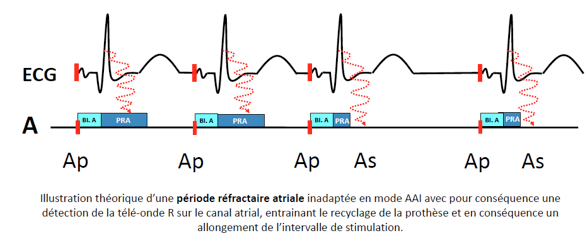
Atrial blanking and the atrial refractory period (ARP) occur following stimulated or detected atrial events.
Post-ventricular atrial refractory period
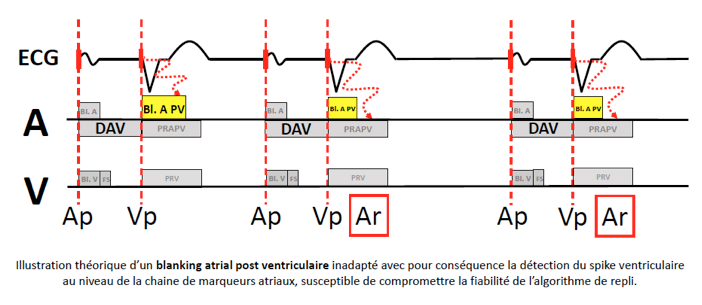
Post-ventricular atrial blanking (PVAB)
This is an absolute refractory period applied in the atrium after ventricular detection and stimulation. Any ventricular event detected or stimulated restarts the PVAB, which is also the first part of the PVARP. PVAB is limited to values less than or equal to those of the programmed PVARP.
Its purpose is to avoid detection, by the atrial chain :
- ventricular stimulation artifact
- depolarization of the spontaneous or stimulated ventricle
This blanking is used when the pacemaker is operating in DDD, DDI, VDD and VDI modes.
Post-Ventricular Atrial Refractory Period (PVARP)
The Post-Ventricular Atrial Refractory Period (PVARP) is triggered by ventricular sensing or pacing.
It occurs when the pacemaker is operating in DDD, DDI and VDD modes.
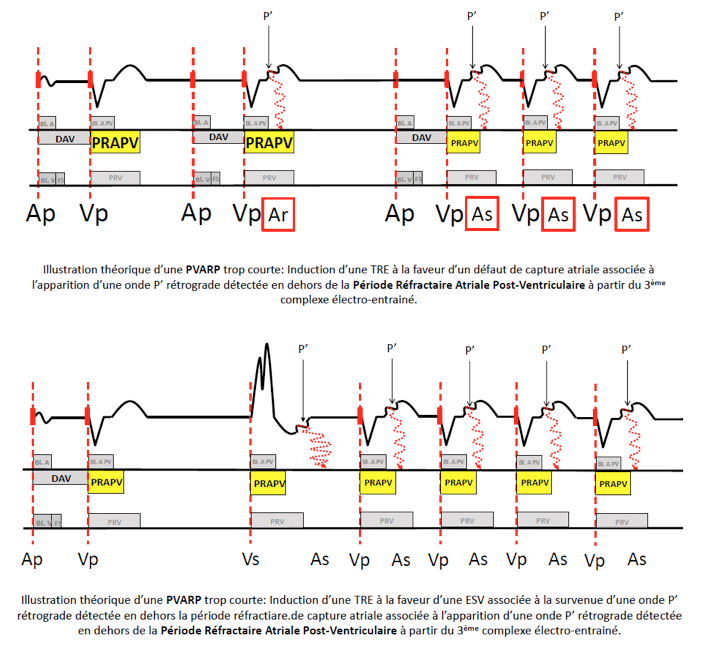
Its main purpose is to prevent the detection of retrograde P-waves that could trigger tachycardias by electronic reentry (atrial tracking modes). When the pacemaker is operating in DDI mode, the PVARP prevents atrial inhibition by detecting retrograde P waves.
Its first part is occupied by the PVAB and is therefore absolutely refractory (depending on the manufacturer). After the PVAB, the period is relative. During PVARP, intrinsic atrial events may be detected as refractory events and identified on event marker recordings, but they do not affect pacing interval synchronization. Thus, an atrial event detected in this period does not induce AV delay. When the pacemaker is operating in DDD and DDI modes, planned atrial pacing is not inhibited.
To avoid recycling ventricular pacing on a retrograde P wave, PVARP should theoretically be programmed to a value greater than the patient’s retrograde ventriculo-atrial conduction time. The mean value of the retrograde conduction time is between 220 and 280 ms, depending on the patient, but can sometimes be even longer, necessitating adaptation of the PVARP.
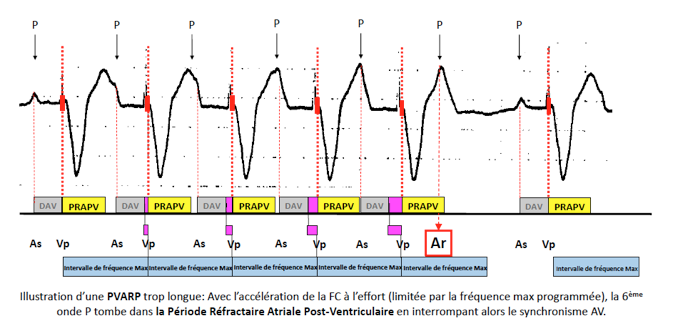
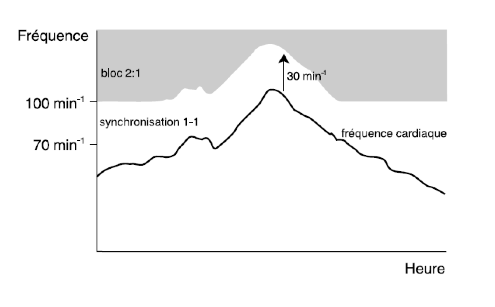
However, too long a PVARP can induce the appearance of a 2:1 block at high intrinsic frequencies when the pacemaker is operating in atrial tracking mode (DDD or VDD). To reduce the 2:1 point, PVARP can be configured to vary according to the frequency indicated by the sensor (sensor-modulated PVARP) or by the mean atrial frequency (automatic PVARP). The specifics of stress settings are covered in another chapter.
Brand specific information
1. Blanking and the post-atrial atrial refractory period
Abbott
There is a programmable post-detection atrial refractory period (between 93 and 190 ms, nominal value 93 ms).
Similarly, after atrial pacing, there is a programmable atrial refractory period (between 190 and 470 ms, nominal value 190 ms).
Events occurring during this refractory period are not taken into account when counting atrial arrhythmias (filtered atrial frequency calculation).
Biotronik
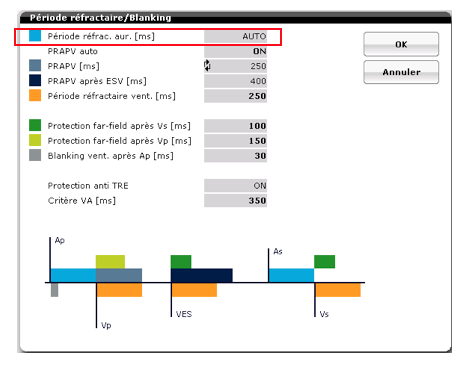
The atrial refractory period (ARP) occurs following a stimulated or detected atrial event (in blue on the image) when it is not in the refractory period. It is set to Auto in nominal, which means that it is equal to a fixed value of 225 ms, but is automatically increased if the AV delay is set to be longer than 225 ms. This parameter is not programmable.
Boston Scientific
There is a different atrial refractory period post-detection and post-stimulation. These 2 values are not programmable.
After atrial detection, there is an 85 ms atrial refractory period, broken down into a 30 ms absolute refractory period, a 40 ms noise window and a 15 ms absolute refractory period.
After atrial pacing, there is an atrial refractory period of 150 ms, broken down into 110 ms absolute refractory period and 40 ms noise window.
Medtronic
If the pacemaker is programmed for MVP mode, and operates in ADI mode, the atrial refractory period is automatically adjusted to 75% of the cardiac cycle, up to a maximum of 600 ms.
Microport
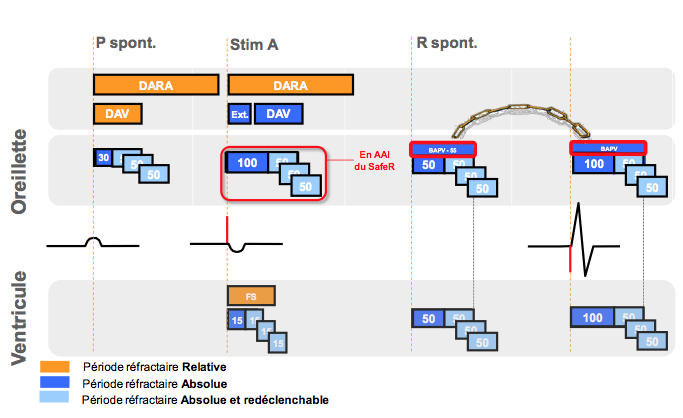
Following atrial detection, an 80 ms refractory period is triggered at the atrial stage. The first 30 ms are an absolute refractory period, and the following 50 ms are automatically retriggered in the event of detection. The value of this period is not programmable.
In DDD mode, following atrial pacing, the periods corresponding to the AV delay are absolute refractory periods at the atrial stage.
Following atrial detection or stimulation, another relative refractory period is triggered at the atrial stage. Its duration is dynamic and calculated as a function of the atrial rhythm. It is effective only after the end of the 80 ms atrial refractory period. Its purpose is to detect acceleration of the atrial rhythm (hence its name: DARA window).
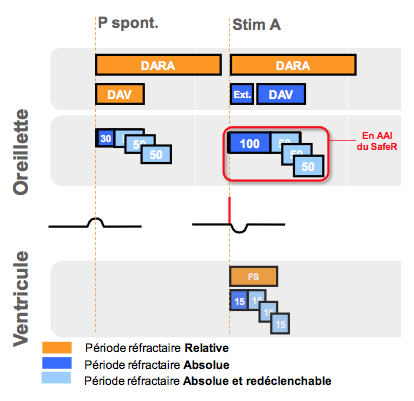
When the SafeR dual-chamber pacing mode is programmed and operating in ADI, a 150 ms refractory period is triggered at the atrial stage. The first 100 ms is an absolute refractory period, and the following 50 ms can be automatically retriggered. The value of this period is not programmable.
2. Post-ventricular atrial refractory period
- Post-ventricular atrial blanking is programmable for all 5 companies.
- An atrial event occurring within this period does not appear on the marker chain and is ignored by the antibradycardia pacing functions for Boston Scientific, Abbott and Microport CRM-Sorin pacemakers.
- An atrial event occurring within this period appears on the marker chain but is ignored by the antibradycardia pacing functions for Biotronik stimulators.
- An atrial event occurring within this period appears in the marker chain and is included in the atrial arrhythmia count for the latest Medtronic pacemakers.
- There is no PVARP in Microport CRM-Sorin stimulators. It is replaced by the DARA window and RetroPwatch.
- There is no PVARP after a detected ventricular event (except for PVC) for Biotronik pacemakers.
Abbott
Post-ventricular atrial blanking
Following ventricular pacing, there is an atrial blanking of 60 to 250 ms (nominal value, 150 ms). Events occurring during this refractory period are not taken into account when counting atrial arrhythmias (filtered atrial rate calculation).
Post-ventricular atrial refractory period (PVARP)
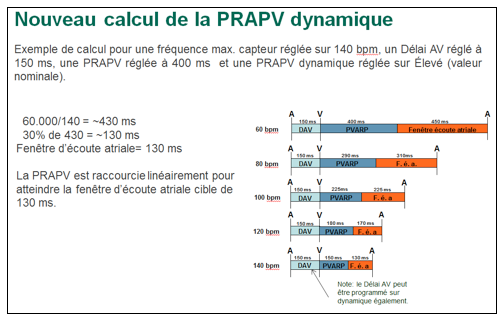
The PVARP is programmable between 125 and 500 ms (nominal value 275 ms).
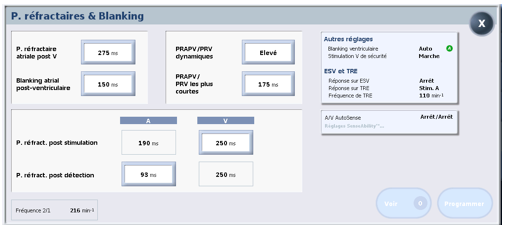
Programming a dynamic PVARP allows you to adapt the PVARP value to your heart rate. This parameter can be set to Off, Low, Medium, High). The shortest PVARP must also be programmed (programmable between 125 and 475 ms, nominal value 175 ms).
Biotronik
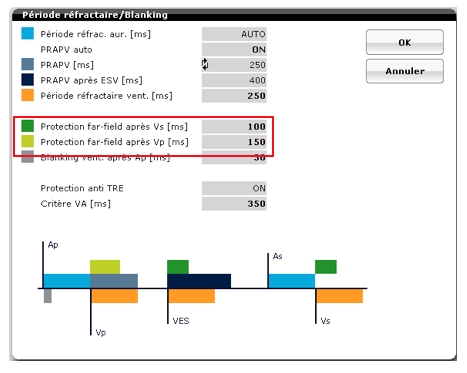
Post-ventricular atrial blanking: far-field protection
This is a refractory period applied in the atrium after ventricular detection and pacing to avoid cross-tapping (far-field protection).
The nominal value is 100ms (programmable between 100 and 220ms) after a spontaneous ventricle (VS) and 150ms (programmable between 100 and 220ms) after a stimulated ventricle. If an event falls within this blanking, it is noted Ars (FFP) but does not trigger an AV delay and is not counted for the diagnosis of atrial arrhythmias.
Post-ventricular atrial refractory period (PVARP)
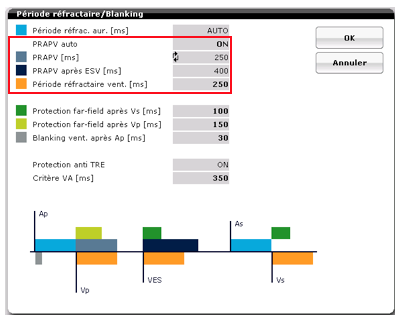
The Post-Ventricular Atrial Refractory Period (PVARP) is triggered solely by ventricular pacing in a Biotronik pacemaker, and not by ventricular sensing (VS). It is also triggered by ventricular extrasystole.
PVARP is programmable to Auto or from 175 to 600 ms. Post-extrasystole PVARP is extended by 150 ms (PVARP + 150 ms).
When PVARP is set to Auto, nominal PVARP is 250 ms. PVARP is extended by 50 ms for 7 days when a TRE episode is diagnosed and treated. If no PMT occurs for 7 days, PVARP is reduced by 50 ms to a minimum value of 175 ms).
Boston Scientific
Post-ventricular atrial blanking
This blanking can be programmed to a fixed value or to SMART. There is a different atrial blanking for post-stimulation and post ventricular detection.
The aim of SMART programming is to reduce blanking times while minimizing the risk of cross-listening by :
- eliminating the noise window of the blanking period
- increasing the automatic gain control threshold to avoid cross-tapping (AGC increased to 3/8 of the measured peak, leading temporarily to lower sensitivity)
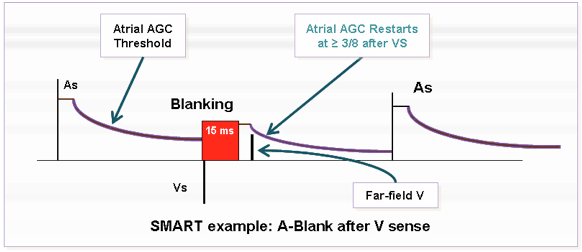
Post-ventricular stimulation atrial blanking can be set to a fixed value (nominal value 125 ms) or to SMART (duration 37.5 ms without noise window).
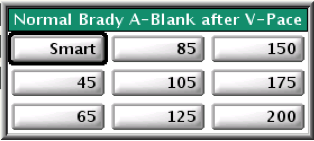
Atrial blanking after ventricular detection can be set to a fixed value (nominal value 45 ms) or to SMART (duration 15 ms without noise window).

Medtronic
Post-ventricular atrial blanking (PVAB)
On Adapta and older pacemakers, an atrial event occurring during this period does not appear on the marker chain and is ignored by the antibradycardia pacing functions.
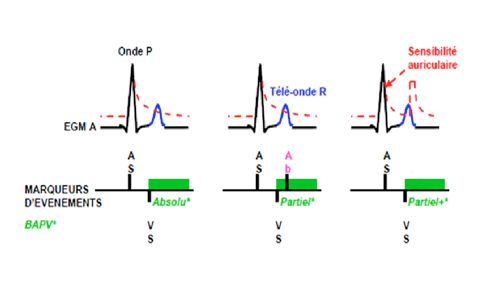
For newer pacemakers, such as Ensura or Advisa (a platform shared with defibrillators), the response to an atrial event occurring within this period differs and is determined by two programmable parameters: the PVAB interval and the PVAB method.
If the PVAB method is programmed to “absolute”: operation is identical to that of older pacemakers, and the event does not appear on the marker chain.
If the PVAB method is set to “partial”: an atrial event occurring within this period appears on the marker chain and is labelled Ab. This atrial event does not trigger an AV delay, but is counted for the diagnosis of atrial arrhythmia. Atrial sensitivity remains unchanged.
If the PVAB method is set to “partial +”, the operation is identical to the previous one, except that after a detected or stimulated ventricular event, the atrial detection threshold increases and the device becomes less sensitive (to avoid cross-listening).
Post-ventricular atrial refractory period (PVARP)
PVARP can be set to a fixed value or to automatic. When automatic PVARP is programmed, the stimulator determines a value for PVARP based on the mean atrial frequency. Automatic PVARP is designed to increase the frequency of the 2:1 block by shortening the PVARP and detected AV delay (if any) at higher follow-up frequencies, and to offer protection against ERR at minimal frequencies with a longer PVARP.
The programmable minimum PVARP parameter value defines a limit on the shortest PVARP allowed.
Microport
Post-ventricular atrial blanking
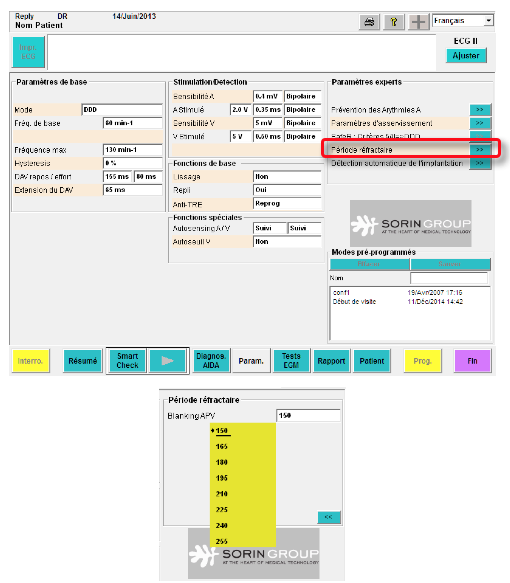
Following ventricular pacing, an absolute refractory period of 150 ms (nominal value) is triggered at the atrial stage. The first 100 ms are an absolute refractory period, and the following 50 ms are automatically retriggered.
Following ventricular detection, an absolute refractory period of 100 ms (nominal value) is triggered at the atrial stage. The first 50 ms is an absolute refractory period, and the following 50 ms can be automatically retriggered.
When the user modifies the PVAB value (post stimulation), he also modifies the PVAB post detection.
Post-ventricular atrial refractory period (PVARP)
Sorin CRM-Microport pacemakers present certain specificities in terms of atrial refractory periods. Strictly speaking, there is no PVARP, which is replaced by :
- the DARA window: following an atrial event, a relative refractory period is triggered at the atrial stage. Its duration is dynamic and calculated as a function of the atrial rhythm. Its main purpose is to detect the acceleration of the atrial rhythm (hence its name: DARA window). The second function of the DARA window is to avoid triggering AV delay on atrial detections too close to a ventricular event. How this works, with dynamic calculation of the DARA window duration, is explained in the chapter on managing atrial arrhythmias.
- RetroPwatch: following a ventricular detection considered as a PVC, a relative refractory period is triggered at the atrial stage. Its duration is 500 ms.