

AF prevention algorithms
Content
Certain algorithms have been developed by different manufacturers to reduce the burden of atrial arrhythmia.
Brand specific information
- An AF prevention algorithm based on increasing atrial pacing frequency is available for the 5 major manufacturers: Biotronik (Atrial Overdrive), Boston Scientific (Atrial Pacing Preference), Medtronic (Atrial Pacing Preference), Abbott (AF Suppression) and Microport CRM-Sorin (Sinus Rhythm Overdrive).
- An algorithm for avoiding atrial post-extrasystolic pause and/or increasing pacing rate following atrial extrasystole is available for Boston Scientific (APP/ProACt), Medtronic (Stabilization of atrial rhythm) and Microport CRM-Sorin (ESA pause suppression and ESA rate acceleration) pacemakers.
- An algorithm for regulating ventricular rate during a transition to AF (to avoid long diastoles) is available for Biotronik (rate stabilization), Boston Scientific (Ventricular Rate Regulation) and Medtronic (Response to conducted AF) pacemakers.
- Medtronic pacemakers feature an algorithm for accelerating pacing rate at the end of an arrhythmia episode (Rapid post-mode switching pacing).
Abbott
AF Suppression
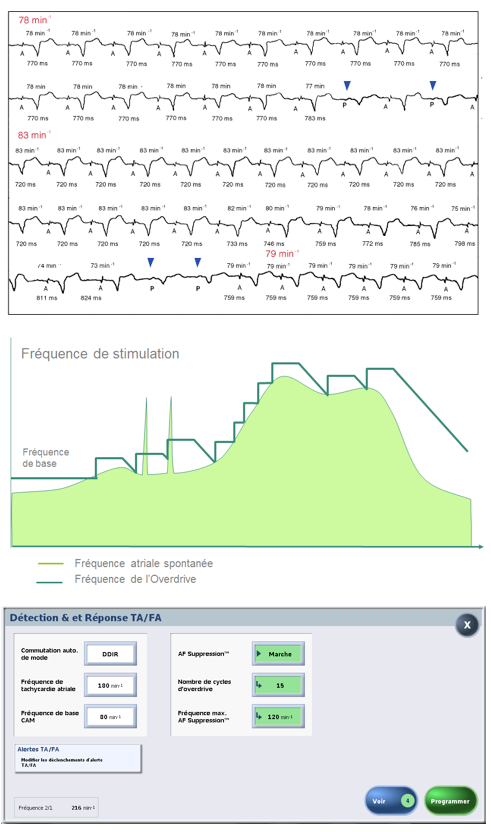
The AF Suppression™ algorithm enables the device to stimulate the atrium at frequencies faster than the intrinsic atrial frequency (overdrive).
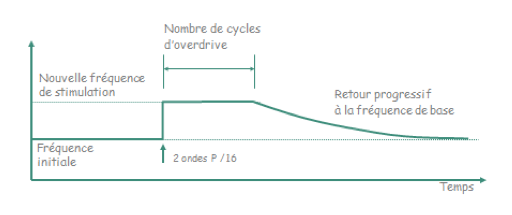
When the algorithm detects two P waves within a 16-cycle window, the device increases the pacing frequency to neutralize spontaneous conduction. After pacing at the AF Suppression frequency for the number of cycles indicated by the Number of overdrive cycles parameter (15 to 40; nominal 15), the device slows down its frequency until it detects two new P waves. If two P waves are not detected, stimulation resumes according to the setting for base frequency, rest frequency or sensor frequency.
Calculation of the overdrive frequency: for simulation frequencies <59 bpm, the overdrive applied is fixed at 10 bpm (=minimum overdrive frequency); for frequencies >151 bpm, fixed overdrive of 5 bpm (=maximum overdrive frequency); for frequencies between 60 and 150 bpm, the AF Suppression algorithm increases the stimulation frequency by a delta between the minimum overdrive frequency and the maximum overdrive frequency.
Return to base frequency: this non-programmable parameter determines the interval and slope of reduction from the overdrive frequency to the base frequency, resting frequency or frequency indicated by the sensor; if the overdrive frequency is greater than 100 bpm, 8ms are added to each cycle up to 100 bpm, then + 12ms to the base frequency.
Biotronik
Atrial overdrive
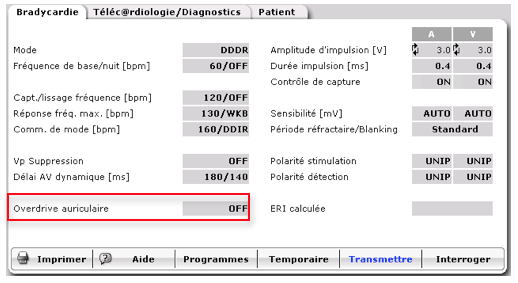
This algorithm “overdrives” spontaneous atrial activation by increasing the frequency of atrial stimulation.
Frequency stabilization
This is an algorithm designed to reduce frequency variations (alternating short and long cycles) during AF when atrio-ventricular conduction is preserved. The device determines an average frequency over 4 cycles and stimulates the ventricle as soon as the frequency falls 10 bpm below this frequency.
Boston Scientific
Atrial Pacing Preference (APP)
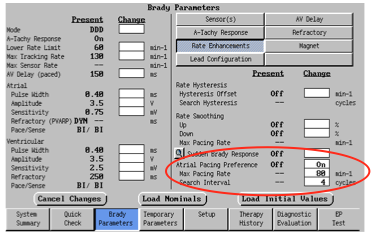
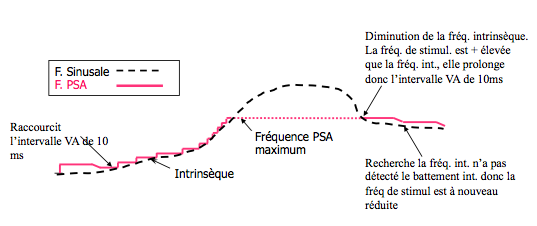
The aim of this algorithm is to prevent the onset of AF by pacing the atrium at a rate slightly above the intrinsic rhythm (8 ms). The atrial pacing frequency is therefore increased when detected atrial events occur (shortening of the 8 ms VA interval). APP pacing frequency is limited by the programmable Maximum APP Pacing Frequency. In the absence of a detected event, the pacing rate is progressively reduced (VA interval increased by 10ms).
APP/ProACt
This algorithm makes it possible to increase the stimulation frequency following a PAC in order to avoid the succession of short and long cycles.
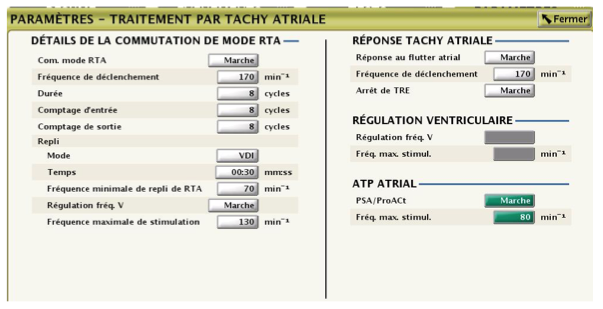
Following an PAC, the ProAct algorithm calculates 75% of the VV interval preceding the PAC and applies this interval to the next cycle in order to favor atrial pacing. The pacing rate is then progressively lowered to the minimum rate by extending the VV interval by 10 ms if 4 consecutive cycles occur with non-PAC detection, no atrial event or atrial pacing. This new VA interval is used until a PAC is detected and the VV interval is shortened by the algorithm, or until the VV interval is again extended by 10 ms. The APP/ProAct rate indicated is limited by the value of the maximum APP/ProAct pacing rate.
Ventricular rate regulation (VRR)
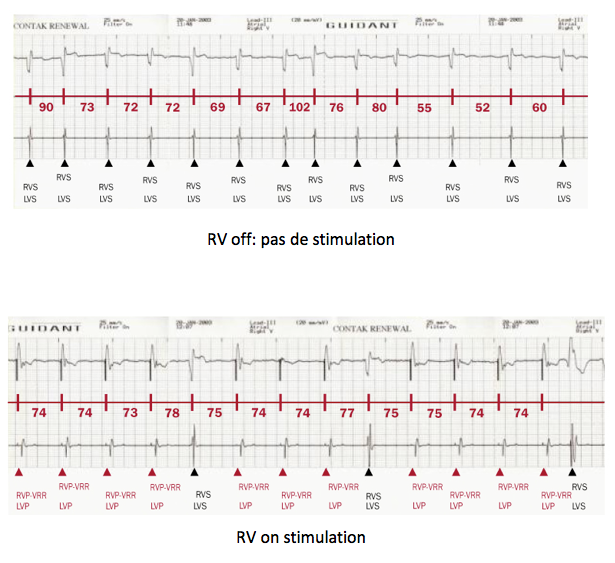
In the majority of patients, atrial arrhythmia generates a rapid and irregular ventricular response, with irregular ventricular cycles potentially altering the patient’s hemodynamics.
The aim of this algorithm is to reduce RR cycle variability by increasing the percentage of pacing. The more irregular the ventricular cycle length, the greater the pacing force.
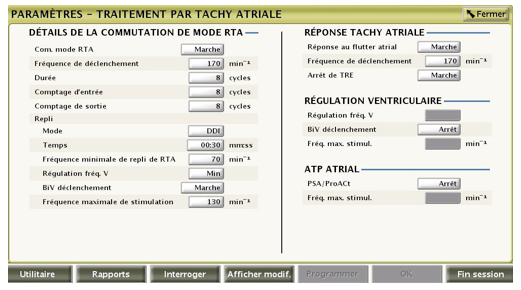
The weighted average of the previous 32 cycles is used to determine the VRR stimulation limit frequency. The VRR algorithm responds to a history of several intervals, with more weight given to recent intervals:
- for detected cycles: VRR interval = 1.1 * 1/16 intervals Current + 15/16 VRR(t-1)
- for stimulated cycles: VRR interval = 1.1 * 1/16 intervals Current + 15/16 VRR(t-1)
Medtronic
Non-competitive atrial pacing
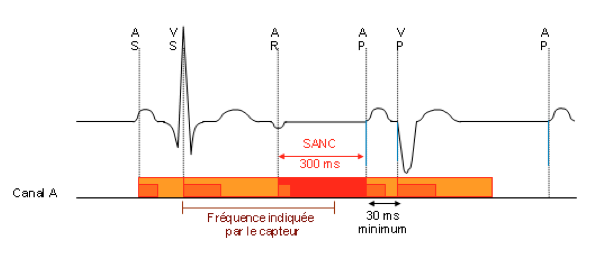
An atrial arrhythmia can be initiated if a paced atrial event occurs during the vulnerable atrial period. Non-competitive atrial pacing (NCAP) is designed to prevent the initiation of an atrial arrhythmia by pacing during the atrial relative refractory period.
When NCAP is set to On, a refractory atrial event detected during PRAPV triggers a programmable NCAP period during which no atrial pacing can occur.
When atrial pacing is delayed by NCAP operation, the pacemaker attempts to maintain a stable ventricular rate by reducing the ensuing stimulated AV delay. However, it does not shorten the stimulated AV delay to less than 30 ms.
The NCAP interval is 400 ms for 1 pacing cycle each time a PVC response or anti-PMT intervention occurs.
Atrial pacing preference
Atrial Pacing Preference (APP) is designed to reduce the incidence of atrial tachyarrhythmias by responding to variations in atrial rate by accelerating the pacing rate to a stable paced rhythm, slightly faster than the spontaneous rate. After each detected non-refractory atrial event, the device decreases the atrial pacing interval by the programmed interval decrement value. Atrial pacing pulses delivered for APP are annotated PP (proactive pacing) on the event marker.
If the next atrial event is another non-refractory event detected, the pacing interval is decremented again. This progression continues until the pacing rate exceeds the spontaneous rate, resulting in a stimulated atrial rhythm. However, the value of the programmed maximum frequency provides a frequency limit for atrial pacing preference. After a programmable period of 100% atrial pacing, the stimulator gradually decreases the pacing frequency in search of the next spontaneous beat. The next sinus beat restarts the pacing preference.
Atrial rhythm stabilization
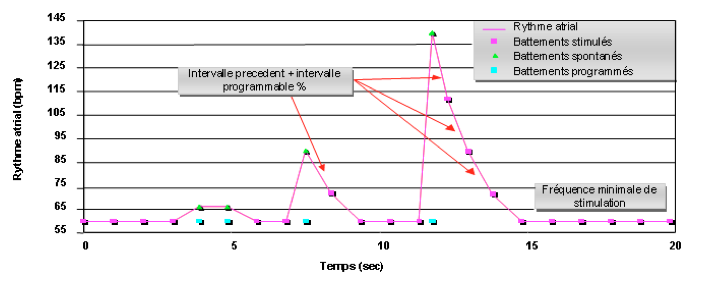
Atrial rhythm stabilization (ARS) is a programmable function designed to avoid the sinus pause that follows an PAC (short-long-short cycle sequences that can lead to the abrupt onset of certain atrial tachyarrhythmias). It reacts to an PAC by instantly raising the atrial pacing frequency, then steadily slowing it down to the spontaneous frequency, the programmed pacing frequency or the sensor frequency.
When the device is activated by an PAC, it delivers a pacing pulse at the premature interval increased by a percentage of this interval (defined by the parameter Interval increment in programmed percentage). For each subsequent stimulated or detected atrial event, the device continues to increase each pacing interval by the programmed percentage of the previous interval. The maximum frequency parameter defines a limit for ARS. Atrial pacing pulses delivered for ARS are annotated PP (proactive pacing) on the event marker.
Post Mode-Switch Overdrive Pacing (PMOP)
Post mode-switch overdrive pacing (PMOP) is a programmable function that provides rapid atrial pacing at the end of a mode switch.
After a mode switch, the device increases the pacing rate beat by beat (decreasing the pacing interval by 15 ms per pulse for the Adapta and 70 ms for the Advisa) until it reaches the programmed fast pacing rate. It continues DDIR stimulation at the fast frequency for the programmed fast stimulation duration. It then regulates the return to the programmed atrial synchronous mode by progressively slowing down the frequency until it reaches the programmed pacing frequency, the programmed minimum frequency or the sensor frequency.
Response to controlled AF
Conducted AF response, referred to as ventricular rate stabilization in previous stimulators, is designed to regulate ventricular rate during AF. The stimulator modifies the pacing frequency beat by beat to stimulate close to the mean intrinsic ventricular rate. Long pauses are eliminated, reducing ventricular rate irregularity. The response to conducted AF operates in asynchronous modes only. Therefore, when the device is programmed in DDD or DDDR mode, the conducted AF response operates only during a switch to VDIR or DDIR mode. To program the conducted AF response to ON, the mode switch must be set to ON.
Increases in stimulation frequency caused by driven AF response are limited by the programmed maximum frequency.
Microport
Sinus rhythm overdrive
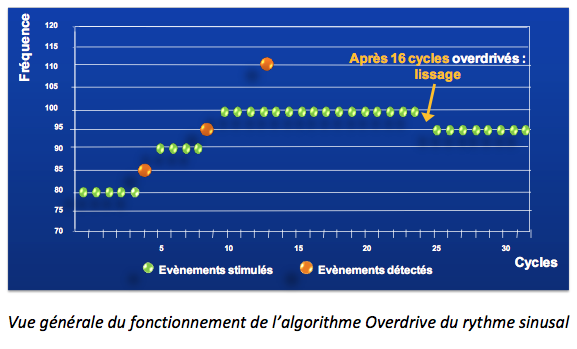
The aim is to ensure permanent atrial pacing slightly above sinus rhythm to prevent the onset of AF by reducing the atrial pacing interval (-50 ms) following the detection of non-accelerated P waves (detection outside the INOV window (and outside the DARA window)). This function is limited by a programmable maximum overdrive frequency. By default, this algorithm is inactive.
To avoid inappropriate acceleration of late atrial extrasystoles, there is a specific window (the INOV window, INappropriate OVerdriving). The value of this late ESA monitoring window is based on the AR or PR conduction time and the max overdrive frequency. If P waves are detected within the INOV window, the sinus rhythm overdrive function is inhibited.
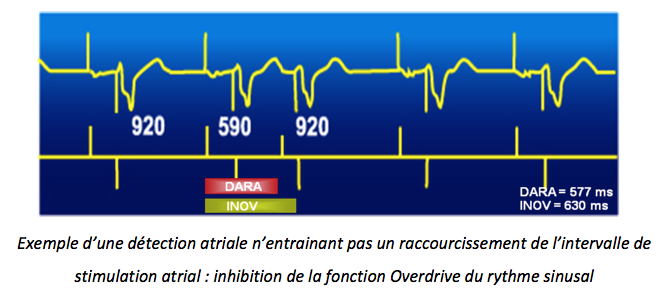
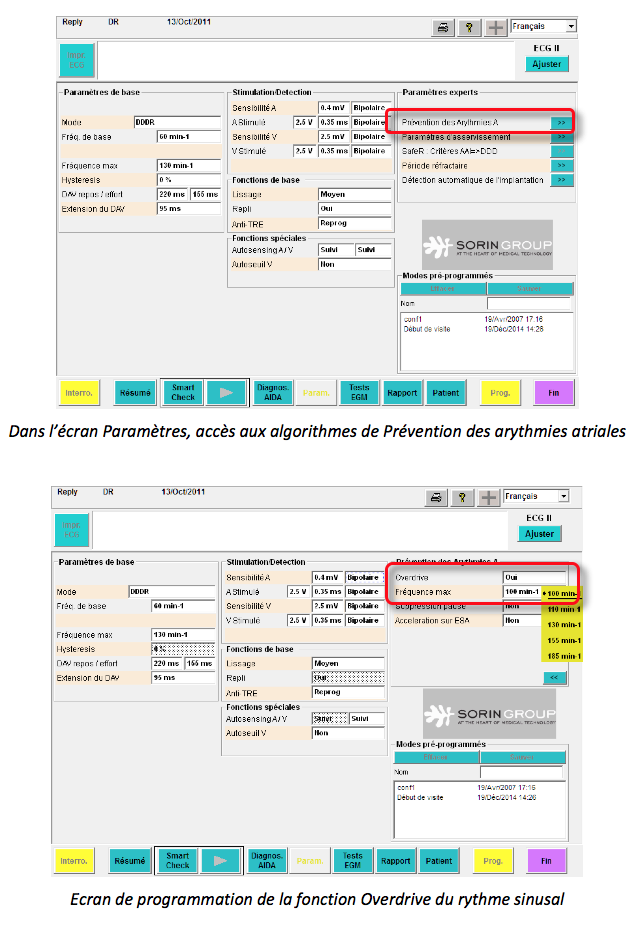
After 16 overdrive cycles, the stimulation frequency decreases with the programmed smoothing (very slow by default). The maximum overdrive frequency is set at 100 min-1.
PAC pause suppression
The aim of this algorithm is to avoid the occurrence of atrial fibrillation on a succession of short atrial cycle (extrasystole), long cycle (compensatory pause).
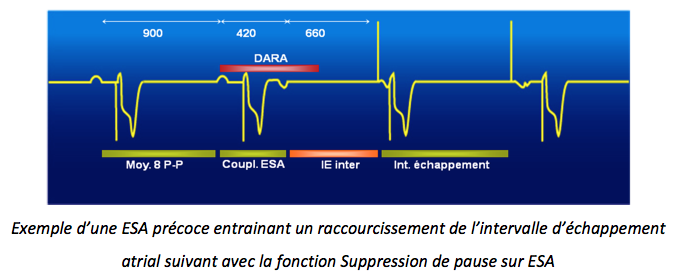
On an isolated “late” PAC (with a coupling greater than 50% of the last P-P interval), the algorithm triggers an automatic AV delay and an intermediate escape interval.
Frequency acceleration on PAC
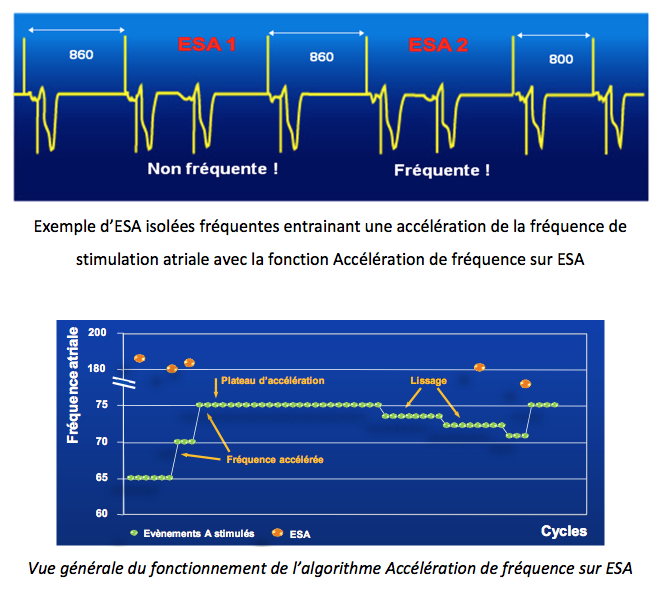
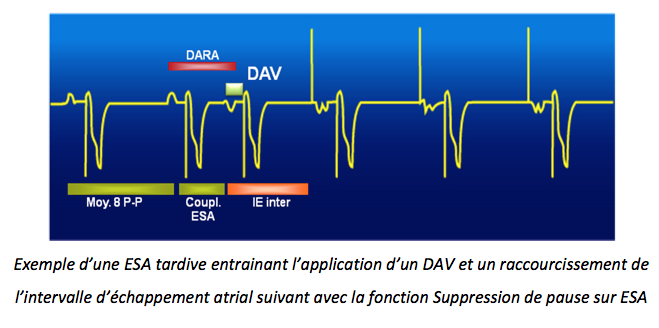
To reduce the number of extrasystoles, this algorithm authorizes rate acceleration (~ 5 min-1) temporarily (24 cycles) following frequent isolated atrial extrasystoles (separated by a maximum of 15 normal atrial cycles). By default, this algorithm is inactive. The acceleration phase is stopped if the maximum acceleration frequency is reached or if the maximum PAC counter is reached. These two stop criteria are non-programmable. This stop is followed by a “final” smoothing down to the base frequency.
The maximum acceleration rate is calculated as follows: if the atrial rate is below 90 min-1, the escape interval is 75% of the average of the last eight P-P intervals just before the first PAC. Otherwise, the escape interval is 75% of the average of the last eight P-P intervals just before the first PAC + 50 ms.