


Microport - Discrimination
Content
Basics
The MicroPort defibrillator algorithm continually evaluates the criteria explained in the following paragraphs as soon as a ventricular cycle is detected in the Tachy/VF zone. Depending on the combination of criteria defined by the physician, some of these criteria will be taken into account in order to establish a classification (diagnosis) that will need to be maintained in order to lead to a binary result, namely therapy (VT) or no therapy (SVT). It should be remembered that in the VF zone (Fast VT zone included), no discrimination is made for differentiating between SVT and VT. The only criterion used is that of stability, in the Fast VT zone only, and not for the diagnosis, but rather to decide whether or not to administer an ATP prior to the capacitor charge if programmed.
Single-chamber discrimination
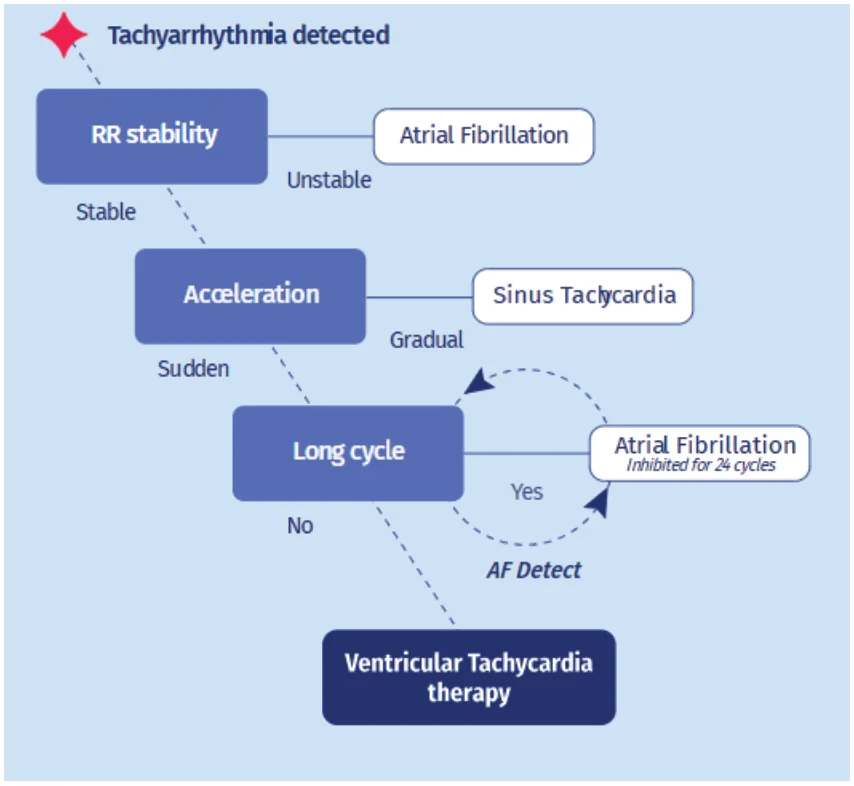
Once the majority rhythm is classified (6 of at least 8 sliding cycles in the Tachy zone: Slow VT or conventional VT), the following criteria are taken into account for VT/SVT discrimination:
- RR stability (stability of delays Vs-Vs)
- Sudden acceleration
- Long ventricular cycle (medium term instability)
The device analyses the rhythm according to different possible combinations:
- rate only: only the ventricular rate criterion is used (no discrimination)
- stability: use of the stability criterion
- stability+: stability criteria + long cycle search
- stability/acceleration: stability and sudden acceleration
- stability+/acceleration: stability, sudden acceleration and long cycle search (as-shipped setting)
The “+” specifies the search criteria and the taking into account of long ventricular cycles.
1. RR stability in VT zones (Slow VT and VT)
When a rhythm is detected in a VT zone (Slow VT or VT), the defibrillator evaluates the majority presence of RR intervals (Vs-Vs) in a given stability window. A majority (75%) of the 8 sliding cycles (6) analysed must have a « similar » coupling interval, namely 75% of the cycles must fit within a 65 ms window (programmable stability window).
2. RR stability in the Fast VT zone
When a rhythm is detected in the VF zone, but in the Fast VT section, the stability analysis is identical, however 75% of the cycles must fit within a 30 ms window (programmable stability window). It should be reminded that this discrimination is not used to differentiate SVT versus VT but to decide whether an ATP is to be administered prior to the capacitor charge.
3. Sudden acceleration
The defibrillator defines a cycle as being accelerated when it is detected in a Slow VT, VT or VF zone, and its duration is shorter than the reference coupling interval (corresponding to the previous cycle if it is normal or the average of the 4 previous non-accelerated cycles) minus the percentage of acceleration (19% nominal, programmable).
4. Long cycle search
When the stability criterion and acceleration criteria are fulfilled, the defibrillator takes into account the presence of at least one long cycle over the last 24 cycles, starting from the first persistence. On subsequent persistence cycles (in the case of a charge, for example), the search for a long cycle is always carried out over the last 24 cycles or less in the case of post-therapy redetection. A long cycle is defined as a cycle whose duration is longer than the average of the last 4 cycles included in the Tachy/VF zone + a programmable duration, by default 170 ms. The long cycle search begins after the detection of 4 cycles classified as VT or VF.
Dual Chamber Discrimination
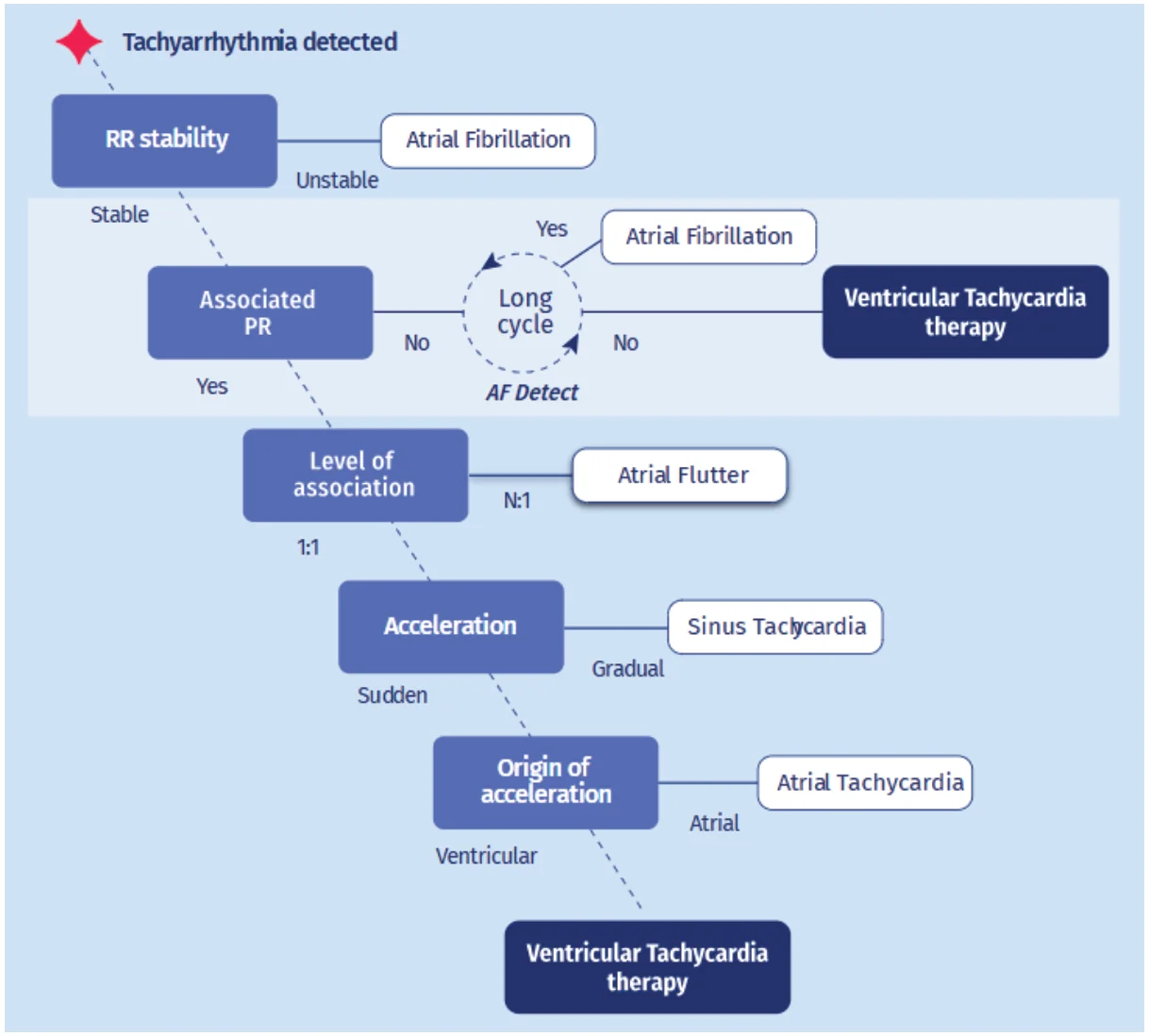
Once the majority rhythm is classified, the following criteria are taken into account for VT/SVT discrimination in dual-chamber PARAD+ algorithm (as-shipped settings):
- RR stability (stability of delays Vs-Vs)
- PR association (stability of the PR (As-Vs or Ap-Vs) delays)
- Level of PR association (1:1 or N:1)
- Acceleration
- Originating chamber of the first sudden acceleration, A or V
- Long ventricular cycle (medium term instability)
The decision tree for the PARAD+ algorithm
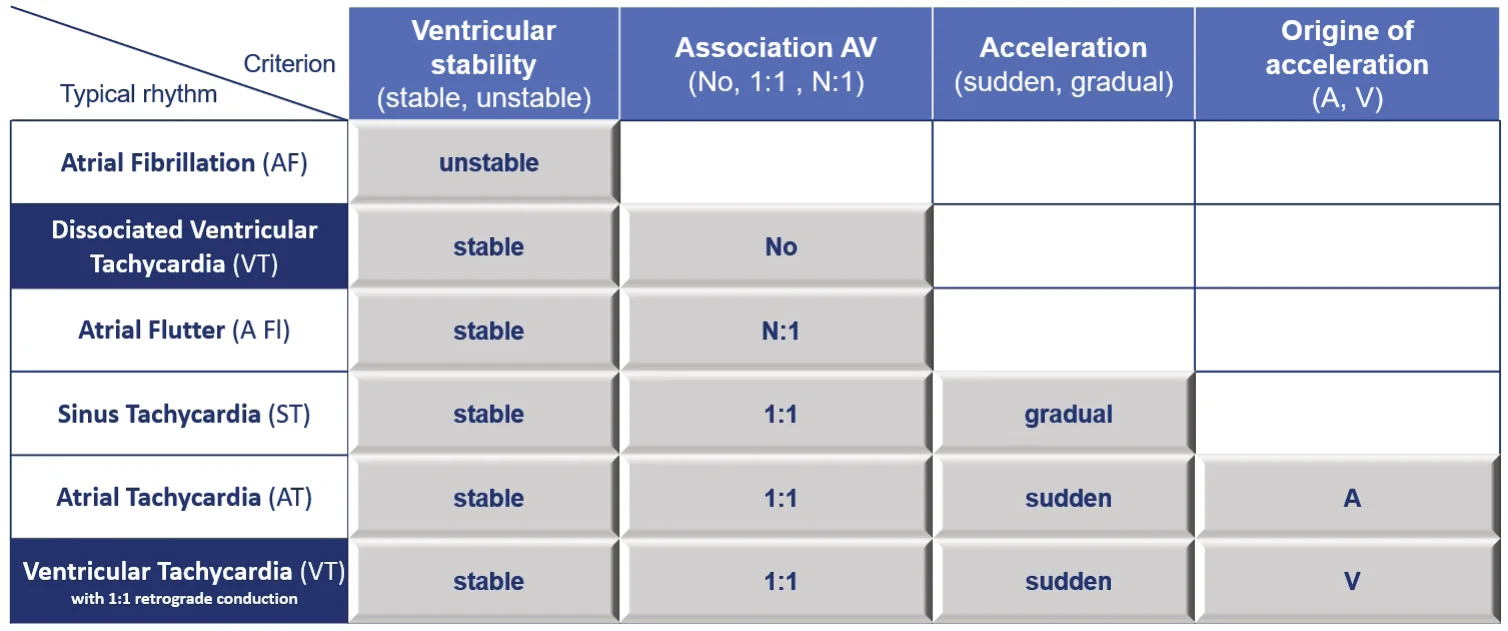
Classification of typical arrhythmias detected by the PARAD+ algorithm
For the functioning of the Stability, PR association and level of PR association parameters in the Slow VT and VT zones, the system divides the RR and PR intervals of the 8 sliding cycles into RR and PR histogram classes in 16 ms steps.
The number of RR and/or PR cycles of each RR and PR histogram class thus constructed is compared with the programmed values of the discrimination algorithm. The first two tachycardia cycles in the Slow VT and VT zones are ignored for the construction of the histograms.
1. RR stability
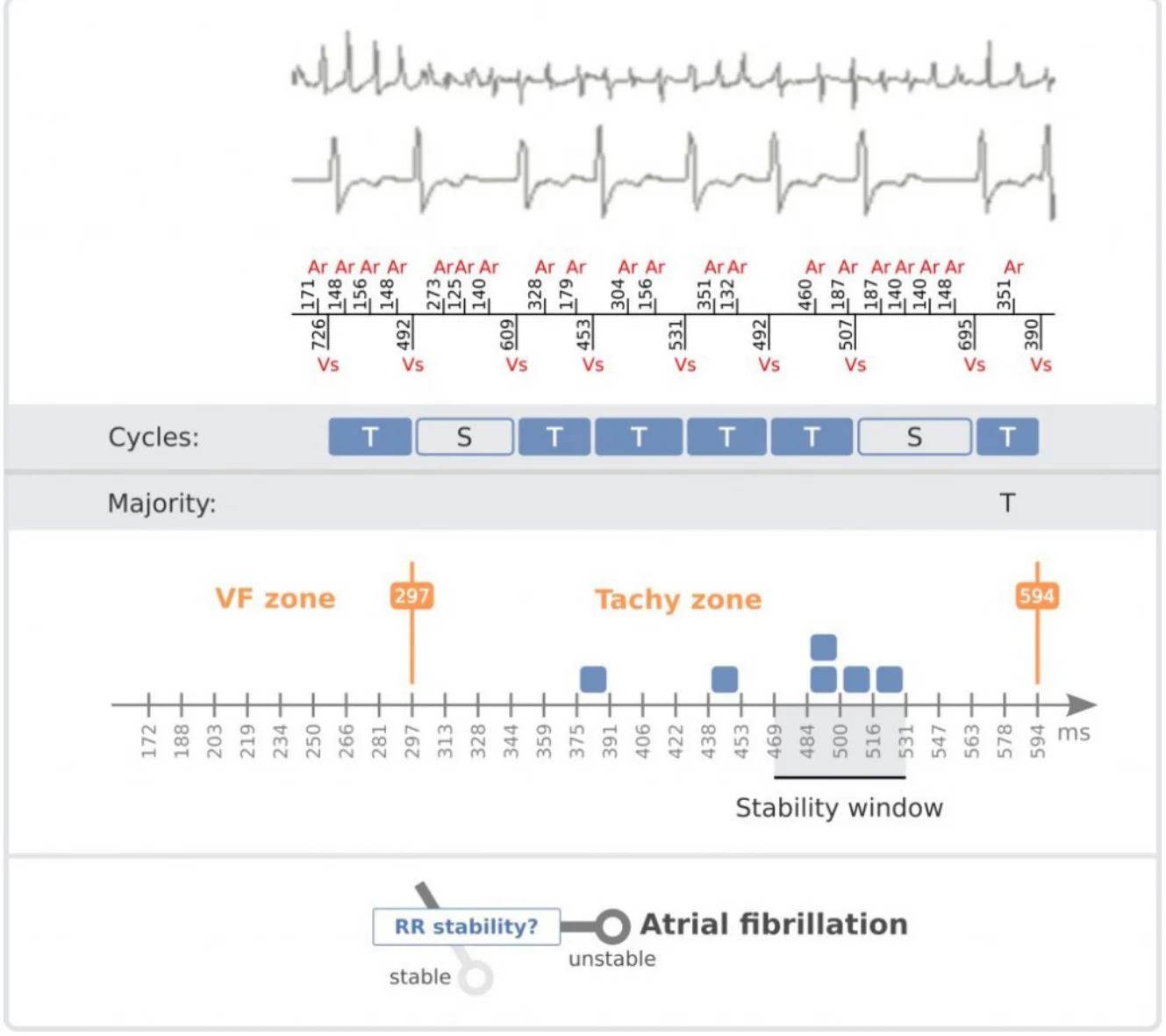
When a majority rhythm is detected in a VT zone (Slow VT or VT), the defibrillator evaluates the presence of majority of RR intervals in the stability window. A majority (75%) of the 8 analysed sliding cycles (6) should have a « similar » coupling interval, i.e. 75% of the cycles should fit within a 65 ms window (programmable stability window = 4 classes of 16 ms).
Here the stability criterion is not reached (4/6 < 75%), the rhythm is unstable and PARAD/PARAD+ analysis is “Atrial fibrillation”.
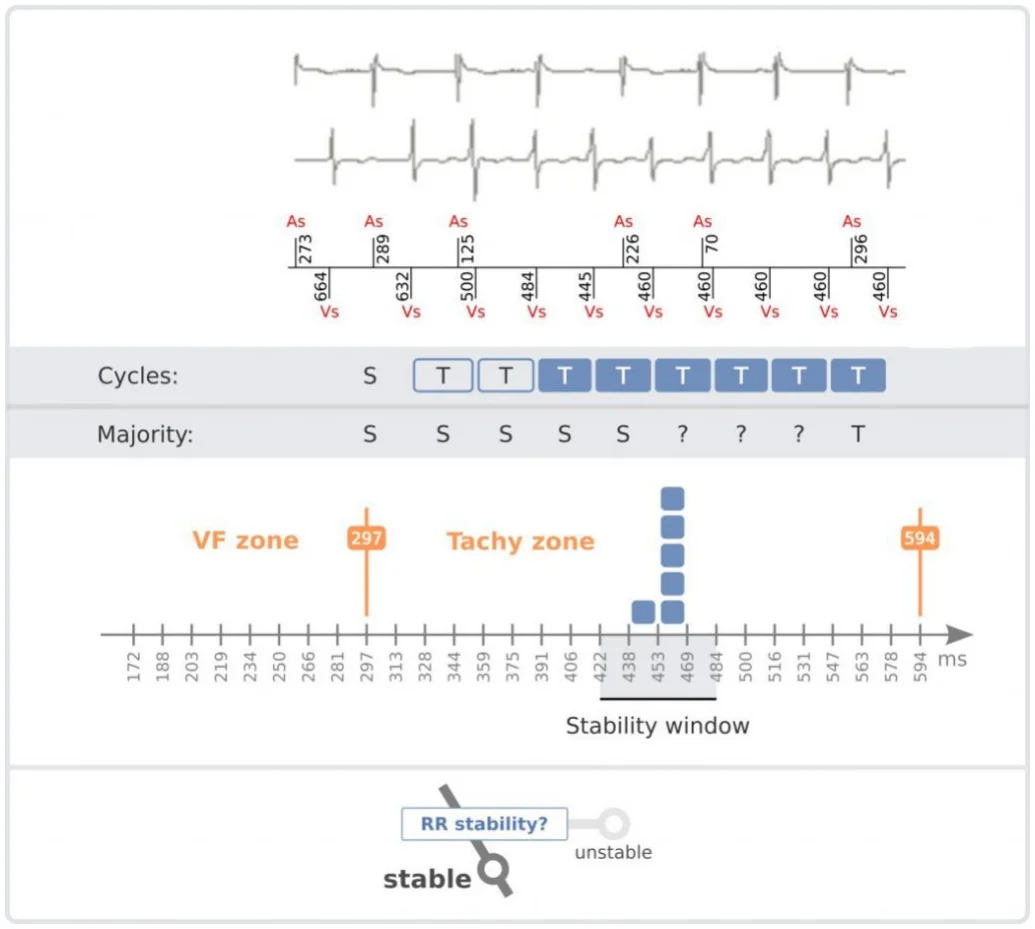
In this example, the rhythm is stable and PARAD/PARAD+ analysis will continue to identify the ongoing rhythm.
2. PR association (stability of the PR (As-Vs) or AR (Ap-Vs) delays)
When the RR stability criterion is fulfilled, the defibrillator counts the number of PR or AR intervals in the association window.
A majority (75%) of solely stable V cycles must be preceded by an atrial event with a « similar » PR or AR interval fitting within a 65 ms window (association window = programmable stability window).
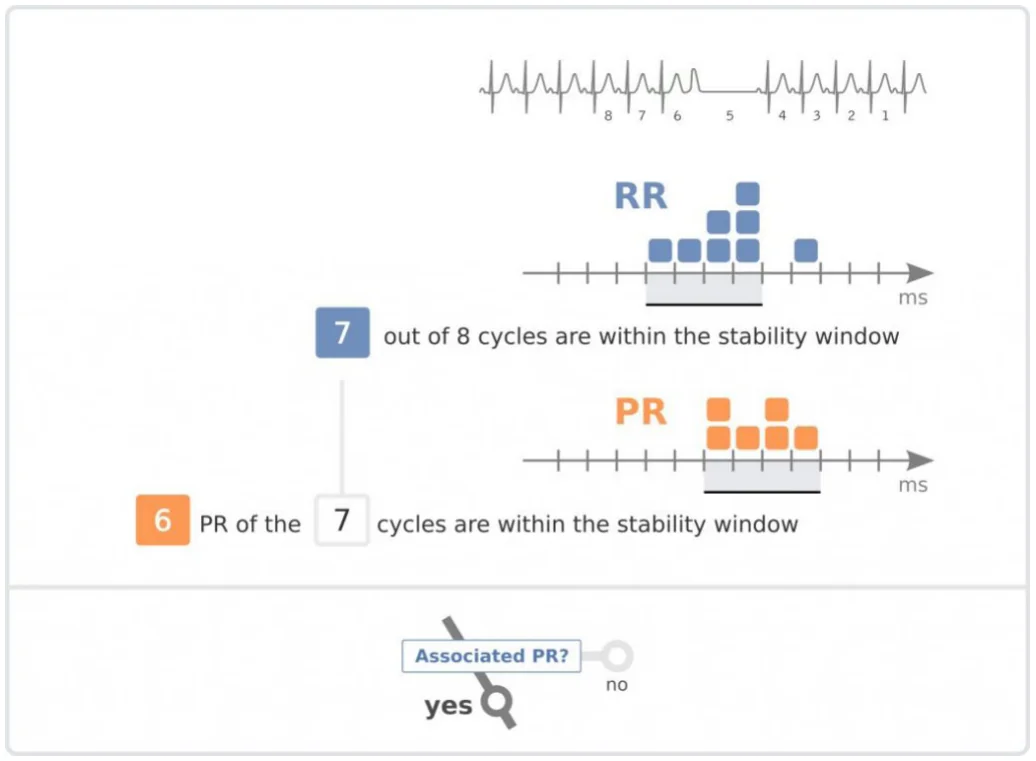
3. Level of PR association
When the RR stability criterion and the PR association criterion are fulfilled, the system searches for the presence of one or more PR groups with each having a « similar » coupling interval. In the distribution of the PR or AR intervals (i.e. As-Vs or Ap-Vs intervals), when 75% of the PR or AR intervals fit within a 65 ms window (association window = programmable stability window), the level of PR association is 1:1. Otherwise, there is no 1:1 PR association, and the association level is said to be N:1.
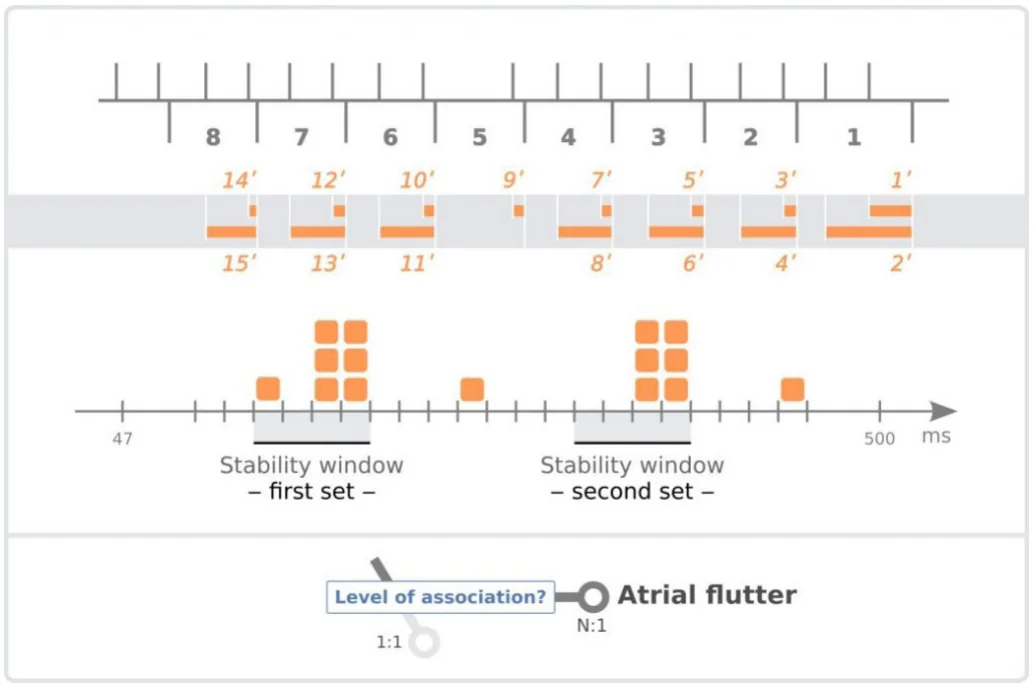
The max number of PR intervals within a stability window is 7 (first set), which represents less than 75% of the total PR intervals (15): the association level is N:1.
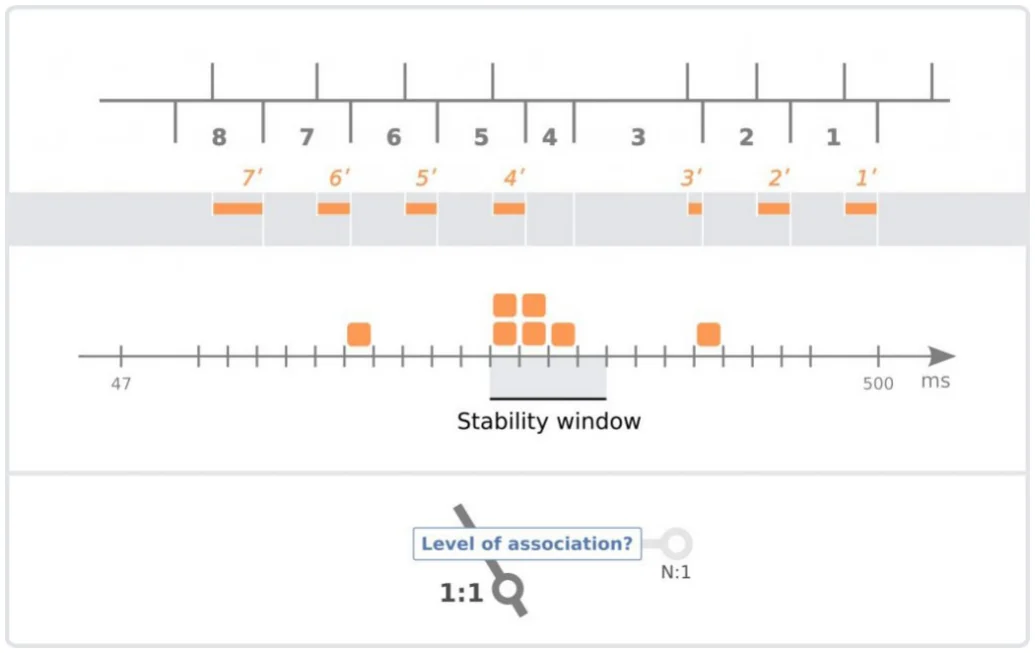
The max number of PR intervals within a stability window is 5, which represents at least 75% of the total PR intervals (7): the association level is 1:1.
4. Search for a long cycle when the rhythm is stable and dissociated
VT therapies are inhibited for the 24 cycles following the detection of a long Vs-Vs cycle only when the rhythm is classified as stable and dissociated and the device is in mode switch. When the VT persistence counter is reached and, at this time, the majority rhythm (“the majority”) is stable/dissociated VT, the device takes into account any long ventricular cycles detected during the last 24 ventricular cycles.
A cycle is long if its coupling interval is longer than the average of the last 4 cycles in the Tachy/VF zone + a programmable gap (170 ms nominal).
The search for a ventricular Long Cycle:
- begins as soon as 4 cycles in the Tachy/VF zone have been detected
- resumes after the delivery of a therapy
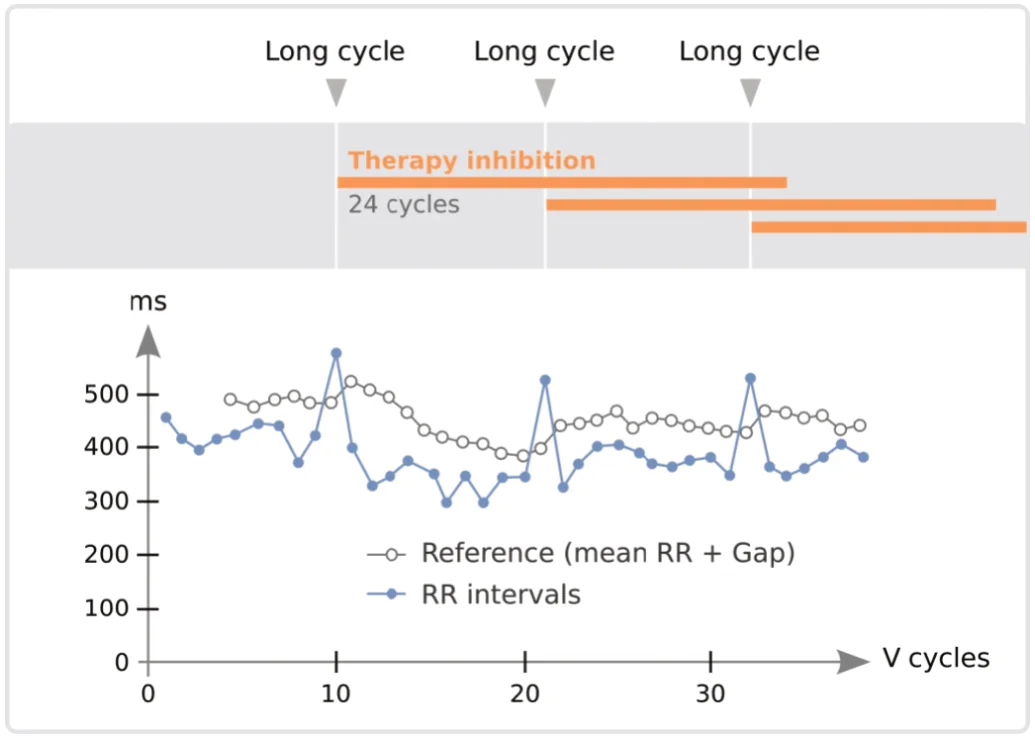
The average calculated of the last 4 cycles is re-initialized if the slow rhythm majority is reached, or after a therapy (ATP or shock).
5. A or V acceleration (chamber of origin of first sudden acceleration)
The defibrillator defines a ventricular cycle as accelerated when the cycle is detected in a Slow VT, VT or VF zone, and its duration is shorter than that of the reference cycle minus the programmed percentage of acceleration (25% nominal, programmable).
The reference cycle corresponds to:
- the previous RR interval, if the latter is « normal » (i.e. this cycle is not accelerated, nor considered as a pause, or a non-conducted cycle) or
- the average of the last 4 RR intervals which were not accelerated when the previous RR interval is: already accelerated (accelerated V or A), a ventricular pause (RR > 125% previous RR) or not conducted from the atria (premature ventricular contraction).
The origin of the acceleration is evaluated differently depending on the programmed pacing mode DDD, DDI or SafeR (AAI/DDD).
In DDD/DDI mode, in the Tachy/VF detection zone, the acceleration is atrial if both R’s of the accelerated RR (Vs-Vs) cycle are conducted (the PR preceding each R is between 31 and 313 ms) otherwise, the acceleration is ventricular.
In SafeR mode in the Tachy/VF detection zone, the acceleration is atrial if the two ventricular events that define the first accelerated cycle are each preceded by an atrial event with a similar delay. That is, the RR interval must be at least 75%* of the PP interval, otherwise the acceleration is of ventricular origin.
*: The percentage of shortening of the RR interval relative to the PP interval is dependent on the programmed prematurity (25% nominal). The percentage of shortening is = 1 – programmed prematurity = 75%.
In the next example, each of the RR intervals that define the first accelerated cycle are preceded by an atrial cycle event occurring in a time range of [31 ms; 313 ms]: the acceleration is of atrial origin.
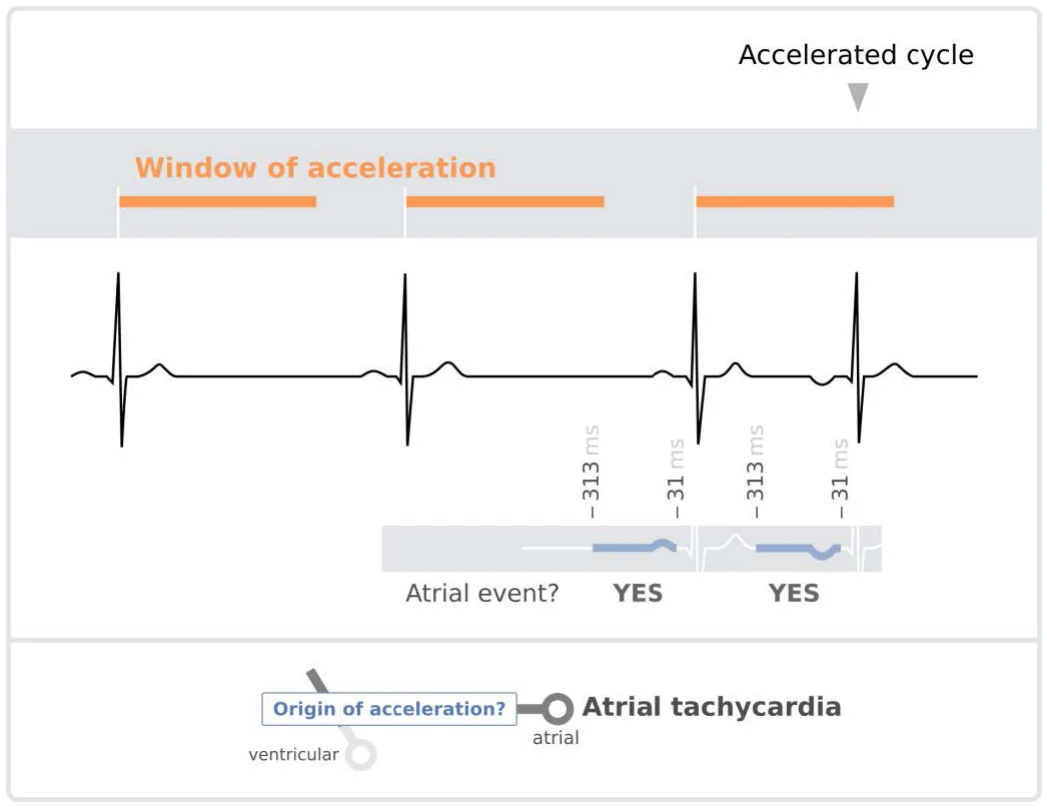
The acceleration is from ventricular origin if at least one of the 2 ventricular events which define the first accelerated interval is not classified as conducted ventricular beat. An example of non conducted beat is presented below.
In the following example, each of the RR intervals that define the first accelerated cycle are not preceded by an atrial cycle (second R wave not preceded by a P): the acceleration is of ventricular origin.
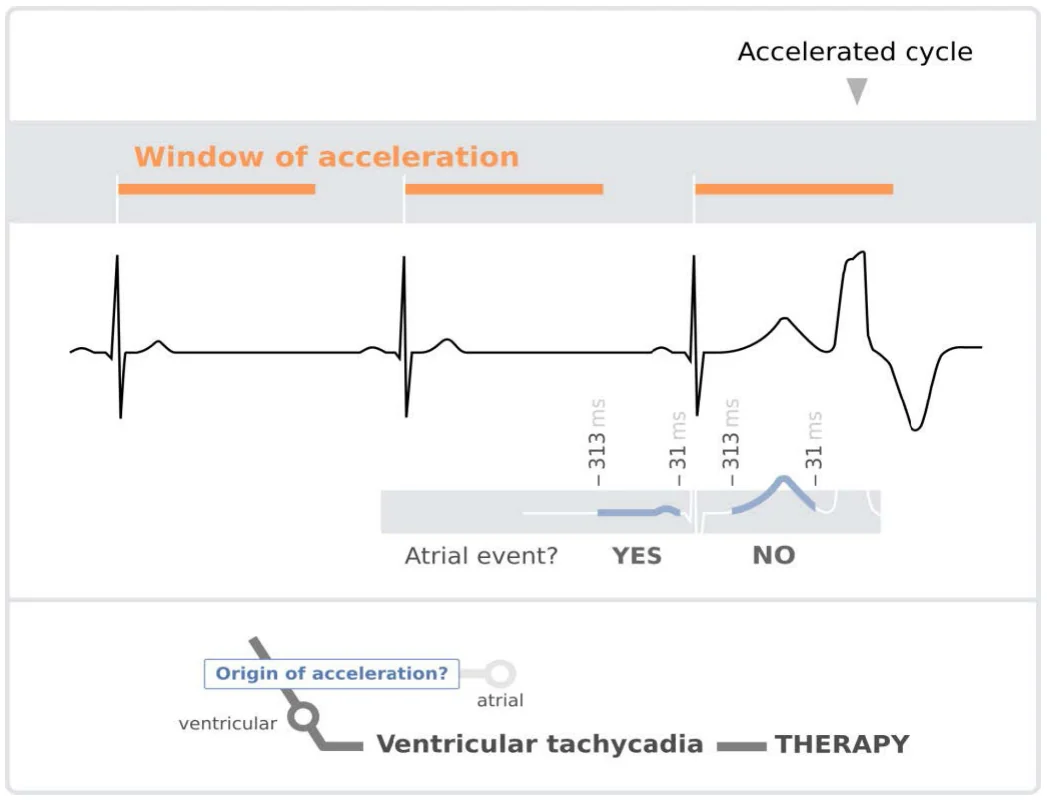
The V or A acceleration criterion is invalidated when 2 consecutive ventricular cycles lose the “accelerated cycle” criterion: the cycle times are longer than that of the reference cycle minus the programmed percentage of acceleration (25% nominal, as shipped value).
Discrimination on the programmer
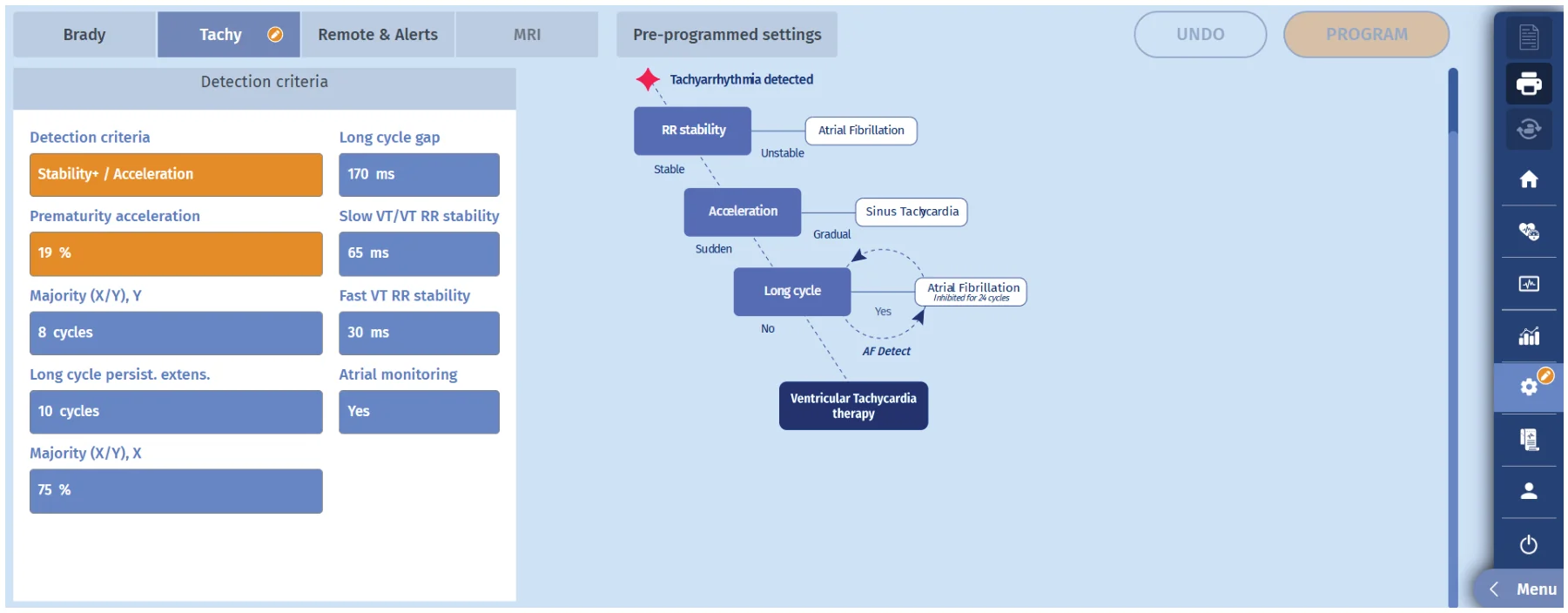
In MicroPort ICDs, don’t forget that the discrimination algorithm is displayed under the Tachy tab under the Detection criteria screen.
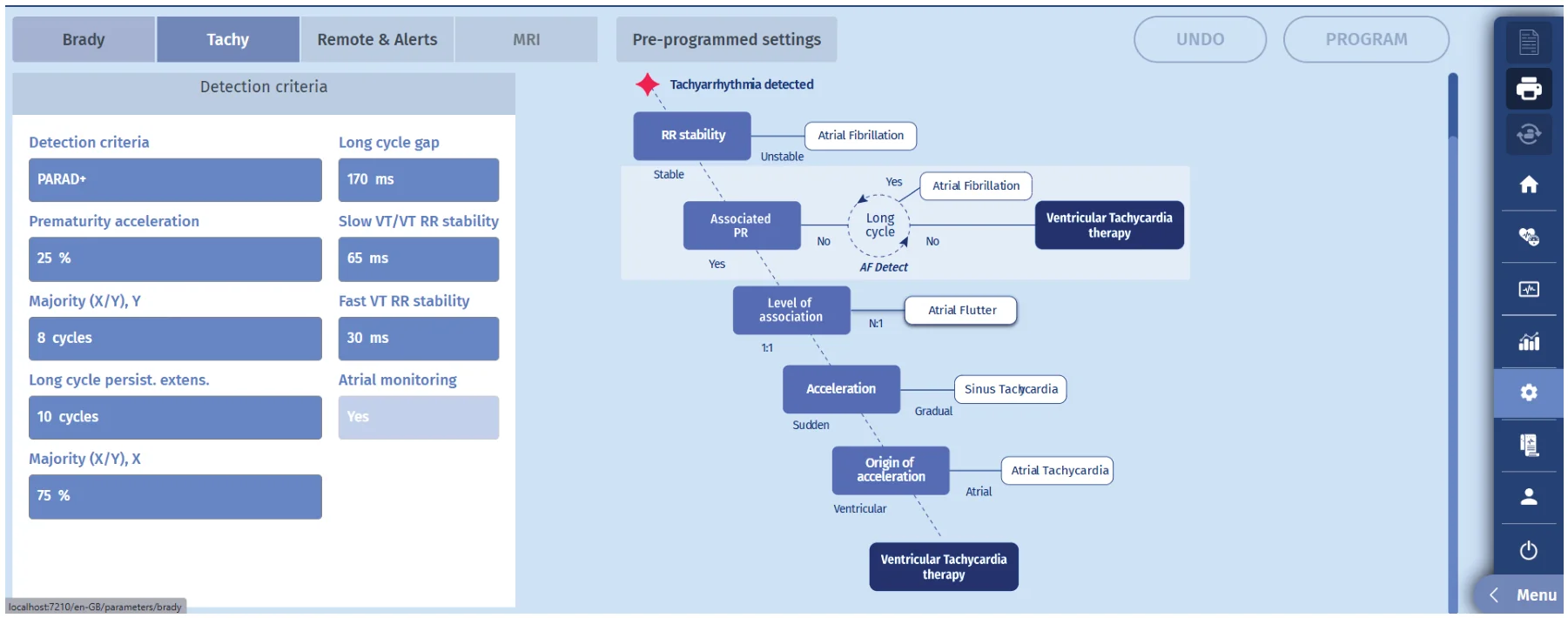
Any changes made to the discrimination parameters directly show up on the programmer screen, like this following example when atrial lead dysfunction prompts switching to a single chamber discrimination algorithm:
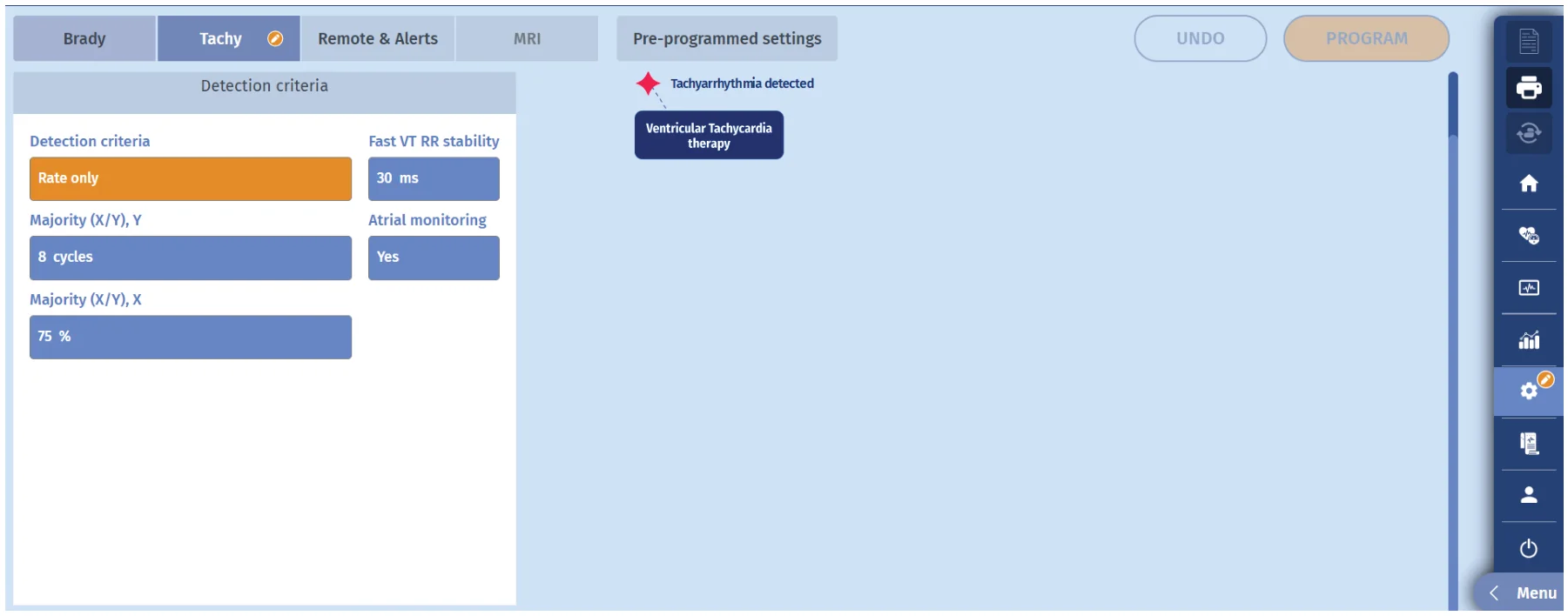
Note: when a patient has complete AV-block, discrimination should be de-activated! Like so:
For more information on Discrimination algorithms in MicroPort ICDs, please see: 6. Discrimination – MicroPort Academy.