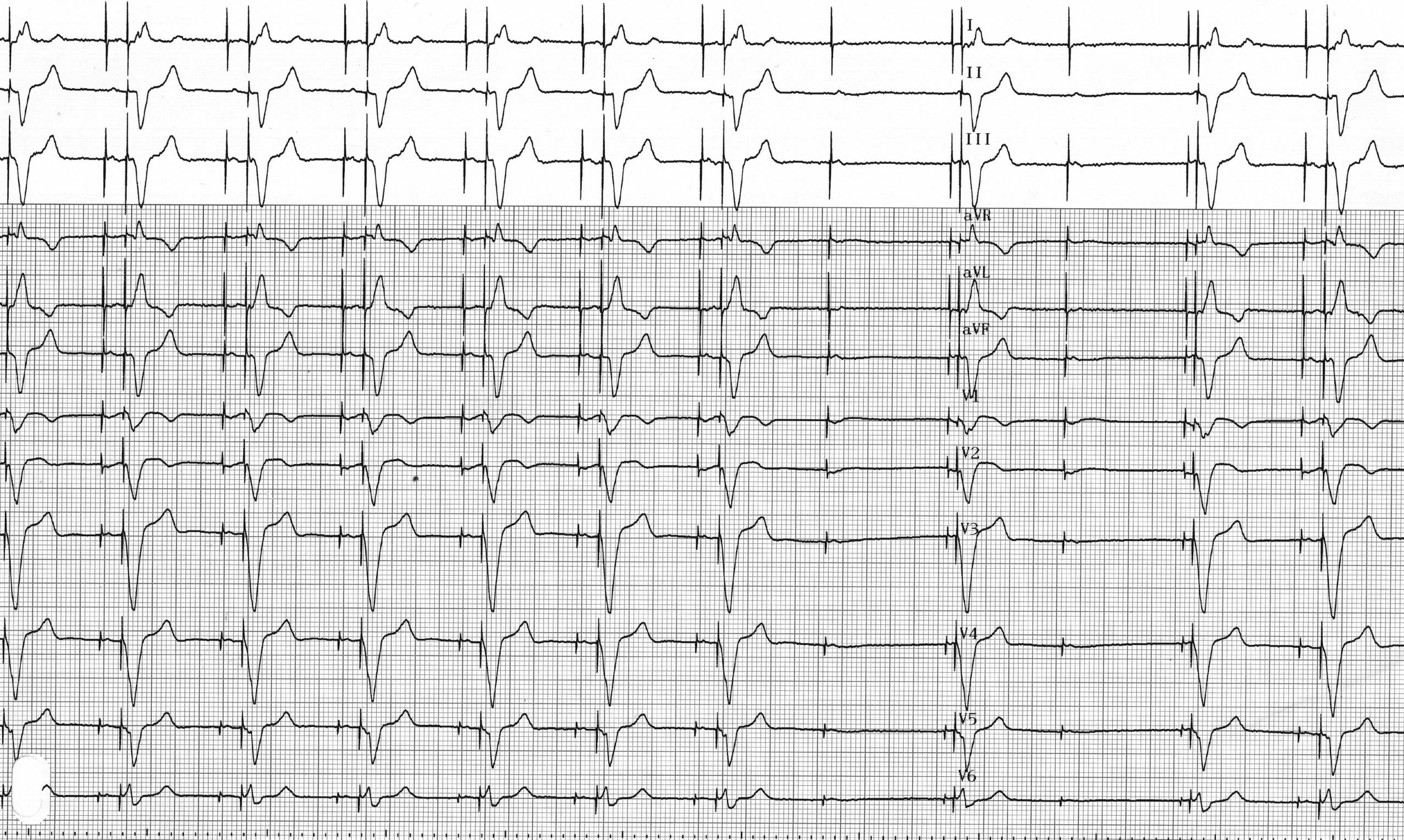
A 67-year-old man with a dual-chamber pacemaker implanted for complete atrioventricular block; this ECG was recorded during the consultation
Regarding this ECG, which of the following is/are the correct answer(s)?
ECG description
Initially, atrial pacing and ventricular pacing (DDD mode); programmed to MVP mode (a mode specific to Medtronic devices); atrial pacing not followed by a spontaneous QRS complex; on the next cycle, atrial pacing and ventricular pacing with a short AV delay (80 ms); this short AV delay on the cycle following the blocked P wave is the signature of MVP mode; identical sequence (blocked atrial pacing, atrial pacing and ventricular pacing with a short AV delay); return to DDD mode with programmed AV delay (switch occurs when 2 out of 4 atrial events are blocked);
Explanation
This trace illustrates the specific characteristics of MVP mode for Medtronic pacemakers. It is essential to understand the basics of how it works so as not to be surprised by the presence of blocked P waves, which might suggest a malfunction. It is not uncommon to receive a call from a nurse who considers a trace with a blocked P wave to be abnormal.
In MVP mode, if a single atrial event (detected outside the refractory period or triggered) is blocked, the device remains in ADI mode and delivers a backup ventricular pacing pulse 80 ms after the next atrial event (detected outside the refractory period or triggered). A single blocked P wave therefore does not trigger a mode switch. However, if 2 out of 4 atrial events (detected outside the refractory period or stimulated) are blocked, the device switches to DDD mode. A safety ventricular pacing pulse is delivered 80 ms after each atrial event following the deficient cycle. Therefore, there cannot be two consecutive blocked atrial events. The duration of the maximum ventricular pause depends on the sinus rate and the programmed minimum rate (the maximum pause is approximately equal to half the programmed minimum rate). There is therefore a single switching criterion (no switching during a long PR interval, for example).
After switching to DDD mode, the device regularly checks AV conduction while waiting to return to ADI mode. The first AV conduction check occurs 1 minute after switching to DDD mode. During this check, the device switches to ADI pacing mode for one cycle. If the next A-A interval includes a detected ventricular beat, the detection check is successful. The device remains in ADI pacing mode. If the next A-A interval does not include a detected ventricular beat (possibility of a blocked P wave), the conduction check fails and the device returns to DDD mode. The interval between each conduction check is then doubled (2, 4, 8… minutes up to a maximum of 16 hours). If the patient has complete atrioventricular block, the device operates in DDD mode continuously. Every 16 hours, the device checks for AV conduction, resulting in a missed beat. All parameters associated with DDD mode apply.
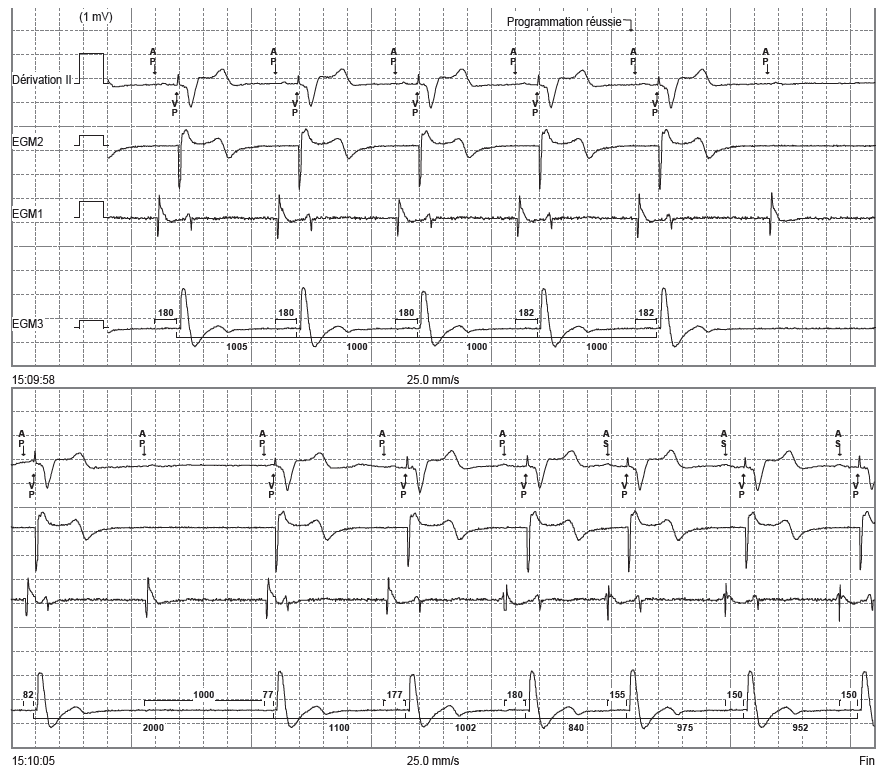
Trace description
Confirmation during EGMs, initially in DDD mode, followed by programming to MVP mode (programming successful); the intervals allow us to observe AV delays: after a blocked atrial pacing attempt, the AV delay was 80 ms on the next cycle;
To remember
Each manufacturer offers a specific mode to reduce the ventricular pacing percentage, each with its own characteristics. A blocked P wave may indicate normal operation for dual-chamber pacemakers from Medtronic, Biotronik, Boston Scientific, and Sorin, but not for St. Jude Medical devices.