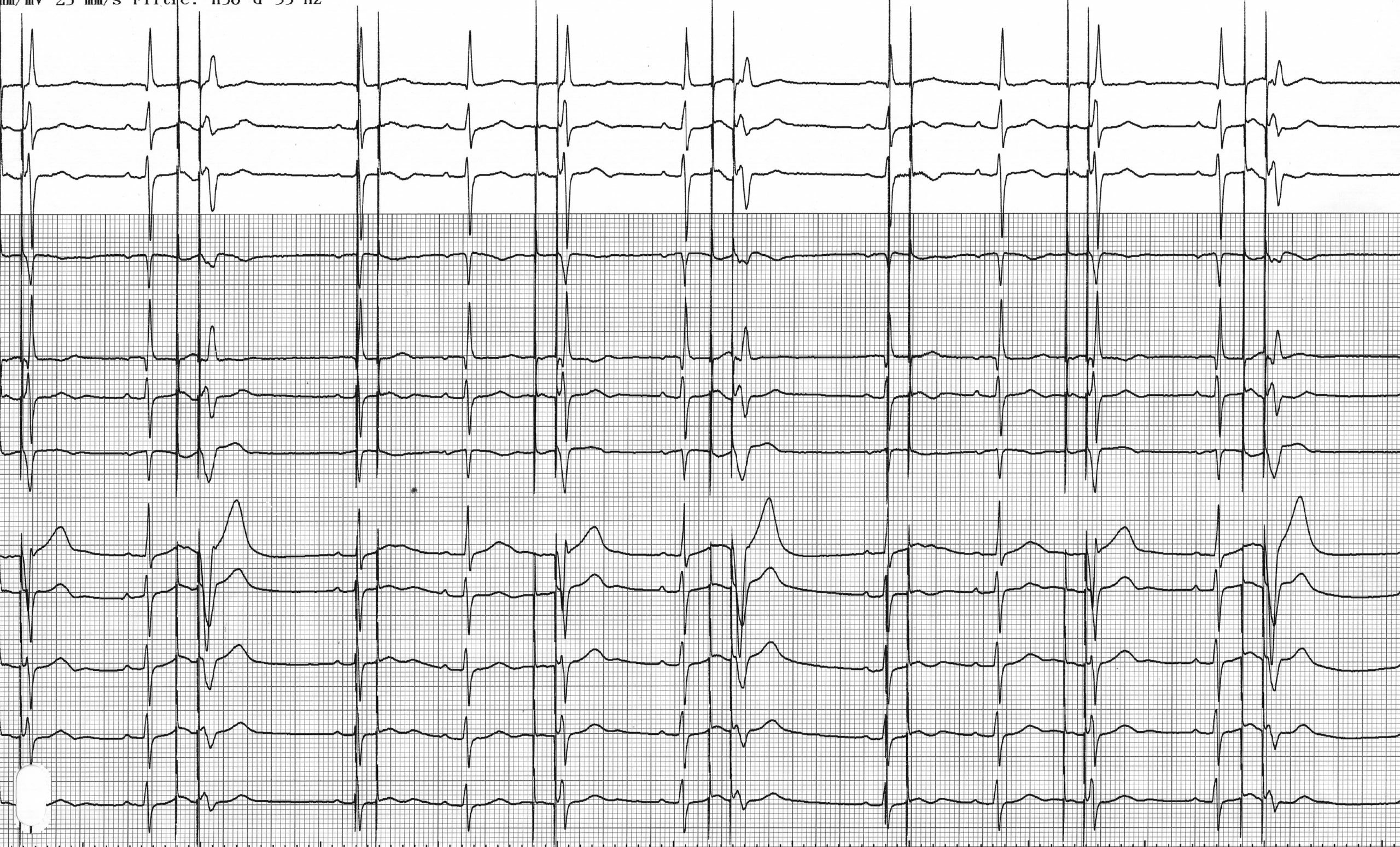
Regarding this ECG, which of the following is/are the correct answer(s)?
ECG description
On this trace, we can see regular atrial and ventricular pacing at a rate of 40 bpm; atrial and ventricular capture is effective only when it occurs outside the myocardial refractory periods (atrial and ventricular); this pacing is asynchronous; atrial and ventricular activities are not detected and therefore cannot inhibit the pacing; when ventricular pacing occurs at the peak of the T wave, capture occurs, posing an arrhythmogenic risk;
Explanation
The operation of D00 mode is the opposite of 0D0 mode: no detection is possible, and pacing occurs at fixed intervals. Fixed-rate asynchronous modes were the only modes available on early pacemakers. D00 mode induces asynchronous sequential atrioventricular pacing without inhibition by intrinsic events.
As seen in this trace, when the patient is not dependent, parasystole occurs due to competition between spontaneous and paced activity. This mode allows for verification of pacing efficacy and helps prevent inhibition in the event of exposure to external interference (such as an electrosurgical unit in a dependent patient, for example). Pacing is effective and captures the atrium or ventricle only when it occurs outside the physiological absolute refractory period following a spontaneous atrial or ventricular beat.
This trace illustrates the risk associated with this mode. Several ventricular pacing events occur at the peak of the T wave of an undetected spontaneous QRS complex. This represents the vulnerable period, during which there is a risk of inducing a ventricular arrhythmia. The risk of ventricular fibrillation is limited but increases in the presence of myocardial ischemia or a metabolic disorder. Similarly, asynchronous atrial pacing during the atrial vulnerable period can trigger an episode of atrial fibrillation.
Asynchronous modes are now obsolete and are used only in two specific circumstances: 1) it is a magnetic mode or magnet mode; in fact, the application of a magnet triggers an A00, V00, or D00 stimulation depending on the programmed mode; 2) D00 mode can be temporarily programmed for dependent patients with an MRI-compatible pacemaker who need to undergo an MRI.
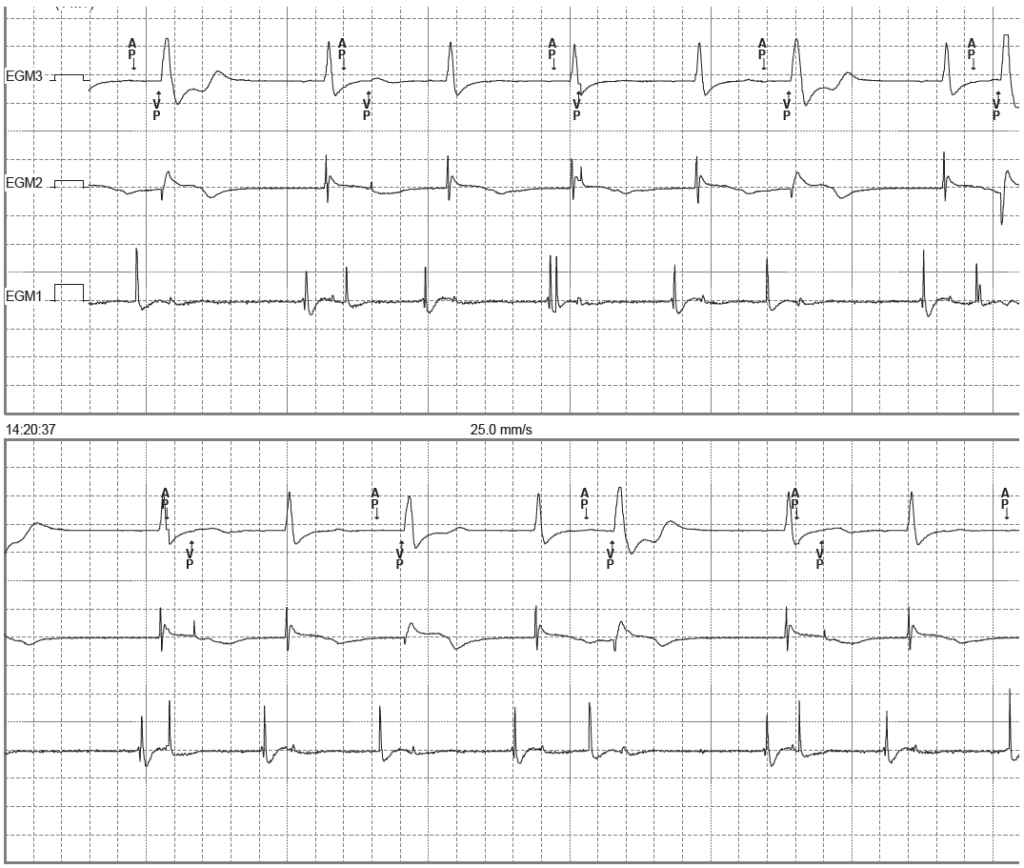
Trace description
EGMs show that the atrial and ventricular signals are large but are not detected (D00 mode), which explains the asynchronous pacing;
To remember
Pacing during a period of ventricular or atrial vulnerability can be arrhythmogenic and may trigger the onset of a ventricular or atrial arrhythmia, most often of the polymorphic type;