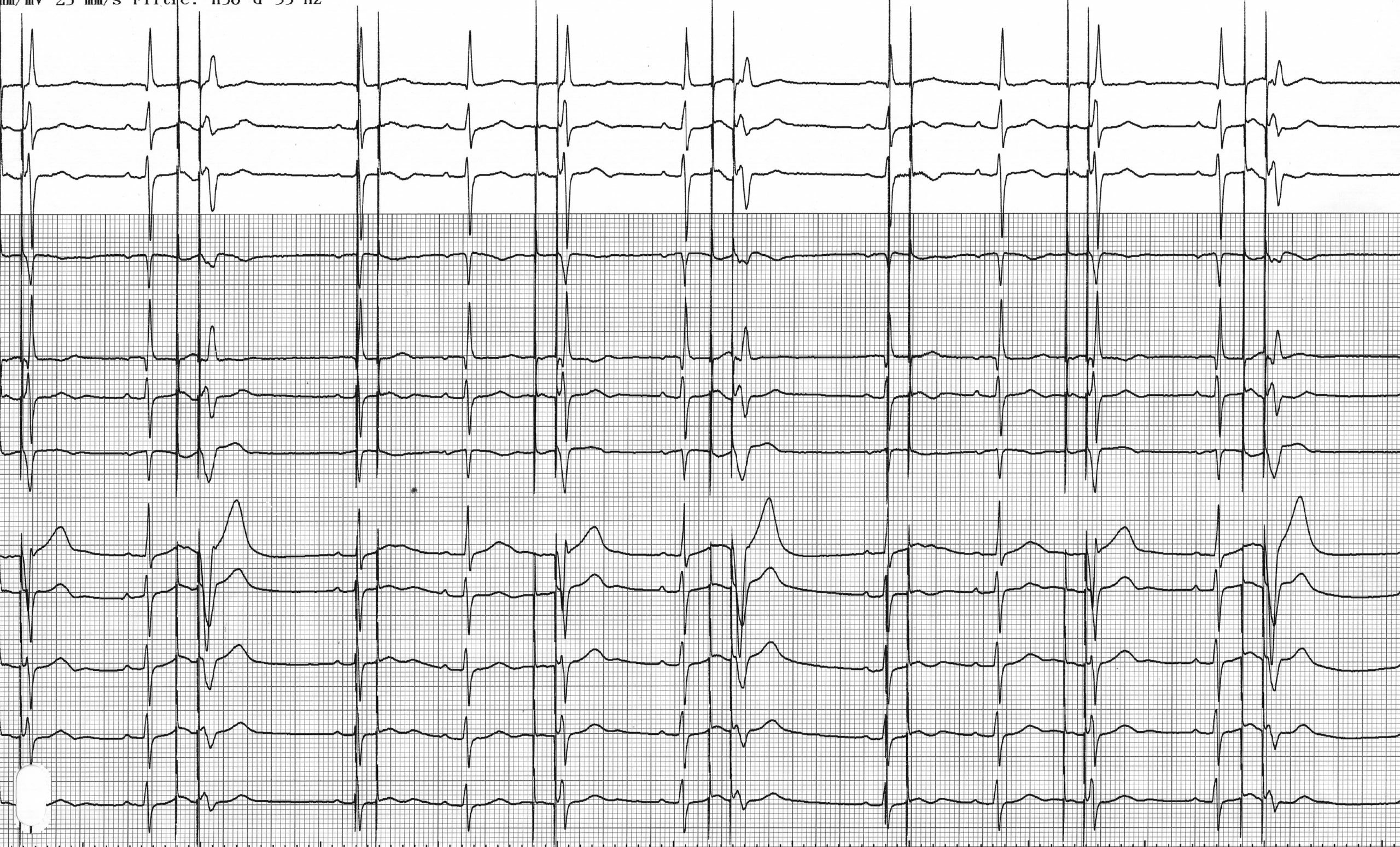
Il s'agit du même patient que celui du tracé précédent ; programmé en mode D00
En ce qui concerne cet ECG, laquelle ou lesquelles des réponses suivantes sont correctes ?
Description de l'ECG
Sur ce tracé, on observe une stimulation auriculaire et ventriculaire régulière à une fréquence de 40 bpm ; la capture auriculaire et ventriculaire n’est effective que lorsqu’elle se produit en dehors des périodes réfractaires myocardiques (auriculaire et ventriculaire) ; cette stimulation est asynchrone ; les activités auriculaires et ventriculaires ne sont pas détectées et ne peuvent donc pas inhiber la stimulation ; lorsque la stimulation ventriculaire survient au sommet de l'onde T, la capture a lieu, ce qui présente un risque arythmogène ;
Explication
Le fonctionnement du mode D00 est l'inverse de celui du mode 0D0 : aucune détection n'est possible et la stimulation s'effectue à intervalles fixes. Les modes asynchrones à fréquence fixe étaient les seuls disponibles sur les premiers stimulateurs cardiaques. Le mode D00 induit une stimulation auriculo-ventriculaire séquentielle asynchrone sans inhibition par les événements intrinsèques.
Comme le montre ce tracé, lorsque le patient n'est pas dépendant, une parasystole survient en raison d'une concurrence entre l'activité spontanée et l'activité stimulée. Ce mode permet de vérifier l’efficacité de la stimulation et contribue à prévenir l’inhibition en cas d’exposition à des interférences externes (telles qu’un appareil d’électrochirurgie chez un patient dépendant, par exemple). La stimulation n’est efficace et ne capture l’oreillette ou le ventricule que lorsqu’elle se produit en dehors de la période réfractaire absolue physiologique suivant un battement auriculaire ou ventriculaire spontané.
Ce tracé illustre le risque associé à ce mode. Plusieurs stimulations ventriculaires se produisent au sommet de l'onde T d'un complexe QRS spontané non détecté. Cela correspond à la période de vulnérabilité, durant laquelle il existe un risque de déclencher une arythmie ventriculaire. Le risque de fibrillation ventriculaire est limité, mais il augmente en présence d’une ischémie myocardique ou d’un trouble métabolique. De même, une stimulation auriculaire asynchrone pendant la période de vulnérabilité auriculaire peut déclencher un épisode de fibrillation auriculaire.
Les modes asynchrones sont désormais obsolètes et ne sont utilisés que dans deux cas précis : 1) il s’agit d’un mode magnétique ; en effet, l’application d’un aimant déclenche une stimulation A00, V00 ou D00 selon le mode programmé ; 2) le mode D00 peut être programmé temporairement pour les patients dépendants porteurs d’un stimulateur cardiaque compatible IRM qui doivent passer une IRM.
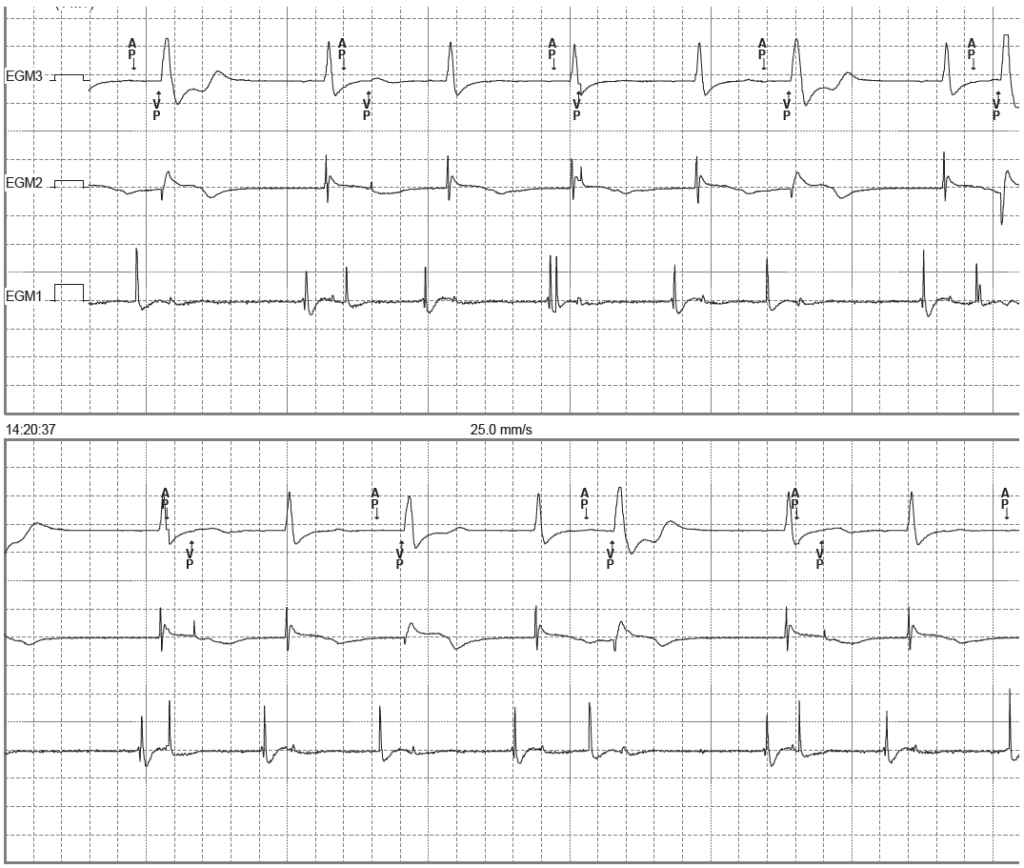
Description du tracé
Les EGM montrent que les signaux auriculaires et ventriculaires sont importants mais ne sont pas détectés (mode D00), ce qui explique la stimulation asynchrone ;
À retenir
La stimulation cardiaque pendant une période de vulnérabilité ventriculaire ou auriculaire peut être arythmogène et susceptible de déclencher l'apparition d'une arythmie ventriculaire ou auriculaire, le plus souvent de type polymorphe ;