

Abbott - Atrial arrhythmia management
Content
Mode-switch due to atrial arrhythmias
Mode-switch algorithm
Automatic mode switching (AMS) occurs when the filtered atrial rate exceeds the atrial tachycardia detection rate (ATDR).
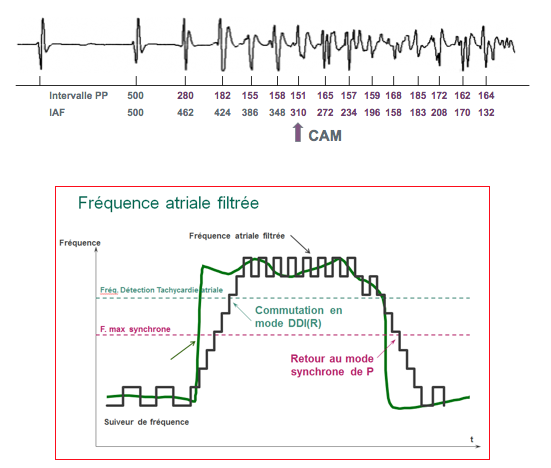
ACM uses a filtered atrial rate, rather than an instantaneous rate, based on a comparison of the current atrial rate with a continuously updated average rate, in order to distinguish between sustained tachycardia and intermittent rapid cycles.
When the filtered atrial rate exceeds the programmed ADFR value, the device switches to DDI(R) or VVI(R) mode.
The device measures the instantaneous PP interval at each cycle.
It calculates a filtered atrial interval (FAI) according to the following rule:
- If instantaneous PP ≤ FAI: FAI decremented by 38 ms
- If instantaneous PP > FAI: FAI incremented by 25 ms
Mode switching occurs as soon as the filtered atrial interval becomes shorter than the atrial tachycardia detection interval.
During mode switching, the pacing rate corresponds to the AMS base rate (programmable independently of the base rate) or to the rate indicated by the sensor (slave rate).
Return to synchronous mode is only possible if the atrial rate falls below the maximum synchronous rate (FAI > maximum synchronous rate interval).
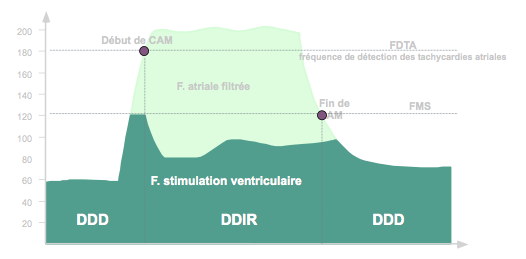
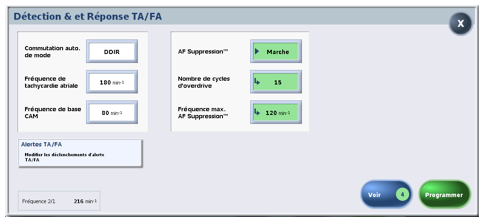
Example: atrial tachycardia detection interval at 180 min⁻¹ / 333 ms
Programming
Recording an AT/AF episode
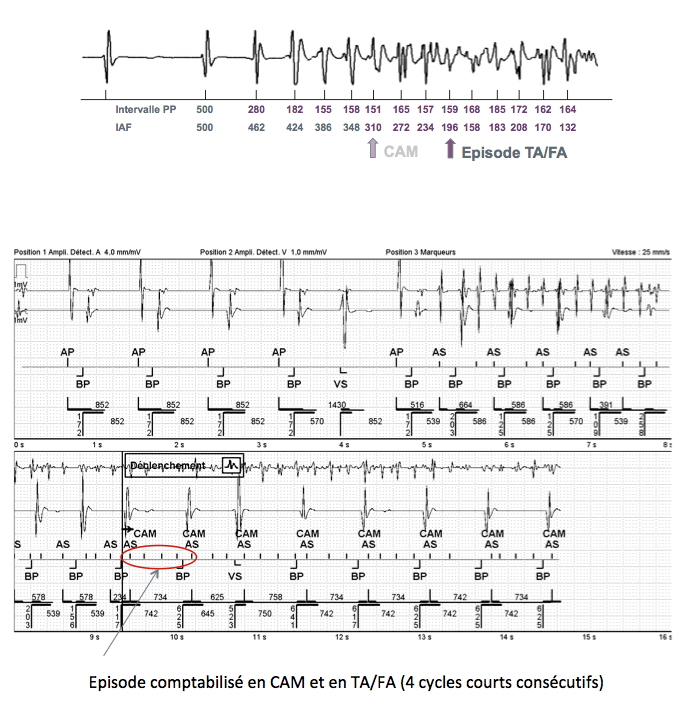
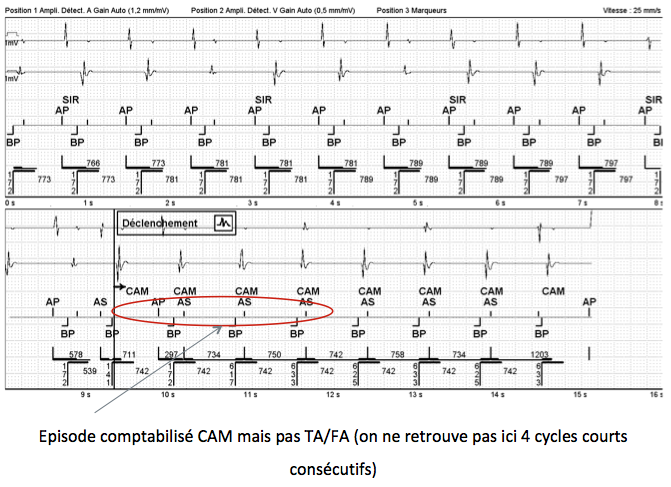
The criterion for recording AT/AF episodes uses the atrial tachycardia detection interval (ATDI). The calculation method for the filtered atrial interval (FAI) is identical.
To record an episode, there must be 4 consecutive cycles with a PP interval and an FAI that are less than the ADTI. These consecutive cycles prevent the recording of AMS episodes on cross-listening (alternating short and long cycles that can cause AMS but not the recording of the episode because there are no consecutive short cycles). The AMS criterion is more sensitive than the recording criterion, which is more specific. Eight cycles with a PP interval and an FAI greater than the IDTA are then required for the episode to be completed (two episodes less than 20 seconds apart are considered a single AT/AF episode).
AF Burden
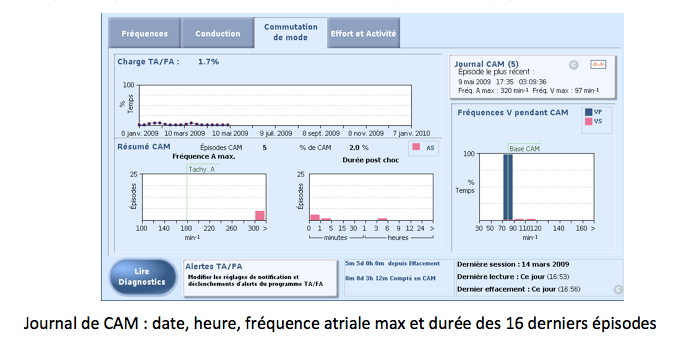
AT/AF Burden is the percentage of time spent in AT/AF over a 52-week period. Each data point on the graph represents the percentage of time the patient was in AT/AF over a seven-day period.
Atrial flutter management
There is no algorithm of this type; when a 2/1 flutter occurs, it is necessary to shorten the duration of the atrial blanking period following ventricular pacing.
Atrial fibrillation prevention algorithm
No such algorithm; when 2:1 flutter occurs, AF Suppression™ is required.
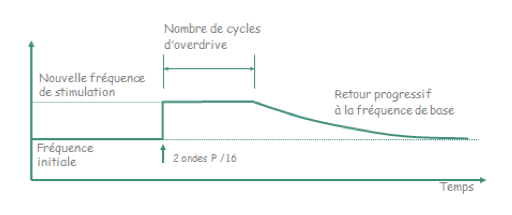
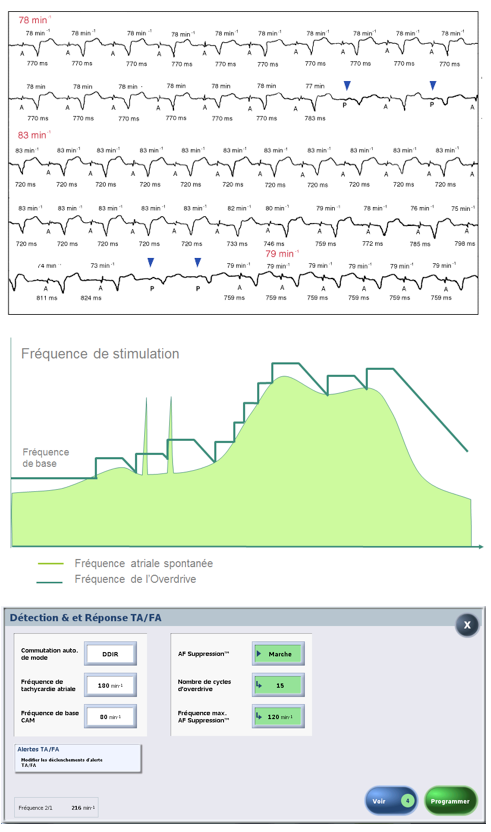
The AF Suppression™ algorithm allows the device to stimulate the atrium at rates faster than the intrinsic atrial rate (overdrive).
When the algorithm detects two P waves within a 16-cycle window, the device increases the pacing rate to override spontaneous conduction. After pacing at the AF Suppression algorithm rate for the number of cycles specified by the Overdrive Cycles parameter (15 to 40; nominal 15), the device slows its rate until it detects two new P waves. If two P waves are detected, it returns to rapid pacing (overdrive). If it does not detect two P waves, pacing resumes according to the base rate, resting rate, or sensor rate setting.
Calculation of the overdrive frequency: for simulation frequencies <59 bpm, the overdrive applied is fixed at 10 bpm (=minimum overdrive frequency); for frequencies >151 bpm, fixed overdrive of 5 bpm (=maximum overdrive frequency); for frequencies between 60 and 150 bpm, the AF Suppression algorithm increases the stimulation frequency by a delta between the minimum overdrive frequency and the maximum overdrive frequency.
Programmable determines the interval and slope of reduction from the overdrive frequency to the base frequency, rest frequency, or frequency indicated by the sensor. if the overdrive frequency is greater than 100 bpm, 8 ms are added to each cycle up to 100 bpm, then +12 ms up to the base frequency.