

Abbott - Pacing modes
Content
VIP algorithm
There is no specific mode as such. The VIP algorithm corresponds to AV delay hysteresis. To promote the return of spontaneous conduction, the device temporarily extends its AV delay (up to a maximum of 450 ms). Spontaneous conduction is only sought for frequencies below 110 bpm. If no spontaneous ventricular event is detected at the end of the extended AV delay, ventricular pacing is delivered. Therefore, there can be no blocked P wave during this search, as ventricular pacing always occurs at the end of the extended AV delay in the absence of ventricular detection. However, the temporary extension of the AV delay may promote the occurrence of a PMT.
Activating VIP
Search for spontaneous conduction with temporary prolongation of the AV delay;
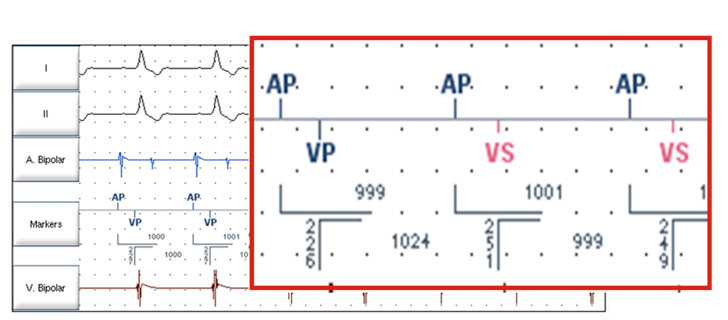
In this example, we see the presence of an R wave in the three intervals with prolonged AV delay; the device continues to operate with a long AV delay.
Deactivating VIP
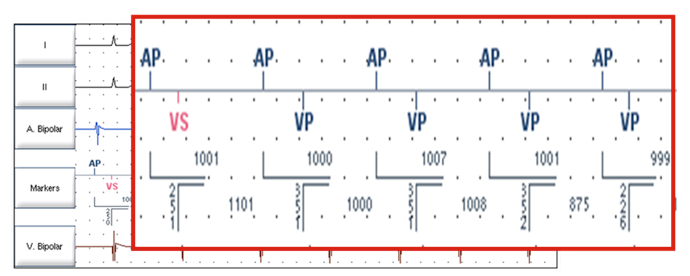
In this example, atrioventricular conduction is impaired with three stimulated ventricles despite a long AV delay (350 ms), resulting in a return to programming with a shorter AV delay (220 ms).
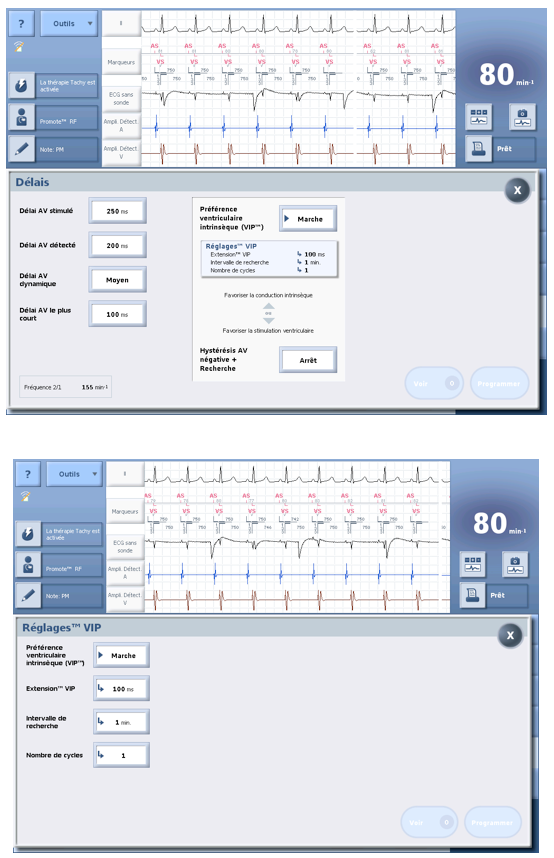
Programming VIP
Three parameters can be programmed:
- VIP™ Extension, which corresponds to the AV delay extension applied to the programmed AV delay (stimulated or detected) to search for spontaneous conduction
- the Search Interval, which corresponds to the time interval between each search for spontaneous conduction (30 seconds, 1, 3, 5, 10, or 30 minutes)
- the number of cycles, which corresponds to the number of consecutive cycles with prolonged AV delay during which the search for spontaneous conduction occurs (1, 2, or 3 cycles)
It is possible to view the atrioventricular conduction histogram in the pacemaker’s memory.
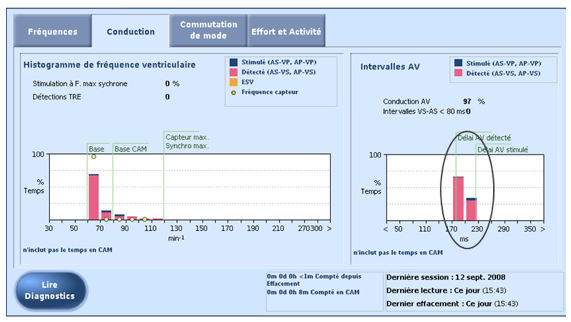
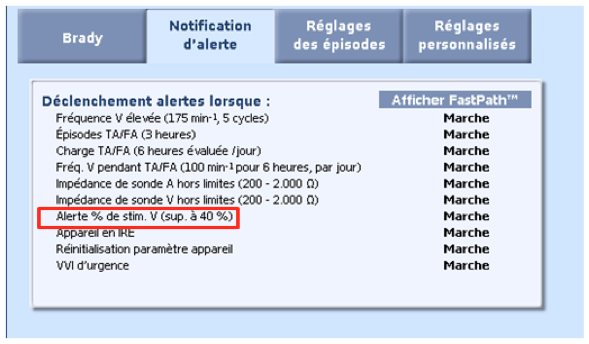
It is also possible to program a specific telemedicine alert when the percentage of ventricular pacing exceeds a programmable threshold.