Reading a full LATITUDE CRT-D follow-up report

Patient

Go to the casebook version optimized for the mobile experience

RESONATE X4 CRT-D with a quadripolar LV lead (LV paced LVTip1>>LVRing2), 9 months after implant; DDD 60-130 bpm, BiV pacing, LV offset −20 ms, LV output Auto (PaceSafe LV)

Remote LATITUDE transmission and its full report (28 pages: Quick Notes, presenting EGM, follow-up, heart failure, atrial arrhythmia, logbook, settings); last in-office interrogation the day after implant. What does a step-by-step reading show?
Reading a full LATITUDE CRT-D follow-up report: Boston Scientific CRT tracing (EGM)


Loading Viewer…


Trace

  1. My Alerts: no alert in this remote transmission. The events listed just below (RV Auto, RA Auto) are automatic threshold tests, not arrhythmias
  2. Battery OK: about 10.5 years to explant; charge time 10.1 s at the last capacitor re-form, 3½ months earlier
  3. Lead table: values at implant, at the last in-office check (the next day) and at the last daily measurement (the day before the transmission). Atrial 3.9 mV, 547 Ω, 0.6 V; RV 392 Ω, 1.3 V (R wave N/R: the RV is paced); shock 70 Ω: all close to their implant values
  4. LV (LVTip1>>LVRing2): 817 Ω and a threshold of 1.7 V @ 0.4 ms, against 1.2 V at implant and 1.3 V the next day: the value that has risen most. PaceSafe LV sets the LV output at 2.7 V (1.7 V + the 1.0 V safety margin). The report calls this output LVa: LVa and LVb are the two LV pacing outputs of MultiSite pacing, but most often a single LV pacing vector is used, so LVa = the LV
  5. Brady/CRT counters since the reset the day after implant: A paced 67%, RV 99%, LV 99% (LVb 0%) = BiV pacing above the 98% target. Just below, AT/AF < 1% of the time
  6. Ventricular counters since the same reset: a single episode, non-sustained (NonsustainedV, with a warning sign; the event log gives 192 bpm for 16 s, 8 weeks after implant), and no therapy: 0 ATP, 0 shock
  7. LV auto threshold over 6 months of trends (one value a day): 1.1-1.5 V in the first weeks, 1.2-1.9 V over the last 3 months, 1.7 V on the last day, with a stable LV impedance above (780-1010 Ω): a slow rise, not a jump; the LV output follows it
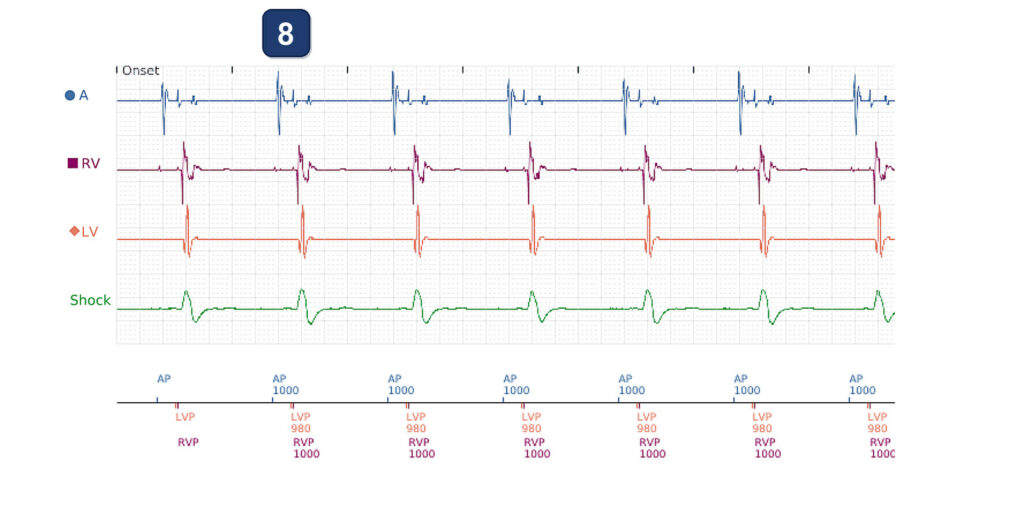
  8. Presenting EGM of the transmission: AP 1000 = atrial pacing at the lower rate (60 bpm), then LVP and RVP 20 ms apart (LVP 980 = 1000 − 20: LV offset −20 ms, the LV interval counted from the previous RV pace); the same paced complex on every beat

Comments

A full LATITUDE report read step by step: no alert, 99% BiV pacing, no therapy, but an LV threshold that has crept up since implant (1.2 → 1.7 V), with a stable impedance

Points to remember

  • Read every CRT report in the same order: alerts, battery, leads, % BiV pacing (aim for 98% or more), arrhythmias and therapies, trends, then the presenting EGM. “No alerts” is only the first step
  • Compare each lead value with its implant value and its trend. Here the LV threshold rose slowly over months (1.2 → 1.7 V @ 0.4 ms) with a stable impedance: a value to follow at each check. PaceSafe LV raises the LV output accordingly
  • Read the arrhythmias with the therapies: one short non-sustained VT (192 bpm, 16 s), no ATP and no shock since implant, about 700 PVCs a day and a single 5-s atrial episode
  • The heart failure trends belong to the same review: here thoracic impedance dipped from about 46 to 42-44 Ω for a few weeks, 2 to 3 months before the transmission, then came back, with a steady respiratory rate and 1-3 h of activity a day

Take home message

“No alerts” does not mean “nothing to see”: compare each lead value with its implant value and its trend. Here the LV threshold crept up over months without raising any alert

Read more about related topics

X