
Chapter 1 · LV pacing and threshold · Case 1
Reading a full LATITUDE CRT-D follow-up report
Patient and episode
Patient
- RESONATE X4 CRT-D with a quadripolar LV lead (LV paced LVTip1>>LVRing2), 9 months after implant; DDD 60-130 bpm, BiV pacing, LV offset −20 ms, LV output Auto (PaceSafe LV)
- Remote LATITUDE transmission and its full report (28 pages: Quick Notes, presenting EGM, follow-up, heart failure, atrial arrhythmia, logbook, settings); last in-office interrogation the day after implant. What does a step-by-step reading show?
The recording
Tap a number on the trace, or an entry in the list below
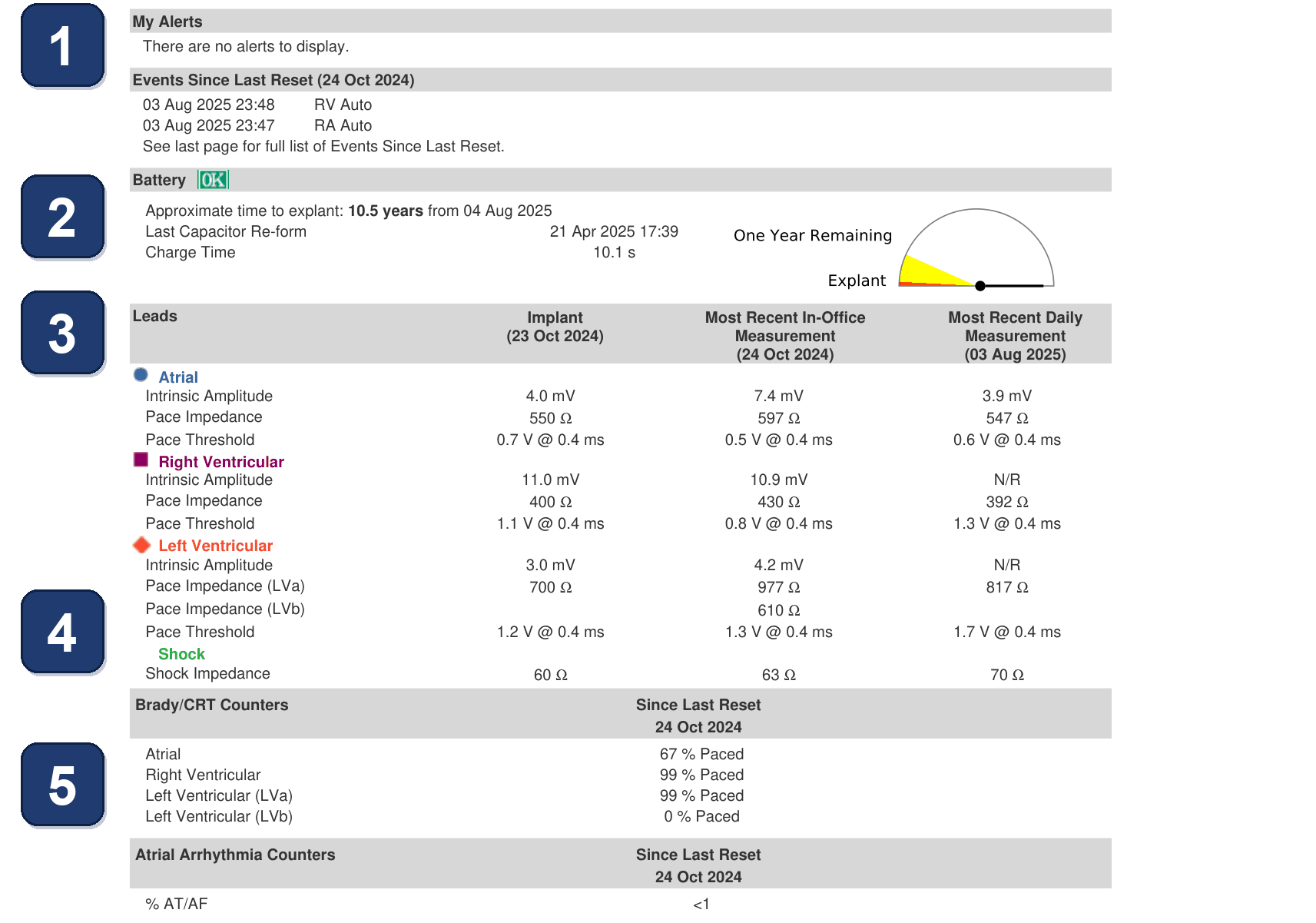
- My Alerts: no alert in this remote transmission. The events listed just below (RV Auto, RA Auto) are automatic threshold tests, not arrhythmias
- Battery OK: about 10.5 years to explant; charge time 10.1 s at the last capacitor re-form, 3½ months earlier
- Lead table: values at implant, at the last in-office check (the next day) and at the last daily measurement (the day before the transmission). Atrial 3.9 mV, 547 Ω, 0.6 V; RV 392 Ω, 1.3 V (R wave N/R: the RV is paced); shock 70 Ω: all close to their implant values
- LV (LVTip1>>LVRing2): 817 Ω and a threshold of 1.7 V @ 0.4 ms, against 1.2 V at implant and 1.3 V the next day: the value that has risen most. PaceSafe LV sets the LV output at 2.7 V (1.7 V + the 1.0 V safety margin). The report calls this output LVa: LVa and LVb are the two LV pacing outputs of MultiSite pacing, but most often a single LV pacing vector is used, so LVa = the LV
- Brady/CRT counters since the reset the day after implant: A paced 67%, RV 99%, LV 99% (LVb 0%) = BiV pacing above the 98% target. Just below, AT/AF < 1% of the time
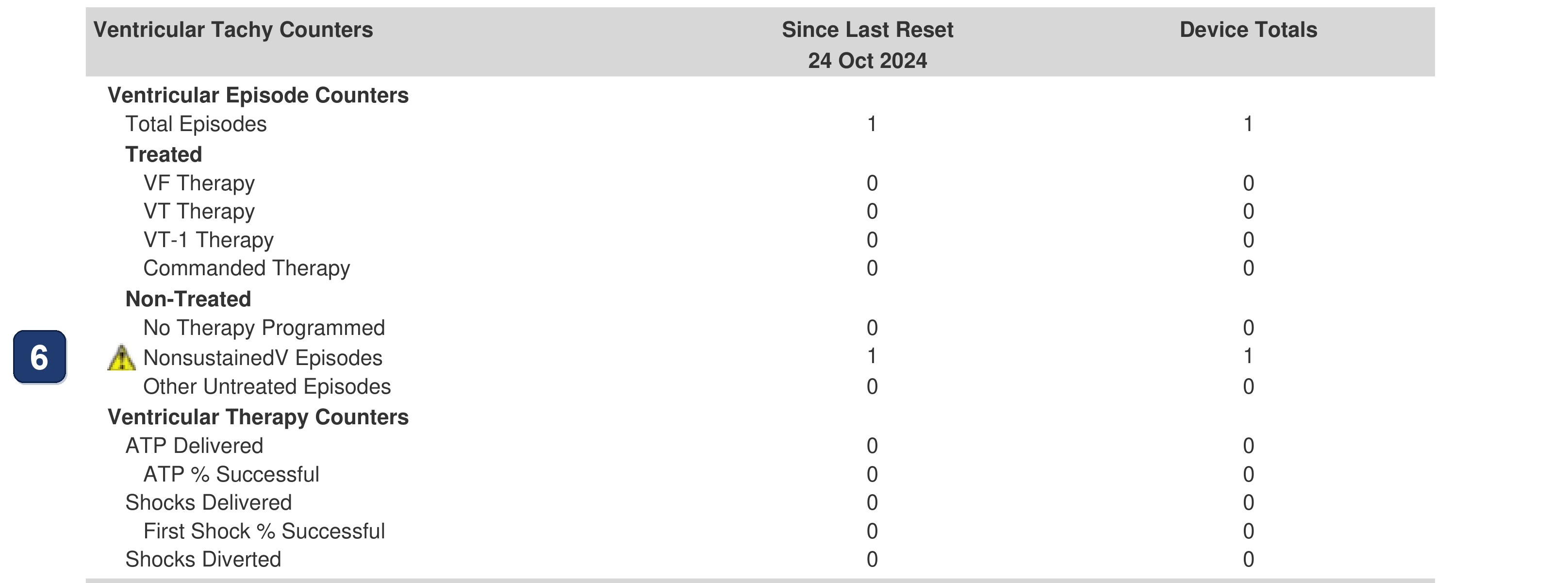
- Ventricular counters since the same reset: a single episode, non-sustained (NonsustainedV, with a warning sign; the event log gives 192 bpm for 16 s, 8 weeks after implant), and no therapy: 0 ATP, 0 shock
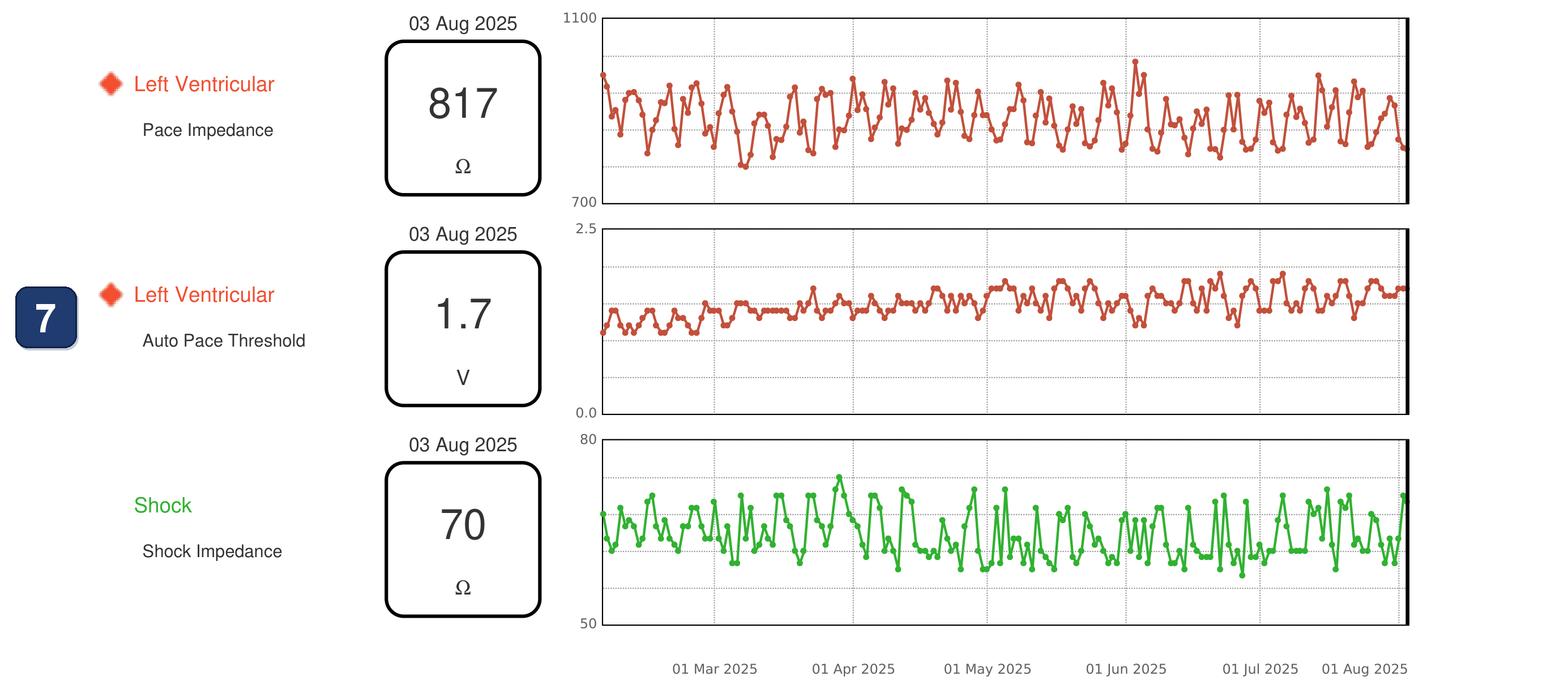
- LV auto threshold over 6 months of trends (one value a day): 1.1-1.5 V in the first weeks, 1.2-1.9 V over the last 3 months, 1.7 V on the last day, with a stable LV impedance above (780-1010 Ω): a slow rise, not a jump; the LV output follows it
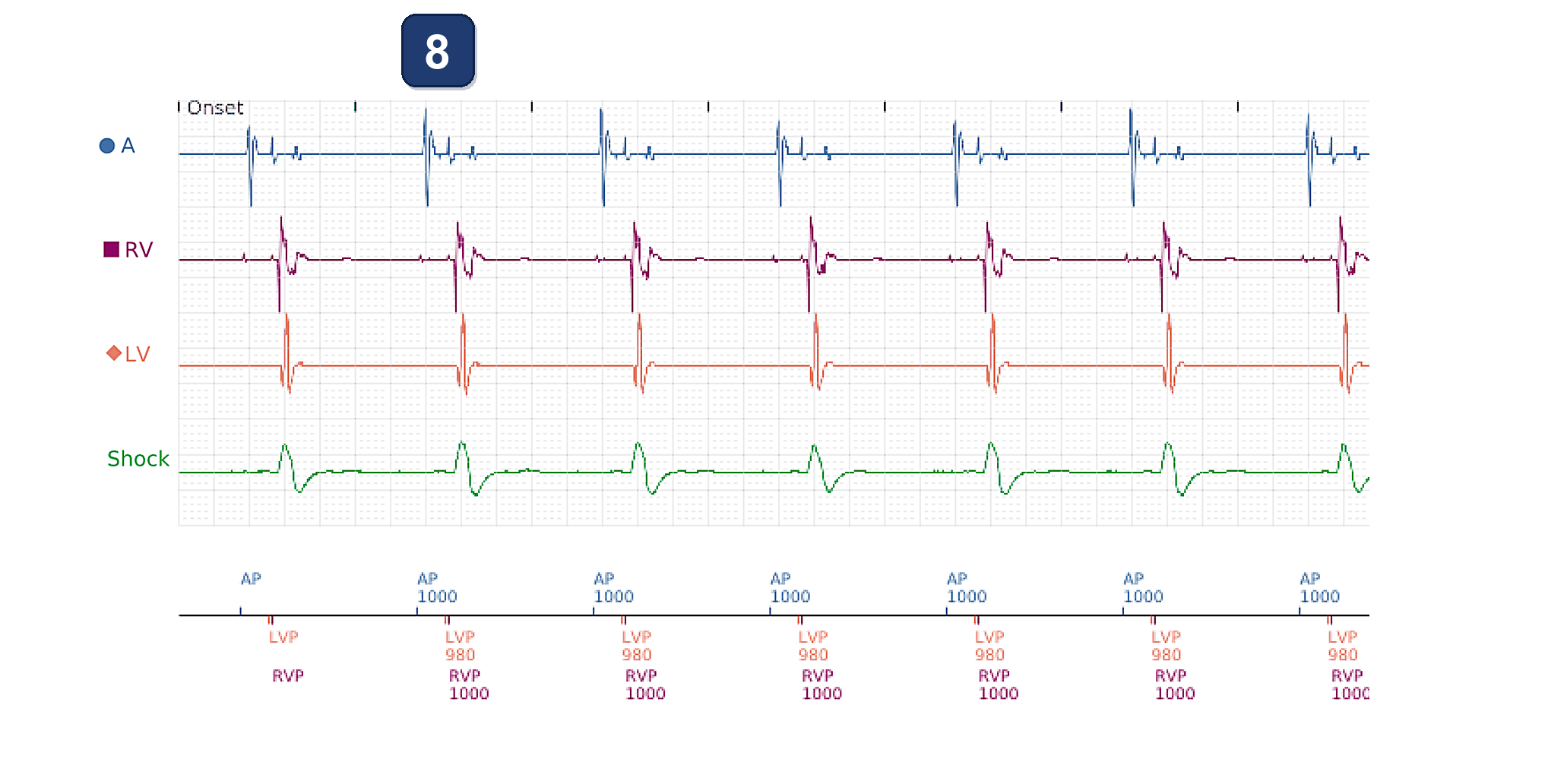
- Presenting EGM of the transmission: AP 1000 = atrial pacing at the lower rate (60 bpm), then LVP and RVP 20 ms apart (LVP 980 = 1000 − 20: LV offset −20 ms, the LV interval counted from the previous RV pace); the same paced complex on every beat
Points to remember
- Read every CRT report in the same order: alerts, battery, leads, % BiV pacing (aim for 98% or more), arrhythmias and therapies, trends, then the presenting EGM. “No alerts” is only the first step
- Compare each lead value with its implant value and its trend. Here the LV threshold rose slowly over months (1.2 → 1.7 V @ 0.4 ms) with a stable impedance: a value to follow at each check. PaceSafe LV raises the LV output accordingly
- Read the arrhythmias with the therapies: one short non-sustained VT (192 bpm, 16 s), no ATP and no shock since implant, about 700 PVCs a day and a single 5-s atrial episode
- The heart failure trends belong to the same review: here thoracic impedance dipped from about 46 to 42-44 Ω for a few weeks, 2 to 3 months before the transmission, then came back, with a steady respiratory rate and 1-3 h of activity a day
Summary
- A full LATITUDE report read step by step: no alert, 99% BiV pacing, no therapy, but an LV threshold that has crept up since implant (1.2 → 1.7 V), with a stable impedance
Clinical pearl
“No alerts” does not mean “nothing to see”: compare each lead value with its implant value and its trend. Here the LV threshold crept up over months without raising any alert
Practice out loud
Just describe the tracing. What do you think is going on? Describing the numbers can help.
00:00
0%
—
From Boston Scientific CRT — clinical cases by M. Strik. Published by Cardiocases. Every numbered marker on a recording is explained in the list beneath it; tap a marker on the trace or an entry in the list.