VISIONIST X4 CRT-P with a quadripolar LV lead; DDD 50-120 bpm, BiV pacing (99-100%), LV offset 0 ms; atrial and RV outputs in Trend (daily thresholds), LV output fixed
The latest LATITUDE remote report, almost 4 weeks after an office visit (the first since the check just after implant), shows an LV impedance jump; the report 11 weeks earlier, 33 months after implant, follows. Is the lead failing?
Loading Viewer…
Trace
The latest report: LV pace impedance, one value a day over 6 months (vertical lines: the 1st of each month): 550-740 Ω up to the office visit, then 1580-1870 Ω from the next day on, stable. A step on the day of the visit (the trend graphs mark P, Program, and I, Office Interrogation, that day), not a drift. Above, the LV intrinsic amplitude has almost no values (“Paced”): the LV is paced on nearly every beat
Battery: about 1 year to explant. The last page gives the power use: 49 µW, 92% of a reference CRT (RV and LV paced 100% at 2.5 and 3.5 V @ 0.4 ms)
At the office visit: LV threshold 1.6 V @ 0.8 ms; pace impedance 676 Ω in office, then 1625 Ω on the last daily measurement. The atrial and RV values have not changed
Pacing Output, Left Ventricular: 2.5 V @ 0.8 ms, 0.9 V above the threshold
Leads Configuration, Left Ventricular: LVTip1>>LVRing2, the LV paced between the tip and ring 2, the bipole it also uses for sensing
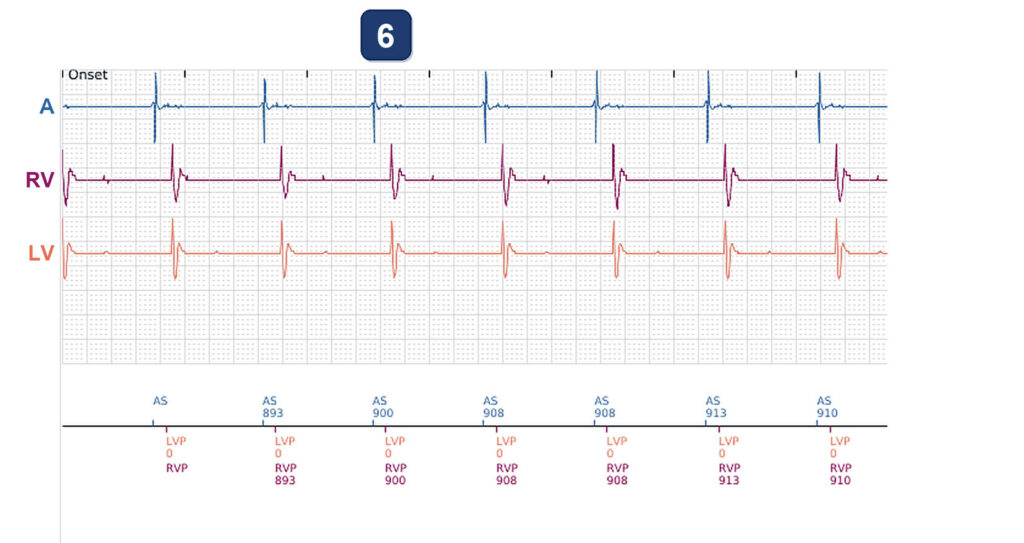
Presenting EGM of the latest report: sinus rhythm at about 67 bpm (AS 893-913 ms), each atrial sensed event tracked and both ventricles paced together (LVP 0, RVP): normal BiV pacing and capture on every beat
Eleven weeks earlier, the first report, 33 months after implant: about 5 months to explant (the needle is close to Explant); power use 151 µW, 282% of the reference
LV lead: pace impedance 405 Ω at the office check just after implant and 589 Ω on the last daily measurement; LV threshold 4.5 V @ 0.8 ms, measured at that check: with a fixed output the report gives no daily LV threshold. The atrial and RV values are normal
Here is the vector change: Pacing Output, Left Ventricular, a fixed 7.5 V @ 0.8 ms (3 V above the threshold), and Leads Configuration LVRing4>>Can (ring 4 to the can) for pacing, LVTip1>>LVRing2 for sensing. At the office visit the LV was moved to LVTip1>>LVRing2, which captures at 1.6 V
LV pace impedance of the first report over 6 months, on LVRing4>>Can: 540-730 Ω, stable: normal at the time
Presenting EGM of the first report: the same normal BiV pacing (AS 880-888 ms, LVP 0, RVP), on the old vector. The paced LV complex differs from the latest report: the LV was paced from another electrode
Comments
The LV pacing impedance almost triples overnight after an office visit: not a lead fault, but a new LV pacing vector with a much lower threshold, which also gives the battery a longer life
Points to remember
Each LV pacing vector has its own impedance. After a change of vector the trend steps to a new, stable level (here about 600 Ω before, about 1700 Ω after): that is not a lead fault
Before suspecting the lead, find out what happened on the day of the jump: an office visit, a programming mark (P) on the trends, a new LV configuration in the settings
A lead problem looks different: a jump with no reprogramming, unstable values, a rising threshold, or noise on the LV channel
A high LV output drains the battery: a fixed 7.5 V @ 0.8 ms left 5 months to explant 33 months after implant. On a vector capturing at 1.6 V the output fell to 2.5 V, and the estimate rose to 1 year
With a fixed LV output the remote report gives no LV threshold, and here it had not been measured since just after implant. A high LV threshold is a reason to test the other vectors of a quadripolar lead
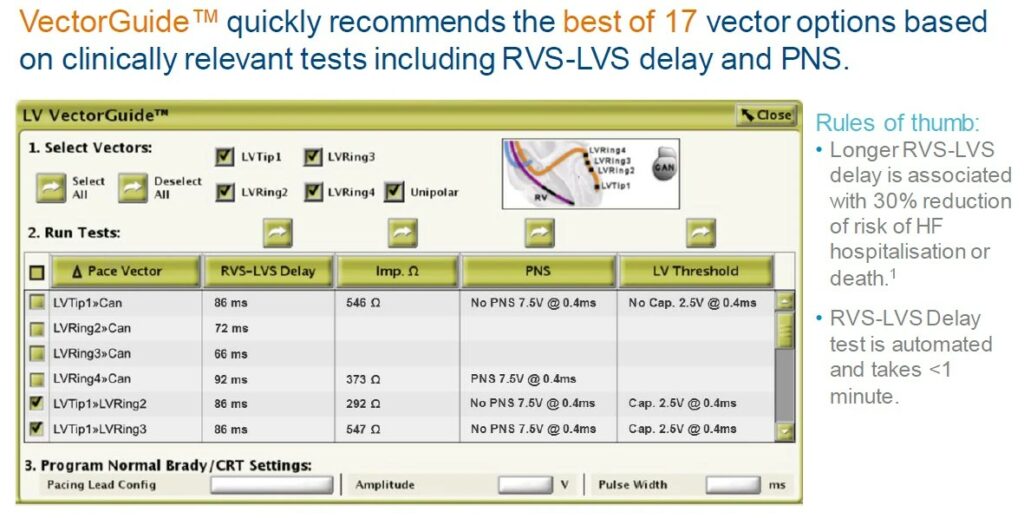
VectorGuide (Boston Scientific programmer) tests the vectors of a quadripolar LV lead: RVS-LVS delay, impedance, phrenic nerve stimulation (PNS) and LV threshold for each one. Every vector has its own impedance: 292 to 547 Ω in this example, where LVTip1>>LVRing2 measures less than LVRing4>>Can; in this patient it measures about three times more
Take home message
Each LV vector has its own impedance: a jump right after an office visit points first to a new pacing vector, not to a lead fault. Check what was programmed that day before suspecting the lead.