CRT with a dual chamber pacemaker using LBBAP
Patient
Go to the casebook version optimized for the mobile experience
When we talk about CRT, we often think of a triple-chamber device, with an RV lead and an LV lead through the coronary sinus. But left bundle branch area pacing (LBBAP) is rapidly becoming popular: coronary sinus access can be difficult, LV leads are not always stable, and the technique has matured.
His bundle pacing can correct the QRS perfectly, even a left bundle branch block, but it is too challenging and comes with many complications, so most implanters have abandoned it. LBBAP is feasible and a fun implant (seeing the QRS narrow while turning the lead by hand is very satisfying), stable, and associated with good results. Studies are ongoing, but most agree that it is a good alternative to the coronary sinus approach.
A 76-year-old man with a left bundle branch block, an LVEF of 30% and heart failure symptoms
Instead of a CRT-P, left bundle branch area pacing (LBBAP) with a dual-chamber pacemaker (ACCOLADE MRI EL): an atrial lead and an INGEVITY+ lead screwed into the left bundle branch area
Trace
The implant
The material, the lead and its guiding catheter; the 12-lead ECG while the lead is placed, screwed in and tested; then a 12-lead ECG with LBBAP.
- The lead: INGEVITY+, a stylet-driven pacing lead with an extendable-retractable helix at its tip, here screwed into the septum. Models 7840 (45 cm), 7841 (52 cm) and 7842 (59 cm). Image: Boston Scientific
- The guiding (delivery) catheter: SSPC NXT, in two curves, 2.5 and Y. Working length 42 cm; outer diameter 9 Fr (through a 9 Fr introducer), inner diameter 7 Fr; a radiopaque tip, which shows the tip of the catheter and of the lead under fluoroscopy; a white hub with a haemostatic seal and a side flush port. The dilator comes with the catheter; the universal cutter (to slit the catheter off the lead) and the 0.035” guide wire are packaged separately. Image: Boston Scientific
- Mapping, before screwing: pacing from the lead tip on the right side of the septum. Lead II positive, lead III negative, and a notch (slurring) in V1: the ideal pattern to start screwing
- While the lead is screwed into the septum, fixation beats appear: premature beats from the Purkinje fibres, a sign that the tip is reaching the conduction system
- Final position, bipolar pacing: a narrow paced QRS with a terminal R’ in V1, the RV being activated last
- Short LV activation time: under 80 ms from the pacing spike to the peak of the R wave in V6. The left bundle branch is captured
- A 12-lead ECG with LBBAP: every complex follows a pacing spike and stays narrow
8 months later
A remote transmission arrives 8 months after the implant, with an alert. The patient was last seen in the office 3 months after the implant.
- Alert: a nonsustained VT at 174 bpm, the day before the transmission. With an LVEF of 30%, a reason to check the LVEF again once the heart is resynchronized
- The LBBAP lead (Ventricular): threshold 0.5 V three months after the implant and 0.7 V on the daily test, impedance 375 and 345 Ω: a stable lead. No R wave can be measured (N/R): the ventricles are always paced
- DDD 60-130 and RYTHMIQ off. Keep it off: when spontaneous AV conduction is found, RYTHMIQ (AAI with a VVI backup) would let the left bundle branch block come back. The goal is to pace the left bundle, to resynchronize
- Paced AV delay 80-180 ms, sensed AV delay 65-150 ms (dynamic: shorter at faster rates): here the ventricles stay paced. If conducted beats appear, a shorter AV delay makes sure the whole LV is captured from the left bundle
- Ventricular output 3.5 V @ 0.4 ms, its threshold measured every day (Trend); unipolar pacing and bipolar sensing. Outputs and sensing are programmed as in any dual-chamber pacemaker. Autothreshold is switched off but could be used in LBBAP leads
- V paced 99% since the implant. With LBBAP, every ventricular paced beat is a resynchronized beat: the % of ventricular pacing is the % of CRT
- Daily trend: the ventricles are paced close to 100% every day (red line, at the top); atrial pacing varies from day to day (blue)
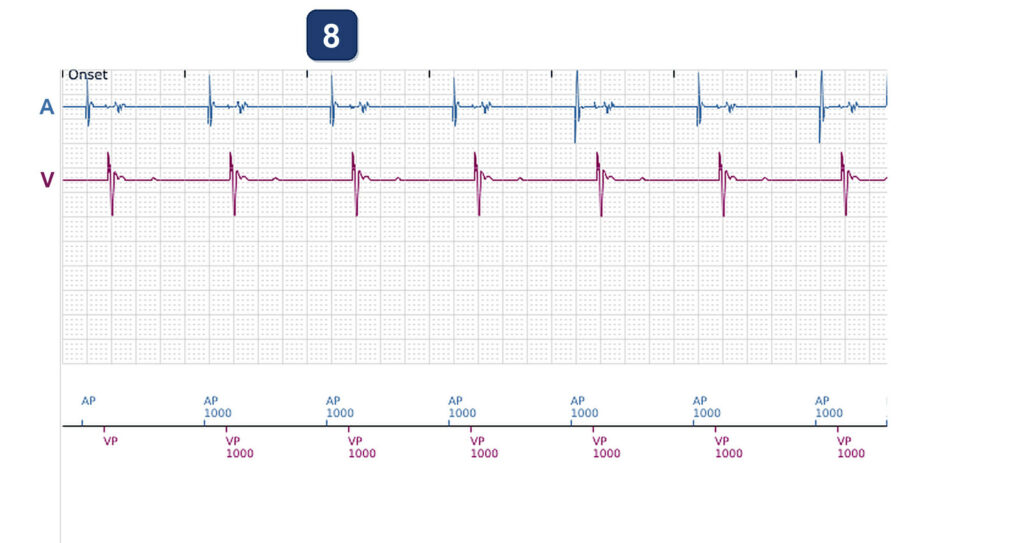
- The presenting EGM: atrial and ventricular pacing at 60 bpm (AP-VP 1000 ms). Every beat is a left bundle paced beat
- The automatic threshold test of the LBBAP lead: the output steps down from 0.9 V, each test pulse followed by a backup pace (VP-BP). At 0.6 V the evoked response (bottom channel) changes: loss of capture (LOC). Threshold 0.7 V: LBBAP leads work with automatic capture
- The PMT stored at 130 bpm, about 3 months after the implant: a sinus tachycardia at about 132 bpm (AS), tracked at the maximum tracking rate (VP-MT, 130 bpm)
- After 16 VP-MT, the PMT algorithm withholds tracking for one beat (PMT-B): the atrial event falls in the extended PVARP, (AS), and the beat conducts (VS), a beat without left bundle pacing. As in CRT, a stored PMT is often a sinus tachycardia above the MTR
Comments
LBBAP with a dual-chamber pacemaker, instead of a CRT-P, for a left bundle branch block with an LVEF of 30%: at the implant, a narrow paced QRS with an R’ in V1 and a short LV activation time. Eight months later, a stable lead whose automatic threshold test works, 99% ventricular pacing (= 99% CRT) with RYTHMIQ off, a nonsustained VT, and a stored PMT that was a sinus tachycardia above the MTR
Points to remember
- LBBAP is a good alternative to the coronary sinus approach: here a dual-chamber pacemaker with a lead in the left bundle branch area resynchronizes the heart, instead of a CRT-P
- With LBBAP, the % of ventricular pacing is the % of CRT: conducted beats and PVCs are beats without resynchronization
- Do not switch on RYTHMIQ, or AV Search+, when spontaneous AV conduction is found: the goal is to pace the left bundle
- For the rest, the follow-up is that of a regular dual-chamber pacemaker: automatic sensitivity (AGC) and automatic capture work on an LBBAP lead, and sometimes a shorter AV delay is needed for full LV capture
- As in CRT patients, a PMT stored at the maximum tracking rate is often a sinus tachycardia above it
Take home message
After LBBAP for resynchronization, read the % of ventricular pacing as the % of CRT, and keep RYTHMIQ and AV Search+ off: every conducted beat brings the left bundle branch block back
Read more about related topics