


Microport - Therapies
Content
Introduction
In this chapter pertaining to therapies, we no longer describe the counting of events which has been detailed in the corresponding chapter. Similarly, discrimination will not be discussed.
The tracings herein will be presented logically beginning with ventricular fibrillation, followed by tachycardias observed in the VT zone. We will describe the sequence of therapies that are called upon according to the programming of the device.
Functioning principles
1 - Initiation of therapies
A VF zone therapy is initiated when the VF majority and the VF persistence are reached.
a. For stable rhythms in the Fast VT zone, the ATP is applied in first intention rather than a shock according to the following additional criteria:
- The rhythm is stable to within 30 ms, and
- The last 4 coupling intervals are all in the Fast VT section
If the ATP is effective, there is no unnecessary charge of the capacitors.
b. For unstable VF or rhythm, the first-line therapy is shock
A therapy in the VT zone is initiated when the VT majority and the VT persistence are reached. The tachycardia rate (average of the last 4 tachycardia cycles) directs the therapy in either the Slow or “conventional” VT zone.
c. VT persistence + Rate in conventional VT zone → Initiation of a conventional VT therapy.
d. VT persistence + Rate in the Slow VT zone → Initiation of a Slow VT therapy.
2 - Level of aggressiveness of the therapies
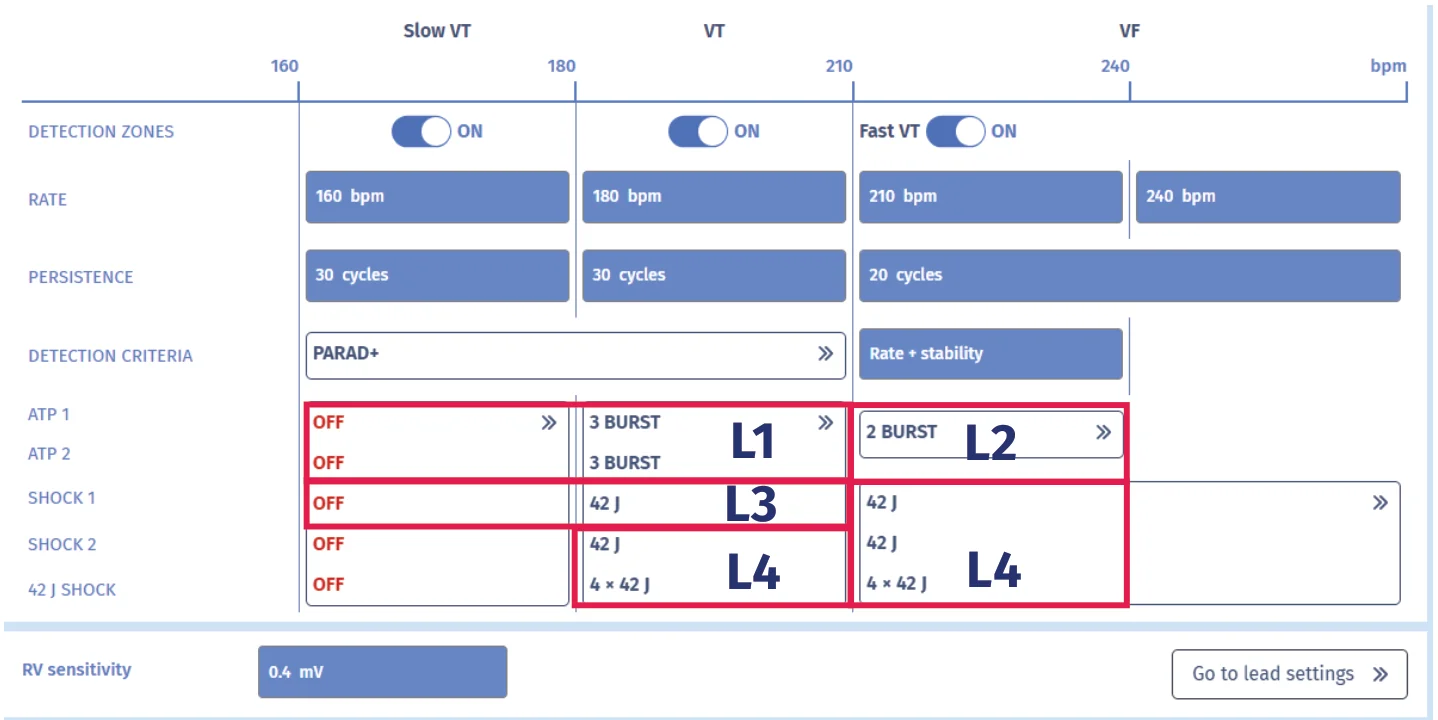
In a same episode, the ensuing initiated therapy program should always have a degree of aggressiveness greater than or equal to that of the previously called upon therapy program. The increasing order of aggressiveness is as follows:
- Level 1: the 2 ATP in the Slow VT zone and the 2 ATP in the conventional VT zone (ATP 1 and ATP 2).
- Level 2: ATP in the Fast VT zone.
- Level n: Shocks in order of increasing energy.
3 - Management of ATP program interruptions and capacitor charge interruptions
An ATP program is interrupted and/or ended by:
- The return to “Slow Rhythm” (Slow Rhythm Majority identified), or
- The complete delivery of the program, or
- The exceeding of the ATP Minimum cycle length or the ATP Time limit, or
- A change of zone:
- acceleration of the rhythm (Other therapy available in the “new” zone → initiation of this therapy)
- deceleration of the rhythm (Other therapy available in the “new” zone → initiation of this therapy).
A temporary interruption of the charge occurs if:
- A cycle outside of the Tachy/VF zone (Slow) has just been detected (the charge can be resumed after detection of a Fast cycle), or
- A SVT/ST Majority, No Majority or VTLC Majority with at least one long cycle over the last 24 cycles.
The charge is definitely halted when:
- The Slow Rhythm Majority is identified, or
- the stored energy level has reached the programmed value, or
- the charging time reaches 40 seconds.
Note: The calculation of the charge time is measured from the time of the last charge onset (without interruption) up to the cycle preceding the delivery of the shock. The measurement accuracy is = 0.125 ms.
4 - Delivery of therapies
An ATP (other than the ATP in the Fast VT zone) is delivered when:
- The cycle is VT, the majority rhythm is VT and the VT persistence counter reaches the programmed limit*, and
- The tachycardia rate (average of the last 4 tachycardia cycles) corresponds to that which led to the initiation of therapy.
A shock is delivered when:
- The capacitors are no longer charging and have reached a charge level corresponding to the programmed energy, and
- The cycle is VF, the majority rhythm is VF and the VF persistence counter reaches the programmed threshold*, or the cycle is VT, the majority rhythm is VT and the VT persistence counter reaches the programmed limit*.
*: Avoids the inappropriate application of therapy for an accelerating or slowing rhythm.
5 - Post-shock redetection
After a shock, a blanking period is triggered for one second. The persistence counters are not reset. The first RR cycle is not taken into account in the stability and association criteria. The acceleration is forced to “Ventricular”. It takes a minimum of 6 redetection cycles to obtain a “Majority”. If the latter corresponds to VT or VF, associated with its persistence counter which has exceeded the threshold, the device can then initiate the remainder of the therapy program or the following program.
The management of available therapies is based on an increasing order of aggressiveness. The next called-upon therapy program should always have a level of aggressiveness greater than or equal to that of the previously called-upon therapy program.
6 - Post-ATP redetection
After an ATP, the persistence counters are not reset. Acceleration is forced to “Ventricular”. A minimum of 6 redetection cycles are required to obtain a “Majority”. If the latter corresponds to VT or VF, associated with its persistence counter which has exceeded the threshold, the device can then initiate the remainder of this therapy program or the next therapy program.
The management of available therapies is based on an increasing order of aggressiveness. The next called-upon therapy program should always have a level of aggressiveness greater than or equal to that of the previously called therapy program.
7 - ‘Special’ post-therapy redetection (rejection of sinus tachycardias)
The purpose of this function (which does not have a name) is to not continue to treat a dissociated ventricular arrhythmia during a return to normal, albeit tachycardia, rhythm.
The following two situations can be identified:
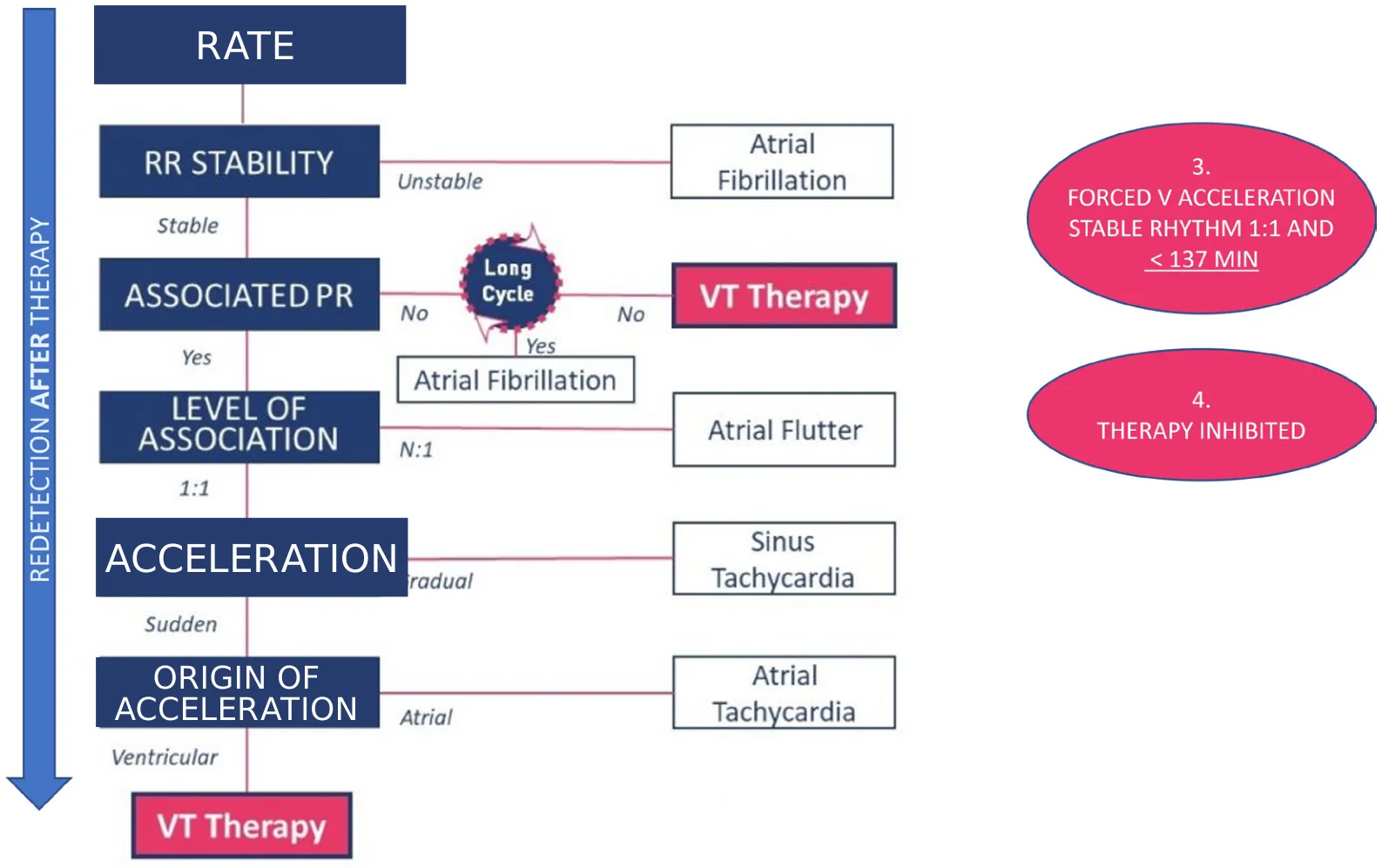
- A dissociated VT treated and followed by a stable 1:1 associated rhythm is most likely a VT followed by a ST (and not followed by a 1:1 VT which is less likely). This situation does not require further therapy.
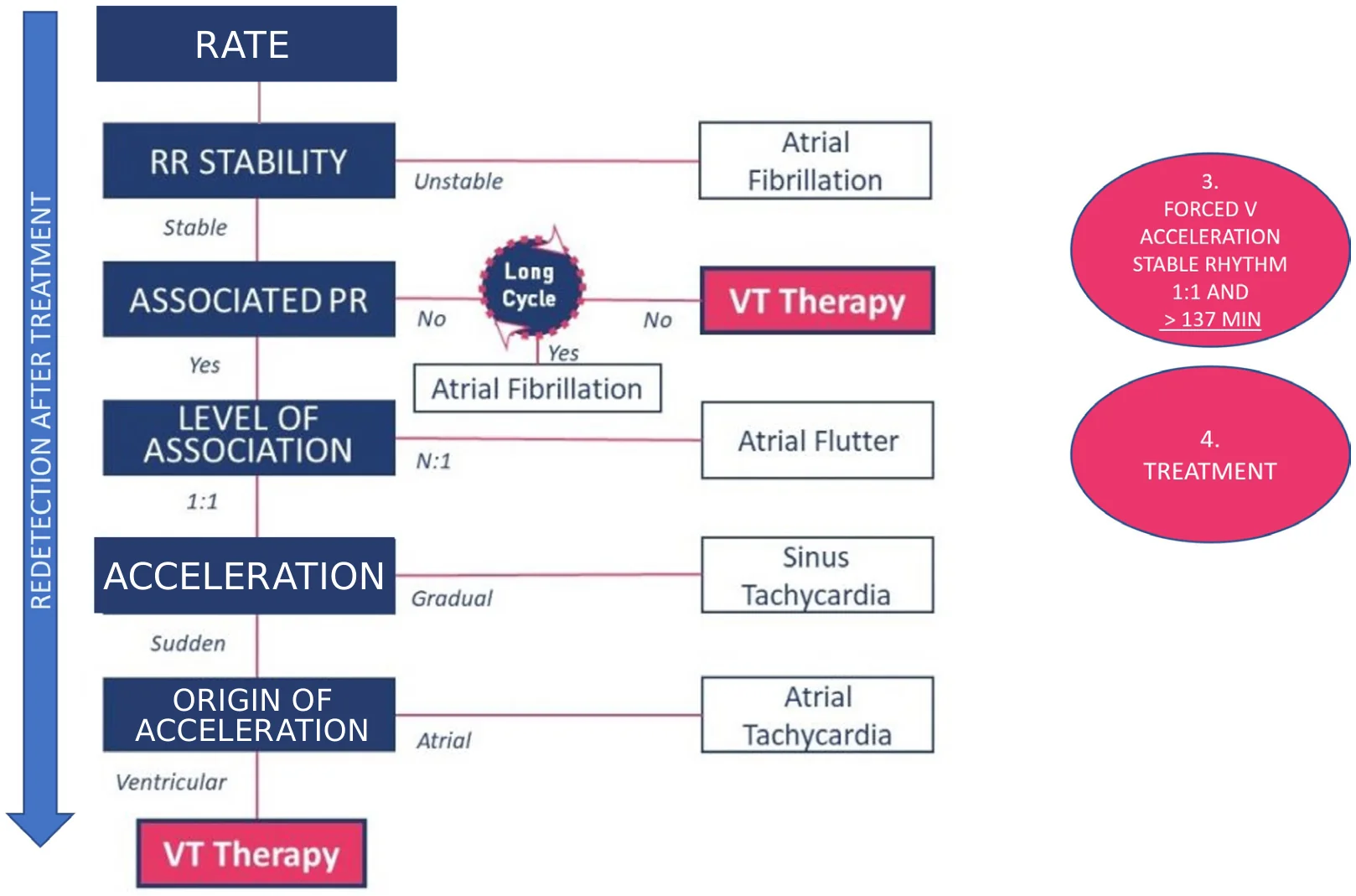
- A VT with retrograde 1:1 conduction treated and followed by a stable 1:1 associated rhythm is most likely a VT followed by a ST or by this 1:1 VT (treated ineffectively). This situation requires further therapy.
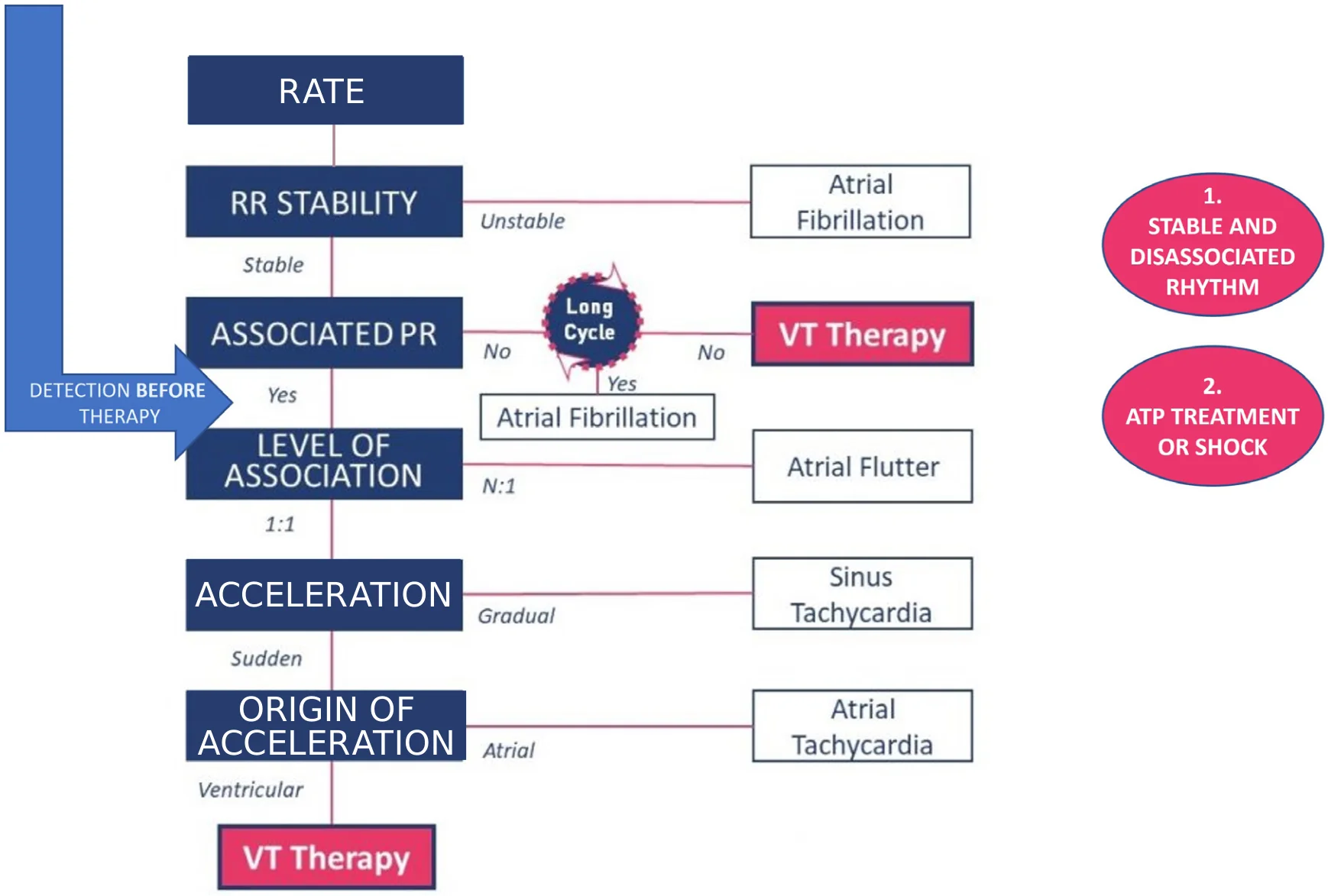
The therapy inhibition rule is therefore the following. If a stable and dissociated ventricular tachycardia rhythm is treated (ATP or shock) (acceleration is forced to V) and is followed by a stable tachycardia rhythm which is 1:1 associated and below 137 bpm, then the therapy programs are inhibited as long as these last 2 conditions persist.
Situation before therapy
Situation 1 after therapy: inhibition
Situation 2 after therapy: new therapy
8 - Return to sinus rhythm
The return to sinus rhythm is obtained when at least 75% of the last 8 cycles are slower than the tachycardia zones or are paced (even those paced in the Tachy zone). The episode is terminated and stored in memory.
For more information on Therapies in MicroPort ICDs, please see: 5. Therapies – MicroPort Academy.