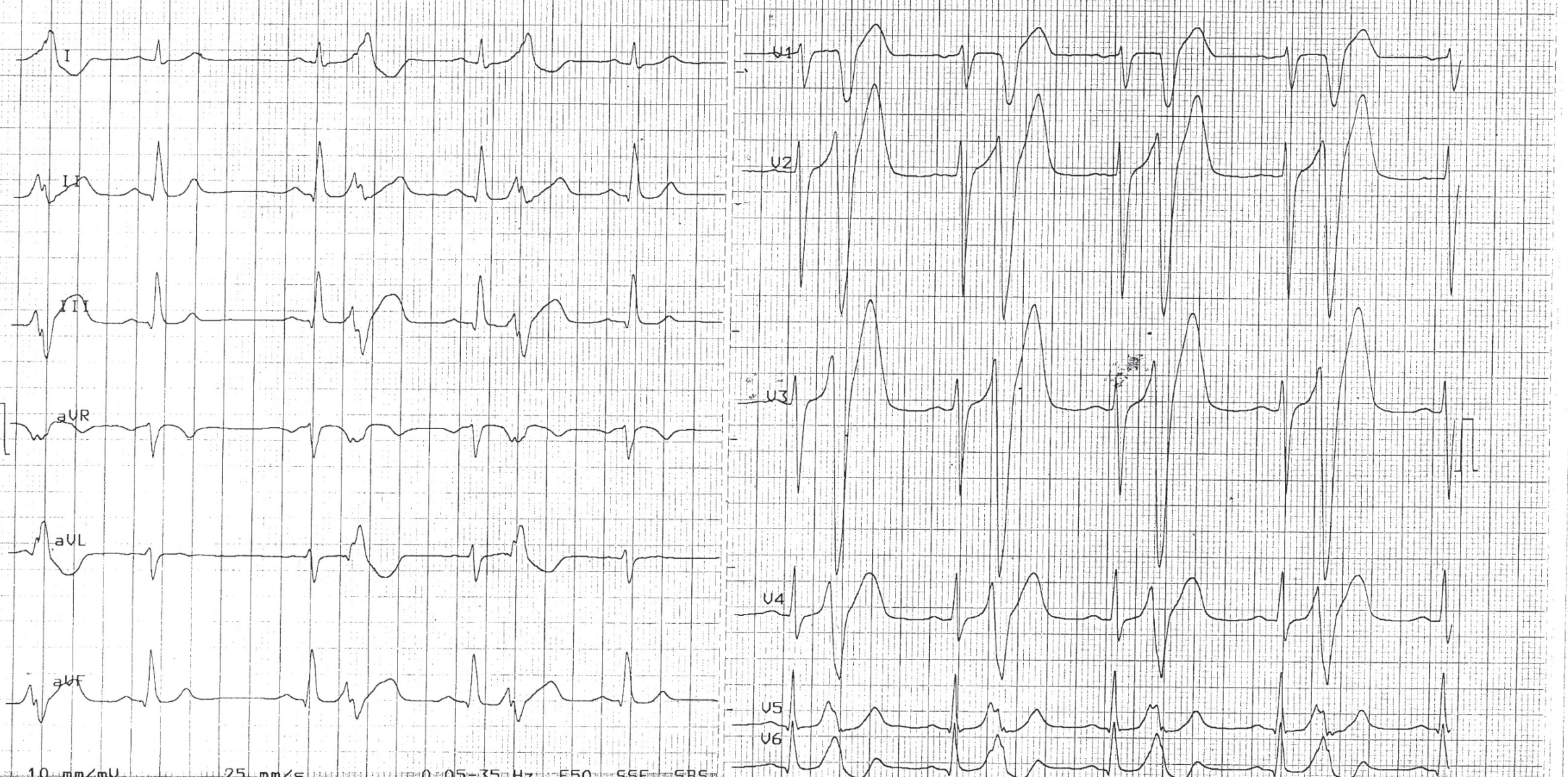
Trace 8.12 : L'ESV et le risque de fibrillation ventriculaire
Informations destinées aux patients
Homme de 48 ans présentant des antécédents d'infarctus du myocarde inférieur ; hospitalisation à la suite de deux épisodes de syncope traumatique ; enregistrement de ce tracé ;
ECG
Question
Sur cet ECG, on observe :
Commentaires
Description de l'ECG
Rythme sinusal (onde P positive dans les dérivations I, II, V5, V6 et négative dans aVR) ; complexe QRS étroit avec infarctus inférieur probable ; extrasystoles ventriculaires très précoces, puisqu'elles surviennent dans la phase ascendante initiale de l'onde T ; schéma de retard gauche, axe supérieur, avec une origine ventriculaire droite très probable compte tenu de la transition retardée (en V5) ;
Explication
Le tracé observé sur cet enregistrement correspond à une extrasystole extrêmement précoce, provenant du réseau de Purkinje distal du ventricule droit et provoquant une fibrillation ventriculaire. Le réseau de Purkinje s'étend dans l'endocarde et se divise en une branche ventriculaire droite fine et deux branches ventriculaires gauches plus épaisses, dotées de nombreuses ramifications permettant une activation rapide de la masse ventriculaire. Il existe actuellement un certain nombre d’études démontrant le rôle central du réseau de Purkinje dans la genèse et le maintien des fibrillations ventriculaires conduisant à la mort subite. La nature arythmogène des cellules du réseau de Purkinje réside dans une plus grande sensibilité à la post-dépolarisation précoce par rapport aux cellules myocardiques environnantes. Le profil des extrasystoles provenant du réseau de Purkinje ventriculaire droit est relativement homogène, tandis qu’il est plus variable pour le réseau de Purkinje ventriculaire gauche en raison d’une arborisation plus riche et plus complexe. Au cours d’une étude électrophysiologique, un potentiel caractéristique peut être enregistré au niveau du réseau de Purkinje responsable de l’arythmie ; il s’agit de la cible privilégiée pour les procédures d’ablation.
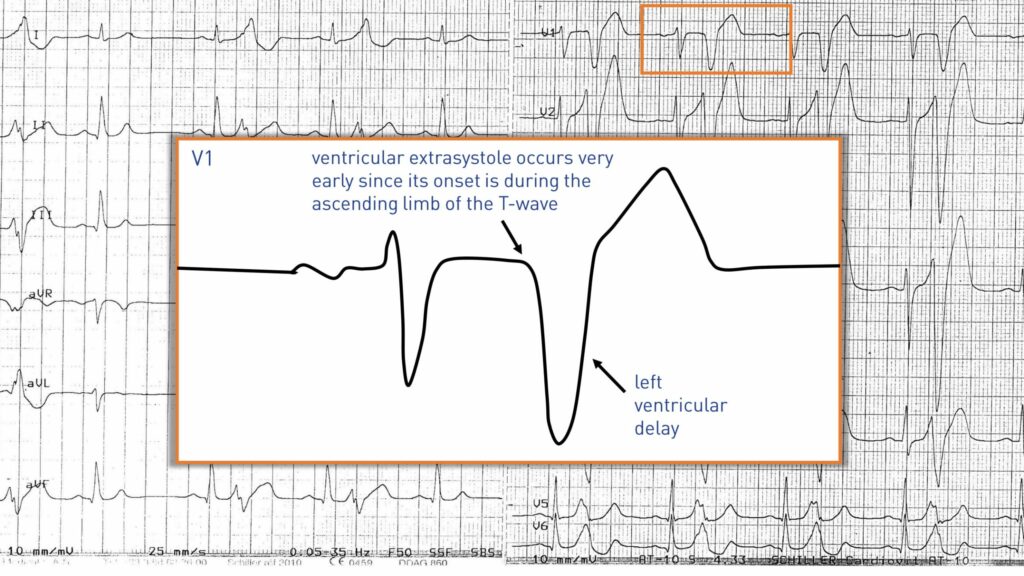
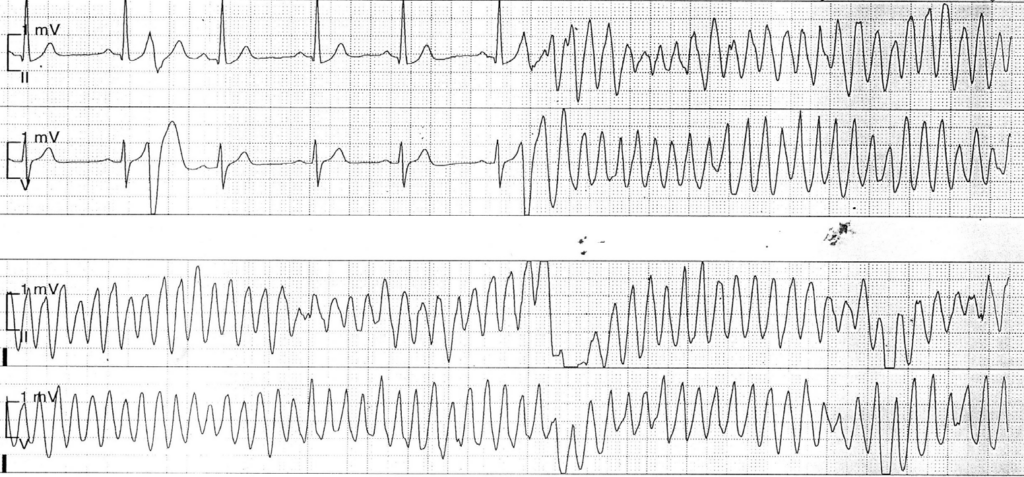
Description du tracé
Données de télémétrie et tracé enregistrés lors d'un arrêt cardiovasculaire nécessitant un choc électrique d'urgence ; extrasystole ventriculaire identique au tracé précédent, entraînant une dégénérescence du rythme en fibrillation ventriculaire ;
À retenir
On distingue deux types distincts de déclenchement de la fibrillation ventriculaire : 1) comme sur ce tracé, une fibrillation ventriculaire d'apparition soudaine, survenant lors d'une extrasystole ventriculaire plus ou moins précoce ; 2) un épisode initial de tachycardie ventriculaire évoluant ensuite vers une fibrillation ventriculaire.