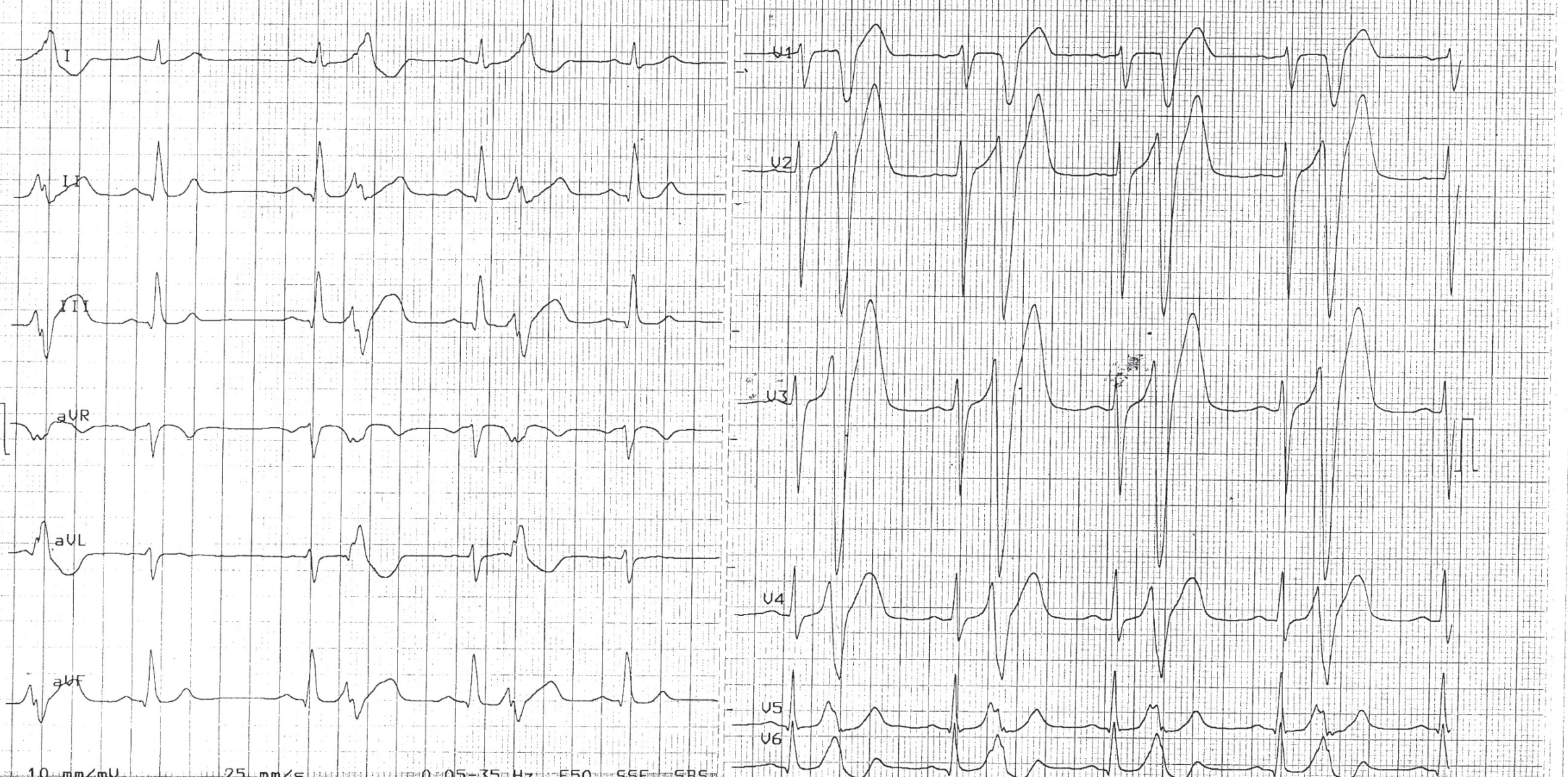
Trace 8.12: PVC and the risk on ventricular fibrillation
Patient information
48-year-old man with history of inferior infarction; hospitalization following the occurrence of 2 episodes of traumatic syncope; recording of this tracing;
ECG
Question
On this ECG, we can find:
Comments
ECG description
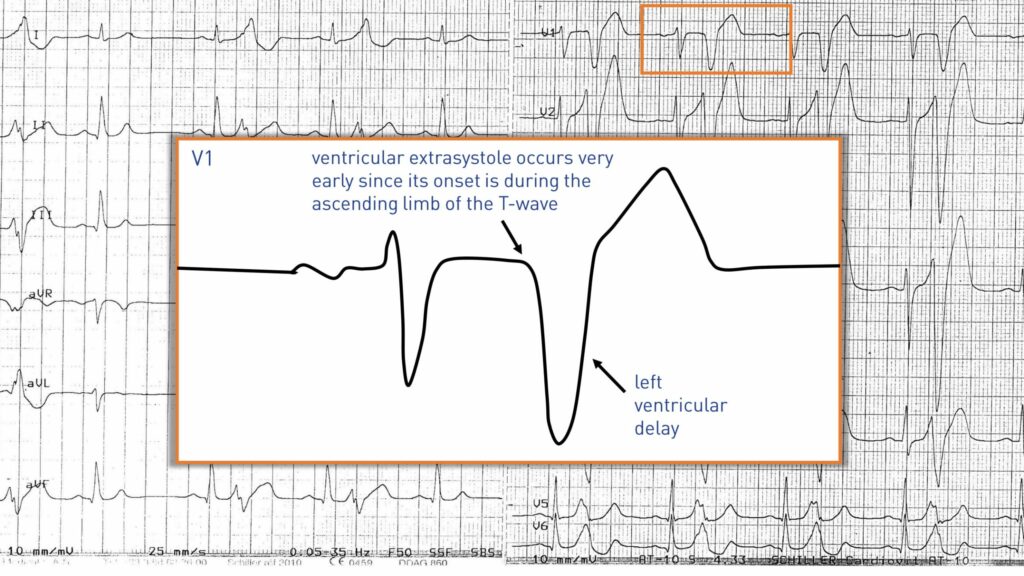
Sinus rhythm (positive P wave in leads I, II, V5, V6 and negative in aVR); narrow QRS with probable inferior infarction; very early ventricular extrasystoles since occurring in the initial ascending phase of the T wave; left delay pattern, superior axis, with very probable right ventricular origin given the delayed transition (in V5);
Explanation
The pattern found on this tracing corresponds to an extremely early extrasystole, originating from the distal right ventricular Purkinje network generating a ventricular fibrillation. The Purkinje network runs in the endocardium and divides into a thin right ventricular branch and two thicker left ventricular branches with numerous ramifications allowing rapid activation of the ventricular mass. There are currently a number of studies demonstrating the central role of the Purkinje network in the genesis and maintenance of ventricular fibrillations leading to sudden death. The arrhythmogenic nature of the cells in the Purkinje network resides in a greater sensitivity to early post-depolarization relative to surrounding myocardial cells. The pattern of the extrasystoles originating from the right ventricular Purkinje is relatively homogeneous whereas the pattern is more variable for the left ventricular Purkinje due to a richer and more complex arborization. During an electrophysiological study, a characteristic potential can be recorded at the level of the Purkinje network responsible for the arrhythmia; it is the preferred target for ablation procedures.
Trace description
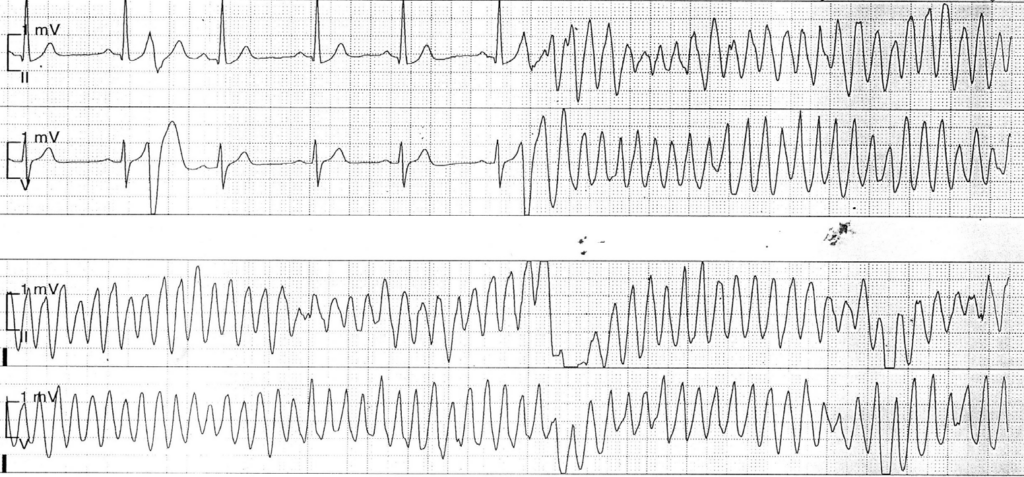
Telemetry monitoring and tracing recorded during a cardiovascular arrest necessitating an emergency electrical shock; ventricular extrasystole identical to the previous tracing causing a degeneration of the rhythm into ventricular fibrillation;
To remember
There are two distinct types of initiation of ventricular fibrillation: 1) as on this tracing, inaugural ventricular fibrillation with abrupt onset on a more or less early ventricular extrasystole; 2) initial episode of ventricular tachycardia subsequently degenerating into ventricular fibrillation.