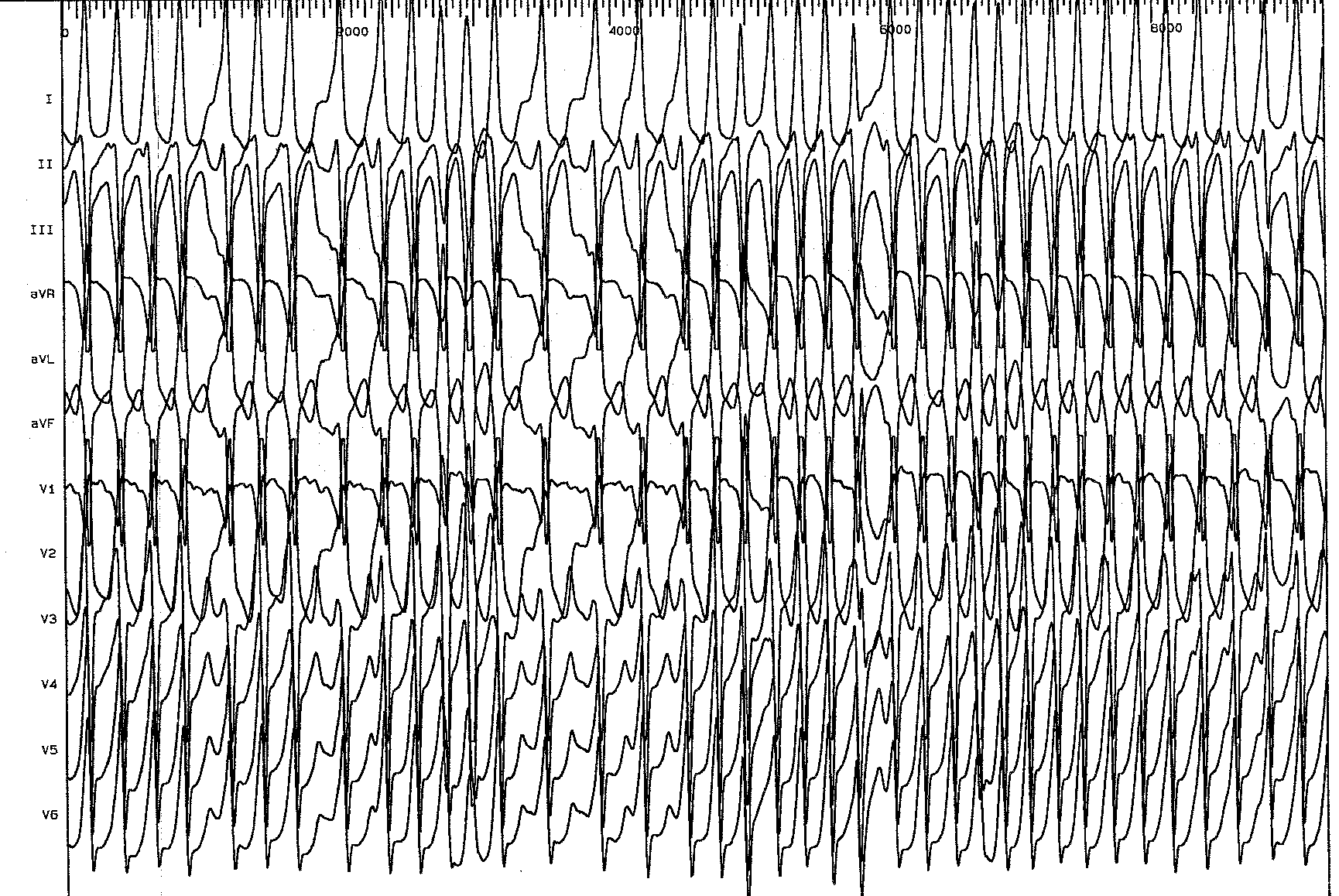
Une étude électrophysiologique a été réalisée afin de mesurer les périodes réfractaires antérogrades de la voie accessoire ; une stimulation auriculaire rapide et l'injection d'isoprotérénol ont été effectuées pour favoriser la conduction dans la voie accessoire ; tracé typique d'une fibrillation auriculaire due à une voie accessoire, présentant un motif caractéristique en accordéon ; présence de cycles RR très courts ;
Le syndrome de Wolff-Parkinson-White est parfois considéré comme bénin et un traitement est généralement proposé chez les patients symptomatiques présentant des épisodes de tachycardie réciproque. Cependant, comme nous l’avons vu précédemment, l’incidence de la fibrillation auriculaire est élevée malgré l’absence de signes évidents de cardiopathie organique. L’apparition de ce type d’arythmie peut aggraver le risque de danger de mort pour le patient, une réponse ventriculaire très rapide sur une voie accessoire très perméable (période réfractaire antérograde très courte) pouvant potentiellement dégénérer en fibrillation ventriculaire mortelle.
La difficulté dans la prise en charge des patients présentant une voie accessoire réside dans le fait qu’un épisode de fibrillation auriculaire rapide entraînant une mort subite peut constituer la première manifestation de la maladie et survenir chez un patient jusque-là asymptomatique. L'identification des patients à risque reste difficile, même s'il est reconnu que le risque de mort subite est le plus élevé chez les patients présentant une période réfractaire antérograde très courte (inférieure à 220 ms).
Face à un patient présentant un épisode de fibrillation auriculaire dû à une voie accessoire, le traitement curatif repose sur une cardioversion d’urgence en cas d’instabilité hémodynamique, ou sur des antiarythmiques de classe IC ou l’amiodarone si l’hémodynamique est préservée. En revanche, les médicaments bloquant la conduction nodale sans ralentir la conduction par la voie accessoire (adénosine, inhibiteurs calciques, bêtabloquants, digitaliques) sont formellement contre-indiqués.
La présence d'un complexe QRS pré-excité associé à des cycles RR très courts lors d'une étude électrophysiologique, ou la survenue d'un épisode de fibrillation auriculaire dont les manifestations cliniques sont peu évidentes, constituent une indication incontestable d'ablation par radiofréquence.
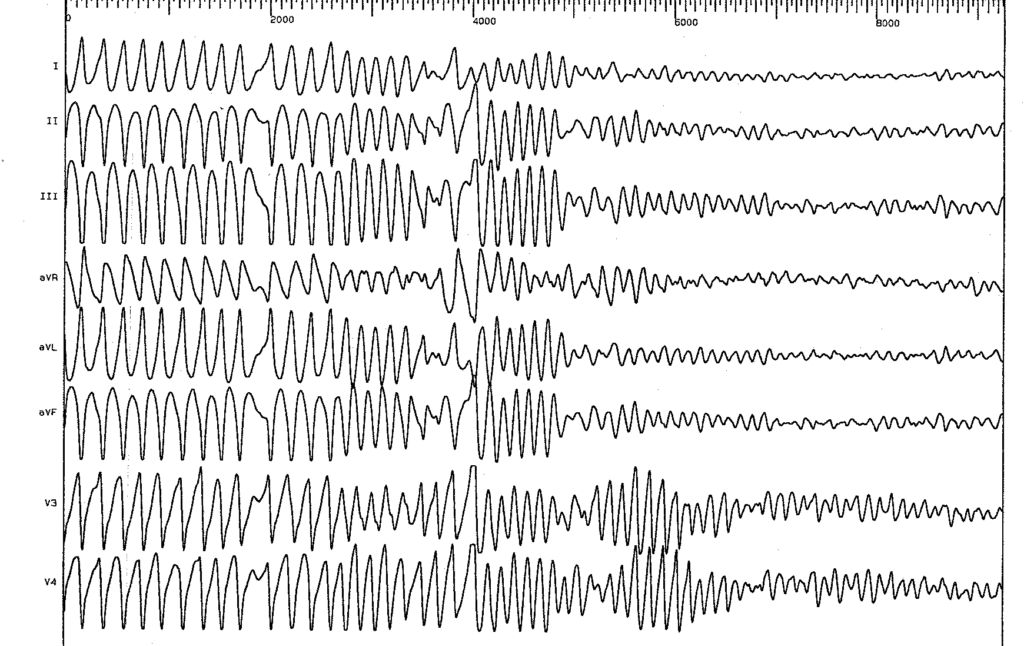
Description du tracé
Cycles RR extrêmement courts ; dans la deuxième partie du tracé, le rythme dégénère en fibrillation ventriculaire (activité désorganisée) ; perte de conscience du patient ; un choc électrique est donc nécessaire pour rétablir un rythme sinusal efficace ;
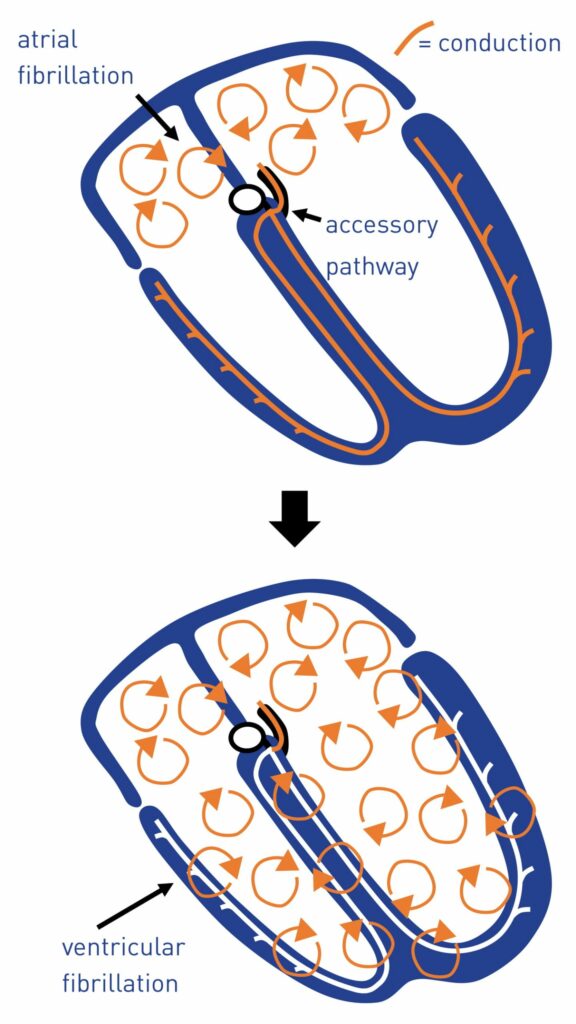
La présence d'une fibrillation auriculaire se propageant rapidement par la voie accessoire constitue le facteur pronostique déterminant chez ces patients. Une période réfractaire antérograde courte expose le patient à un risque de mort subite et constitue une indication formelle d'ablation.