


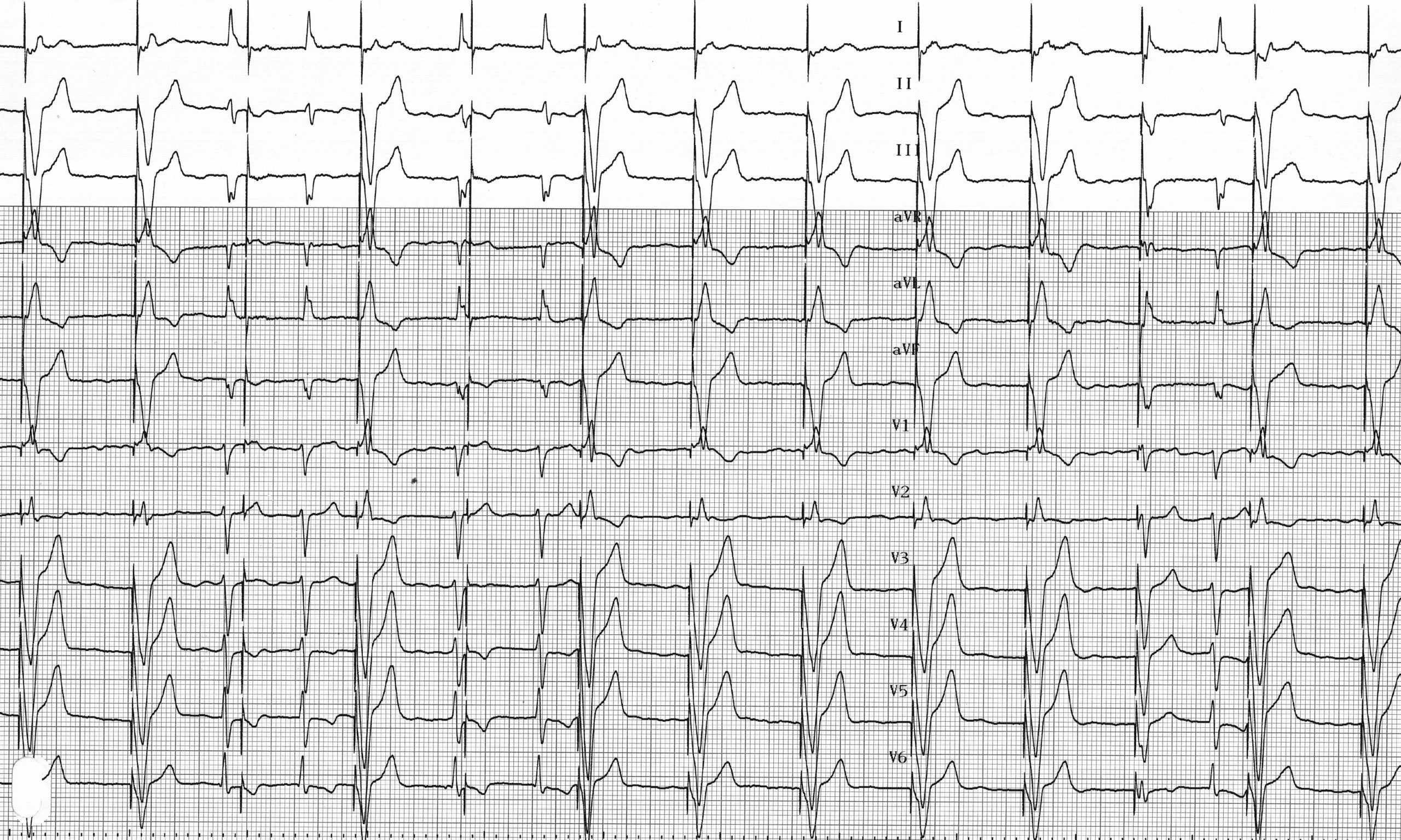
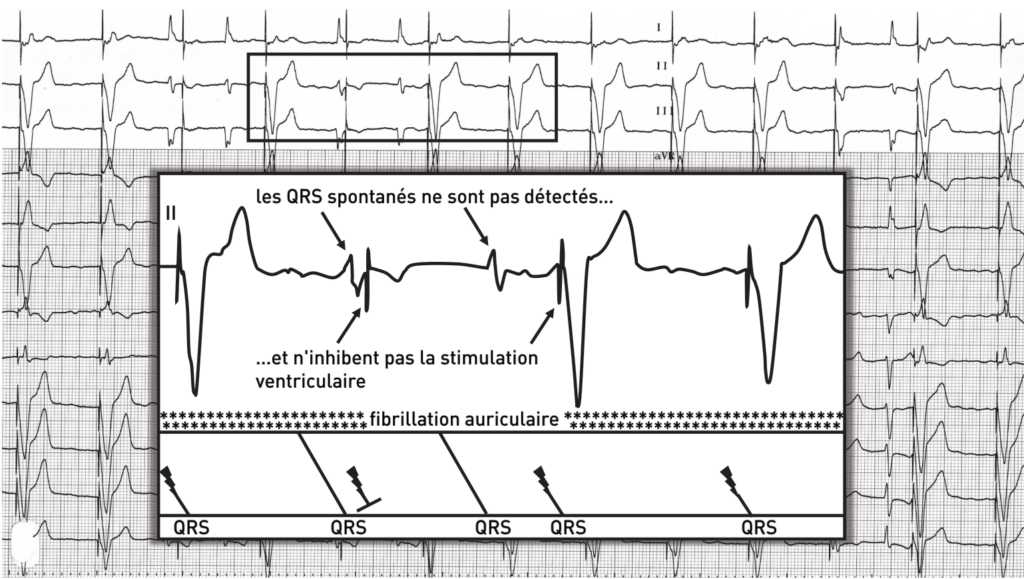
Ce tracé révèle une sous-détection ventriculaire, ce qui peut parfois entraîner une stimulation pendant la période de vulnérabilité. En l’absence d’une détection adéquate, le stimulateur cardiaque fonctionne en mode asynchrone, ce qui rend impossible l’inhibition des contractions ventriculaires spontanées. Il existe un risque théorique faible, mais non nul, de provoquer une arythmie ventriculaire polymorphe maligne susceptible de compromettre la survie du patient. De plus, cette stimulation inutile entraîne une consommation d’énergie qui nuit à la durée de vie du dispositif.
La sensibilité, exprimée en millivolts (mV), décrit la capacité du stimulateur cardiaque à détecter correctement les événements cardiaques spontanés. Un stimulateur cardiaque est équipé de filtres d'entrée qui détectent spécifiquement les ondes P dans l'oreillette et les ondes R dans le ventricule, en s'appuyant sur l'analyse de trois caractéristiques de ces signaux électriques : le spectre de fréquences, la pente et l'amplitude.
Une programmation adéquate du niveau de sensibilité doit permettre de détecter tous les événements cardiaques spontanés survenant dans la cavité implantée, tout en évitant la détection d’événements d’autres types (interférences avec la détection de signaux cardiaques provenant de l’autre cavité, myopotentiels, parasites, etc.). La programmation pour une détection bipolaire augmente la spécificité de la détection par rapport à la détection unipolaire en limitant le risque de capter des signaux extracardiaques ou des interférences, et permet de programmer des valeurs de sensibilité élevées. En revanche, dans une configuration unipolaire, le risque de détection croisée ou de captation de signaux extracardiaques nécessite de programmer un niveau de sensibilité plus faible, ce qui entraîne un risque accru de sous-détection.
Traditionnellement, contrairement aux défibrillateurs, les stimulateurs cardiaques fonctionnaient avec une sensibilité stable et fixe tout au long du cycle cardiaque. De plus en plus, même si les exigences en matière de détection ne sont pas les mêmes (il est essentiel pour un défibrillateur de détecter et de traiter des arythmies ventriculaires très rapides, polymorphes et de l'ordre du microvolt), les stimulateurs cardiaques modernes offrent une sensibilité adaptative (un niveau de sensibilité qui varie en fonction de l’amplitude de l’onde R ou de l’onde P détectée) avec une augmentation progressive de la sensibilité au cours du cycle cardiaque (ce qui permet de détecter des signaux de faible amplitude sans détecter de manière excessive l’onde T).
Le réglage d'une sensibilité ventriculaire adaptative plus adaptée a permis de résoudre le problème chez ce patient.
English English English French English English English French