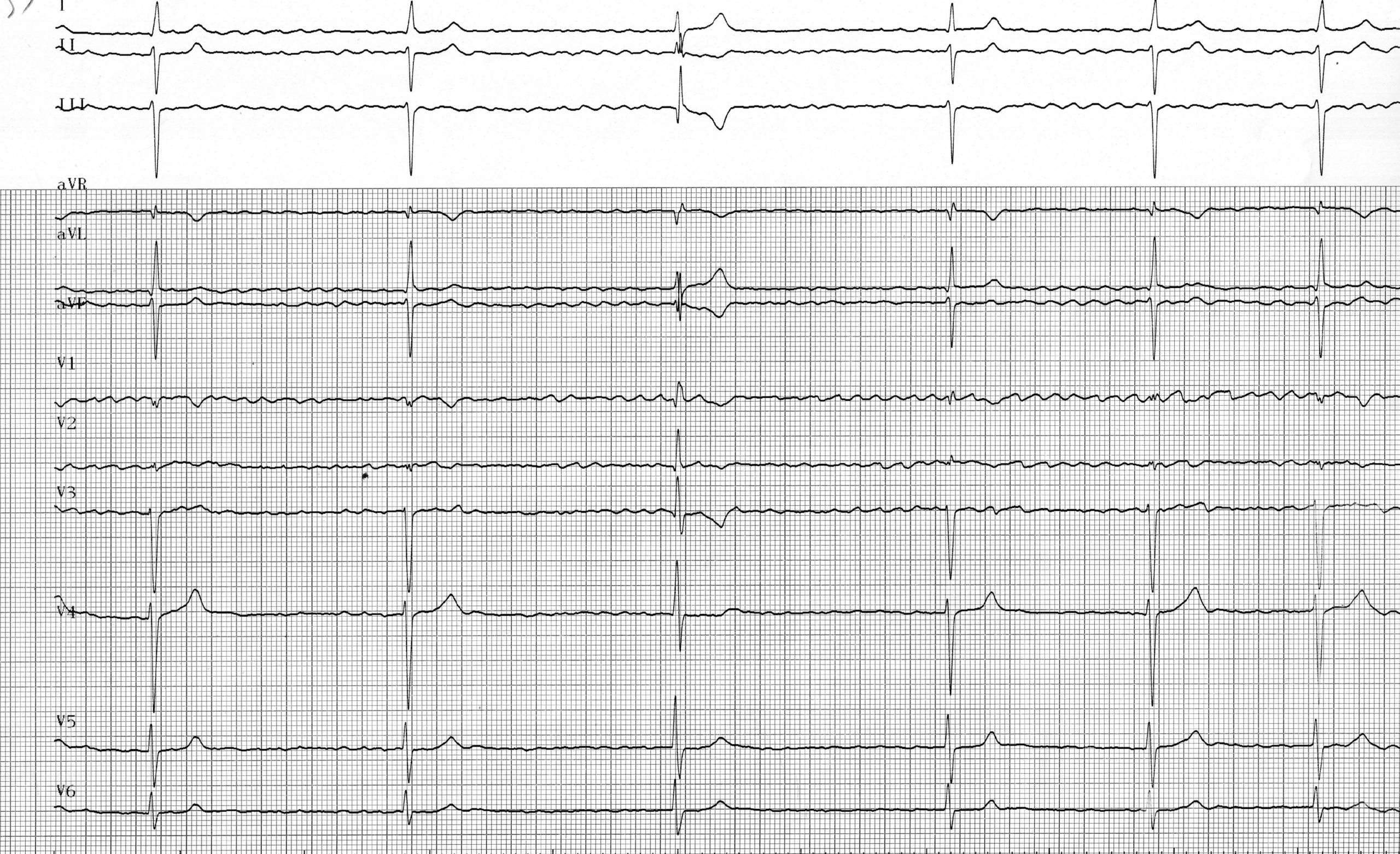
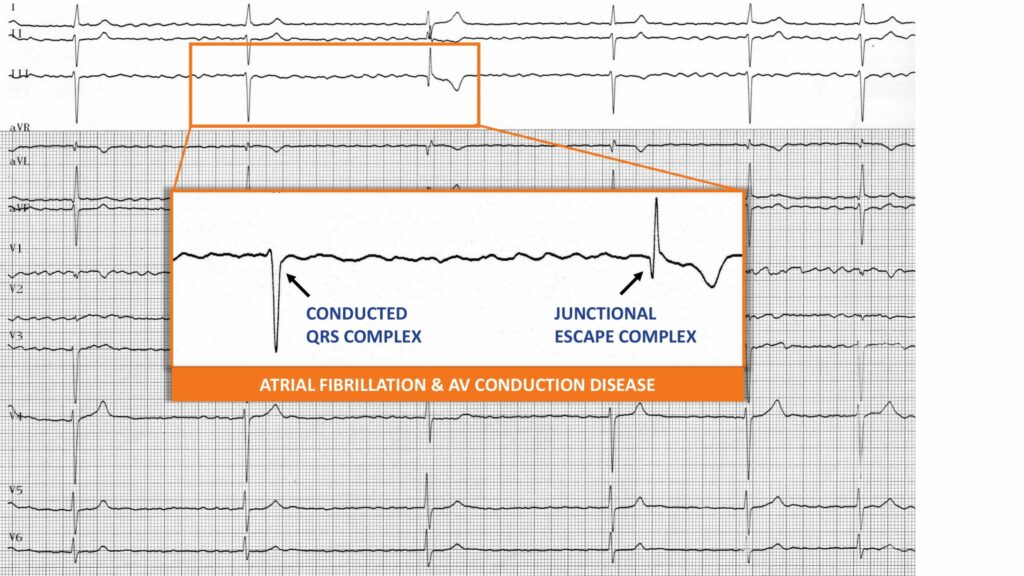
Trace 1.11: Atrial fibrillation and atrioventricular conduction trouble
Patient information
83-year-old man; hospitalized for syncope;
ECG
Question
Which answer(s) is(are) true?
Comments
ECG description
Atrial fibrillation: very rapid atrial activity, polymorphic, disorganized with baseline tremor; ‘slow AF’ corresponding to conducted AF (irregular narrow ventricles) but with altered atrioventricular conduction (very slow ventricles); the third complex probably corresponds to a junctional escape rhythm (narrow QRS with a slightly different pattern compared to the conducted QRS complexes);
Explanation
This patient has atrial fibrillation with slow atrioventricular conduction. During an AF episode with preserved atrioventricular conduction, ventricular rhythm is generally irregular, rapid and greater than 100 bpm, although remains much lower than that of the atria. There is indeed a functional “block” at the junction due to the duration of the refractory period of the atrioventricular node. There are, however, certain peculiarities to be known. The ventricular rate can be very slow, as in this patient, with a rate of less than 40 bpm. A regular ventricular bradycardia suggests the presence of a complete AV block with total interruption of conduction accompanied most often by a junctional escape rhythm. An irregular ventricular rhythm tends to favor a highly altered, albeit consistent, conduction. In both cases, when the patient is symptomatic due to a very slow ventricular rate, the indication for pacemaker implantation is indisputable.
To remember
The diagnosis of atrial fibrillation should be focused on the evidencing of an irregular, disorganized and very rapid atrial activity. The presence of a rapid and irregular ventricular rate is common but is not a prerequisite for diagnosis. Indeed, as in this patient, the ventricular rate may be slow and relatively regular in the presence of an atrioventricular conduction disorder.