Remote real-time EGM in a dialysis patient
Patient
Go to the casebook version optimized for the mobile experience
AUTOGEN CRT-D in a 78-year-old man with chronic AF and complete AV block, on dialysis for chronic renal failure
Remote monitoring (LATITUDE): alert for a drop in the BiV pacing percentage; the transmission includes a real-time EGM
Trace
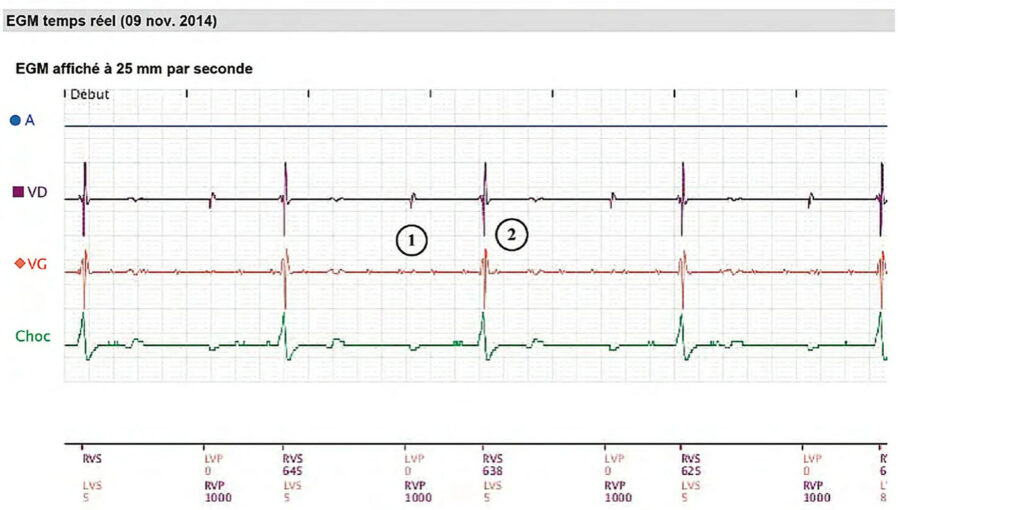
- Remote real-time EGM: the device paces both ventricles 1000 ms after the last ventricular event (RVP 1000, LVP 0 = together), but no ventricular complex follows on any channel = BiV pacing without capture
- A spontaneous ventricular complex comes 625 to 645 ms after each ineffective pace (RVS, then LVS 5 ms later), regular, about 37 bpm: probable ventricular escape rhythm; to the device, paced and sensed ventricular events alternate
- Patient called in: the episode retrieved from the device at the visit (APM-14) shows the same pattern, BiV paces 1000 ms after each ventricular event without capture, and an escape beat 503 to 640 ms after each pace
- RV threshold test (RV paced at 665 ms, from 7.5 V in 0.5 V steps): first loss of capture at 6.0 V/0.4 ms, with no paced complex on the RV EGM (VD) and no QRS on Lead II; the RV threshold is 6.5 V/0.4 ms, while the RV output was programmed at 3.5 V/0.4 ms
- LV threshold in the programmed configuration, LV distal to LV proximal (VGdist»VGprox, LV paced alone): capture down to 4.0 V, lost at 3.5 V/0.4 ms (no QRS on Lead II, nothing on the RV EGM; one beat still captures). The LV threshold, 4.0 V/0.4 ms, is above the programmed LV output of 3.5 V/0.4 ms
- LV threshold from LV distal to the can (VGdist»boîtier): first loss of capture at 2.1 V/0.4 ms (no QRS on Lead II, nothing on the RV EGM); the LV threshold is 2.2 V/0.4 ms, far lower than in the programmed configuration (4.0 V)
Comments
Total loss of BiV capture: the RV and LV thresholds both rose above the programmed outputs (6.5 V and 4.0 V, for 3.5 V), leaving only a slow ventricular escape rhythm
Points to remember
- Both thresholds rose above the 3.5 V outputs (RV 6.5 V, LV 4.0 V), so the paces no longer captured. With complete AV block, only a slow escape rhythm of about 37 bpm was left: the patient was called in
- A rise of both ventricular thresholds at once is rare. It is seen mainly in dialysis patients, whose blood potassium swings over the 24 hours: high potassium raises pacing thresholds
- The device did not see the loss of capture: it saw paced and sensed beats alternate and only sent an alert for a drop in BiV pacing. So read the real-time EGM sent with each transmission: BiV pacing is not BiV capture
- The outputs were reprogrammed with wide safety margins, in the LV configuration with the lowest threshold (LV distal to the can: 2.2 V instead of 4.0 V)
Take home message
In a dialysis patient, high potassium can raise the RV and LV thresholds together, and the device then paces without capturing. On the real-time EGM of every transmission, check that each pace is followed by a paced complex
Read more about related topics