RA lead impedance alert in a paced CRT patient
Patient
Go to the casebook version optimized for the mobile experience
AUTOGEN CRT-D implanted almost 9 years earlier (about 5 months left to explant), AV block; DDD 70-100 bpm, paced AV delay 90-150 ms, sensed AV delay 70-120 ms, BiV with LV offset −40 ms; atrial output 2.5 V @ 0.4 ms
Remote transmission with an alert; counters since the office check 11 days earlier: A paced 98%, RV 99%, LV 98%
Trace
- Remote transmission: alert “Atrial pacing lead impedance out of range”, raised the day before
- Atrial lead: pacing impedance 1304 Ω at the office check 11 days earlier, and 2399 Ω on the last daily measurement, the day before the transmission (warning sign); atrial threshold at that check 2.5 V @ 0.4 ms, equal to the programmed atrial output: no safety margin. Atrial events are still well sensed (intrinsic atrial amplitude 7.5 mV); RV and LV impedances stay at 340-397 Ω
- Atrial pacing impedance over 6 months, one value a day: about 850-950 Ω on most days, with isolated peaks at 1250-1500 Ω, then a jump on the last two days, to 2399 Ω the day before the transmission
- Atrial automatic threshold: 0.5-0.7 V (mostly 0.6 V) until a month before the transmission, then no value at all (“No data collected”); the 2.5 V threshold was measured at the office check
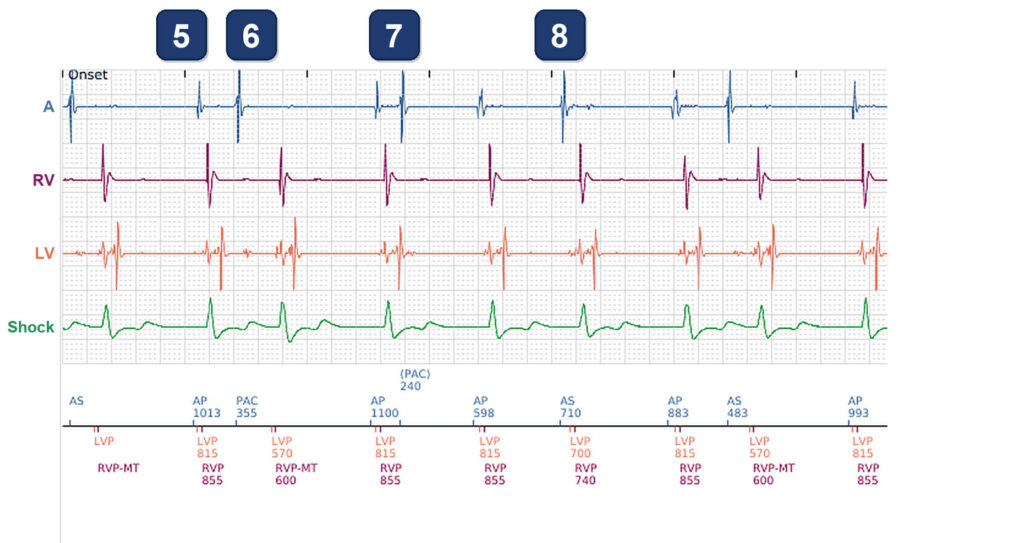
- Presenting EGM of the transmission (channels A, RV, LV, Shock). AP 1013: the atrium is paced at the lower rate, then the LV and the RV 40 ms apart (LVP 815, RVP 855 ms ≈ 70 bpm; LV offset −40 ms). On the A channel the AP is followed by a small spike only, nothing like the patient’s own atrial events
- 355 ms after the AP, a large atrial deflection: the patient’s own atrial event, sensed (marked PAC: only 355 ms after the AP) and tracked; the ventricles are paced at the maximum tracking rate (LVP 570, RVP-MT 600 ms = 100 bpm)
- AP 1100, and only 240 ms later an atrial event of the patient’s own, in PVARP ((PAC)): not tracked, and not conducted either: no ventricular sense before the next paced beat, 690 ms later = AV block
- The patient’s atrial events march through at their own regular rate, every 1310-1370 ms (about 45 bpm), whatever the timing of the APs (1013, 1100, 598, 883, 993 ms): the atrium is never captured. Yet every beat stays BiV paced, after a tracked atrial event (AS 710 → LVP 700, RVP 740) or after an AP that did not capture
Comments
Atrial pacing impedance alert with a complete loss of atrial capture, yet no loss of CRT: because of the AV block, every beat is still BiV paced. At the check one month later, all was back to normal
Points to remember
- Read atrial capture on the atrial EGM: here the patient’s own atrial events keep their regular rhythm through the atrial pacing spikes, never reset by them, so the atrium is not captured at all
- The counters stay high (A paced 98%, RV 99%, LV 98%): they count pulses, not capture. With the AV block, every beat stays BiV paced, after an atrial pulse or a tracked atrial event
- With intact AV conduction, the same lead problem could cost CRT: atrial events falling in the PVARP are not tracked, could conduct, and BiV pacing would be lost on those beats
- Read an impedance alert with the threshold and the trends: here 2399 Ω against about 900 Ω on most days, an office threshold equal to the output (no safety margin), and impedance peaks for months before the alert
Take home message
In AV block, losing atrial capture does not stop CRT: each atrial pulse still starts the AV delay and both ventricles are paced. The counters cannot show it (98% atrial pacing); the atrial EGM can
Read more about related topics