LV threshold and impedance rising in the first weeks after implant
Patient
Go to the casebook version optimized for the mobile experience
RESONATE X4 CRT-D with a quadripolar LV lead; DDD 50-130 bpm, BiV pacing (98%), LV offset 0 ms; LV paced LVRing2>>LVRing3; LV output Auto (PaceSafe LV)
LATITUDE reports in French: a remote transmission 7 weeks after implant, an office visit the next day, and a second transmission a week after the visit. What happened to the LV lead, and what was done at the visit?
Trace
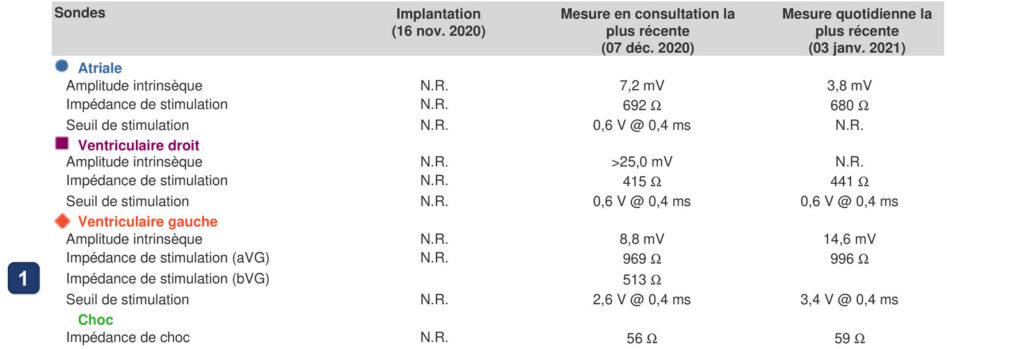
- First report, 7 weeks after implant (Seuil = threshold, Impédance = impedance). LV pacing impedance 969 Ω at an office check 3 weeks after implant and 996 Ω on the last daily measurement, the day before the transmission; LV threshold 2.6 V, then 3.4 V @ 0.4 ms. The atrial, RV (0.6 V, 415-441 Ω) and shock (56-59 Ω) values are stable
- Pacing output (Amplitude de stimulation), LV: Auto 4.4 V @ 0.4 ms. PaceSafe LV has followed the threshold up: the highest recent threshold, 3.4 V, plus a 1.0 V safety margin
- Lead configuration: LV paced VGprox2>>VGprox3 = LVRing2>>LVRing3, a bipolar vector between rings 2 and 3 of the LV lead; LV sensing VGdist1>>VGprox3 = LVTip1>>LVRing3
- LV pacing impedance, one value a day since implant (vertical lines: the 1st of each month): 710-840 Ω in the first 2 weeks, then 860-1000 Ω: rising
- LV automatic threshold (Seuil de stimulation auto, PaceSafe LV): 1.3 V the day after implant, 3.3 V ten days later, then 2.4-3.4 V: the threshold has risen, and the automatic output with it. The green trend below is the shock impedance (49-64 Ω), stable
- A week later, after the office visit: the LV pacing impedance drops from about 1040 Ω just before the visit to 610-670 Ω on the new vector
- The LV automatic threshold drops too, from 2.4-3.4 V to 1.4-1.6 V since the change of vector (Auto 1.3 V at the office visit)
- Second report: LV Auto 2.6 V @ 0.4 ms instead of 4.4 V: the highest threshold since the change, 1.6 V, plus the 1.0 V margin
- LV now paced VGprox3>>VD = LVRing3>>RV, from ring 3 of the LV lead to the RV lead; LV sensing unchanged
Comments
In the first weeks after implant the LV threshold and impedance both rise on LVRing2>>LVRing3, and PaceSafe LV raises the output to 4.4 V. At the office visit the LV is moved to another vector of the quadripolar lead, LVRing3>>RV, which captures at 1.3 V
Points to remember
- Watch the LV threshold and impedance trends closely in the first weeks after implant: here both rose on the LV vector (threshold 1.3 → 3.4 V, impedance about 730 → 1000 Ω) while the atrial, RV and shock values stayed stable
- PaceSafe LV kept capture by raising the output (to 4.4 V), but it never goes above its programmed maximum: a threshold that keeps rising would reach that ceiling, and LV capture could be lost
- Before accepting a high output, test the other vectors of the quadripolar lead: here LVRing3>>RV captured at 1.3 V in office, and the output came back down to 2.6 V
- A new vector has its own impedance (610-670 Ω instead of about 1000 Ω): a step on the day of a reprogramming is expected; compare impedances only on the same vector
Take home message
Watch the LV threshold closely in the first weeks after implant. When it climbs, do not just accept a higher output: test the other vectors of the quadripolar lead, as one may capture at a much lower output.
Read more about related topics