LV impedance out-of-range alert near battery end of life
Patient
Go to the casebook version optimized for the mobile experience
VISIONIST CRT-P implanted about 6 years earlier, with a bipolar LV lead; paroxysmal AT/AF (5% of the time); RV and LV outputs fixed at 4.0 V @ 0.4 ms
Two LATITUDE reports: a remote transmission with an LV impedance alert (VVIR 60, atrial lead off), then a second report five and a half months later (DDDR 60-130). What should be done with the LV lead?
Trace
- First report (remote transmission): alert “Left ventricular pacing lead impedance out of range”, raised the day before the transmission
- Battery: about 8 months to explant
- Under the lead table, the report states that an automatic safety switch from bipolar to unipolar occurred on the day of the alert, due to an LV pace impedance measurement of >3000 Ω. The device itself moved LV pacing to LVtip>>Can (tip to can); the report’s settings show that configuration with a warning sign
- LV pace impedance 323 Ω at the last office visit, 6 weeks earlier, and >3000 Ω on the day of the alert (warning sign); LV threshold 1.5 V @ 0.4 ms in office. The RV (345 → 354 Ω) and atrial (453 → 473 Ω) values have not moved
- The first report’s LV pace impedance over 6 months (vertical lines: the 1st of each month): 300-400 Ω almost every day, one isolated jump near 1000 Ω about 5 months earlier, and above 3000 Ω on the last day, the day of the alert: sporadic jumps between normal values. Below, the LV automatic threshold reads “No data collected”: with a fixed LV output the device does not test the LV threshold
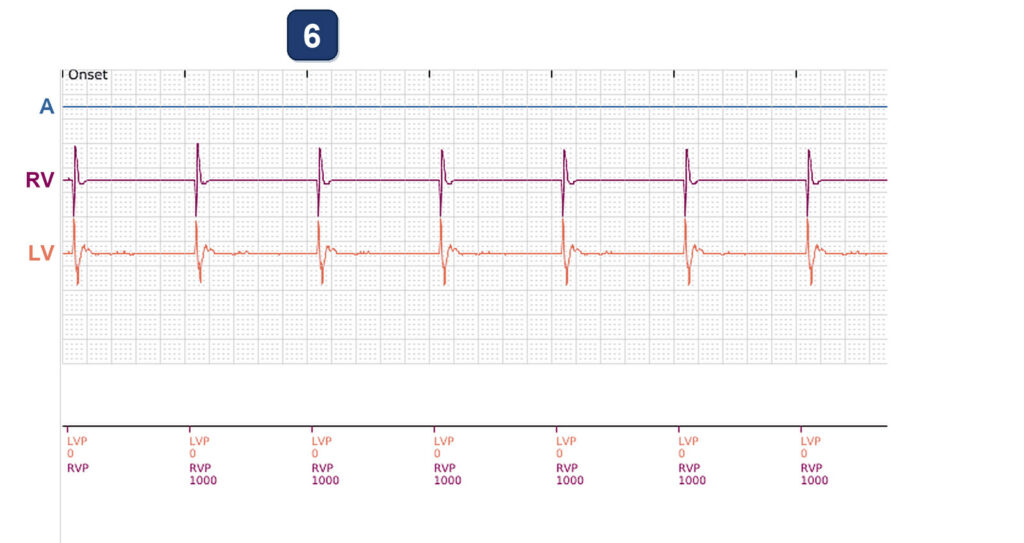
- Presenting EGM of the first report, after the switch to unipolar (VVIR 60, atrial lead off: the atrial channel is flat): LV and RV paced together every 1000 ms (LVP 0, RVP 1000), the same paced complex on every beat: the LV lead works normally
- Second report, five and a half months later: less than 3 months to explant (8 months on the first report): the generator change is near
- LV in LVtip>>Can: 323 Ω at the last office visit, 6 weeks before this report, and 308 Ω on the last daily measurement; threshold Auto 1.4 V @ 0.4 ms in office, for an output still fixed at 4.0 V @ 0.4 ms. Below: LV (and RV) paced 100% since the last counter reset
- LV pace impedance over the 6 months before this report: 330-450 Ω, the single point above 3000 Ω (the day of the switch), then 310-350 Ω every day in LVtip>>Can, the setting kept by programming at the next office visit, 17 days after the switch
- Presenting EGM of the second report (DDDR): an atrial pace (AP 1000) or an atrial sensed event (AS 878), each followed by LV and RV paces together (LVP 0, RVP): normal BiV pacing and capture again, in unipolar
Comments
Sporadic LV impedance jumps on the bipolar circuit (near 1000 Ω, then above 3000 Ω), with normal values and normal pacing in between: most probably a conductor fracture with intermittent contact. The device switched LV pacing to unipolar by itself, and with the battery near replacement it is time to decide about the lead
Points to remember
- Read an LV impedance alert with the trend and the other leads: here sporadic jumps on the bipolar LV circuit (once near 1000 Ω, then above 3000 Ω) among months of normal values, while the RV and atrial impedances did not move
- This is most probably a conductor fracture. The broken ends are in good contact most of the time, giving normal function and normal impedances; during certain movements the contact is lost, which explains the sporadic high impedances
- The device reacted on its own: the same day it switched LV pacing from bipolar to unipolar (tip to can) and sent an alert. Pacing and capture stay normal on both EGMs, and the unipolar setting was kept by programming at the next visit
- The generator change, less than 3 months away, is the time to decide: test the LV lead again, bipolar and unipolar, and weigh it against a new lead
- Both ventricular outputs are fixed at 4.0 V for thresholds of 1.3-1.9 V: the device uses 163% of the power of its reference settings, at a cost in battery life
Take home message
Weigh the clues of LV lead dysfunction (noise, threshold, impedance, phrenic stimulation, ECG) against the risk of adding a new LV lead (or a LBBAP lead), with or without extraction of the old one: a high-risk procedure, with an infection risk above 5%
Read more about related topics