AUTOGEN X4 CRT-D, 6 years after implant; VVIR 60, the atrial lead out of use (impedance >3000 Ω); BiV pacing (92% of beats), LV offset 0 ms, LV vector LVTip1>>RV, LV output Auto (PaceSafe LV)
A remote report with an LV impedance alert; three weeks later, a PaceSafe LV test stored by the device
Loading Viewer…
Trace
Remote report: alert “Left ventricular pacing lead impedance out of range”, raised the evening before
RV lead stable: pacing impedance 404 Ω at the last office visit and 431 Ω on the daily measurement, RV threshold 0.8 V @ 0.4 ms
LV lead: pacing impedance 289 Ω and threshold 0.8 V at the last office visit; 612 Ω and 2.0 V @ 0.4 ms on the last daily measurements. On the trends both had been stable for 6 months (360-505 Ω, 0.6-0.8 V) and jump on the last day; PaceSafe LV sets the LV output to 3.0 V (threshold + safety margin)
Presenting EGM of the report: BiV pacing at the lower rate, LV and RV paced together every 1000 ms (LVP 0, RVP 1000; LV offset 0 ms), with the same paced complex on the Shock channel at every beat
Sharp deflections on the LV channel only (nothing on the RV and Shock channels) = noise, sensed as LVS 798: the LV pace due 200 ms later is inhibited (Inh-LVP, LV protection period) and only the RV is paced; the Shock complex changes and the LV is activated late (large LV deflection)
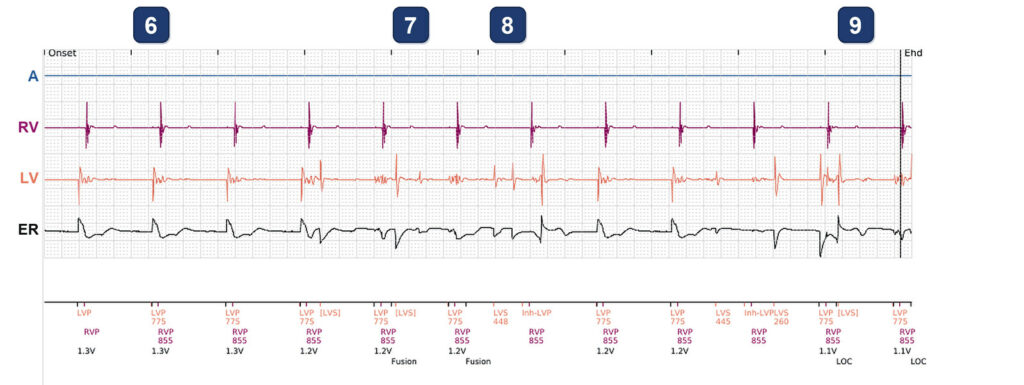
Three weeks later: ambulatory PaceSafe LV test in VVIR. Each LV test pulse (LVP 775) is backed up by an RV pace 80 ms later (RVP 855); at 1.3 V the evoked response (ER, bottom channel) is the same after every LV pulse = capture
1.2 V: bursts of noise and sharp spikes appear on the LV channel only (the RV channel stays clean), some sensed in the refractory period ([LVS]); the evoked response is distorted and the device labels 2 beats “Fusion”
An isolated sharp LV spike, with nothing on the RV channel, is sensed (LVS 448): the test pulse due 330 ms later is inhibited (Inh-LVP) and only the RV is paced; the same happens again 3 cycles later (LVS 445)
1.1 V: loss of capture (LOC) on 2 beats, the evoked response changes and the LV is activated late ([LVS]): end of the test (End). 1.2 V was the last amplitude that captured, a value measured among noise
Comments
An LV lead problem (the lead or its connection): the LV impedance and threshold jump together, and noise on the LV channel alone inhibits LV pacing on the presenting EGM, then spoils a PaceSafe LV test three weeks later
Points to remember
Read an LV impedance alert with the trends and the other leads: here the LV impedance and the LV threshold jump together after 6 stable months, while the RV lead is unchanged. With noise on the LV channel only, this points to the LV lead or its connection
Noise on the LV channel alone is sensed as LVS, and the next LV pace is withheld (Inh-LVP): the beat is paced from the RV only, and CRT is lost on those beats
Noise also spoils the automatic LV threshold test: a threshold measured among noise cannot be trusted. And LV capture is not checked beat by beat, so a lead that worsens between two tests can lose capture unnoticed
Next step: see whether another vector of this quadripolar LV lead can replace LVTip1>>RV, testing each for threshold and phrenic nerve stimulation and keeping one with a low threshold and no phrenic capture. With a vector to the RV, also look for anodal capture (at high output the RV electrode, the anode, can capture the RV, and the device cannot see it); a 12-lead ECG confirms that the LV is captured
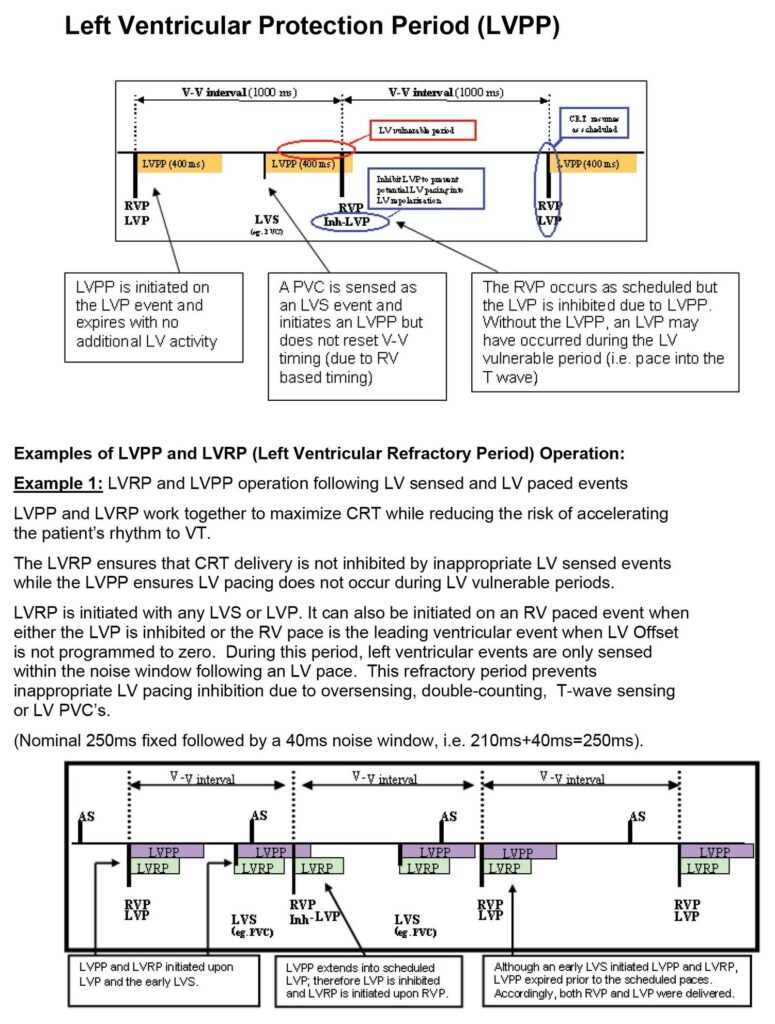
Left ventricular protection period (LVPP): after an LV sensed or paced event the LV is not paced for a while (nominal 400 ms); an LV pace due within it is inhibited (Inh-LVP) and the RV is paced as scheduled
Take home message
It is essential to understand the LV channel markers to understand how the LV lead works: an LVS on noise followed by Inh-LVP means that the LV was not paced on that beat