Intermittent RV-only paced beats in a RESONATE CRT-D
Patient
Go to the casebook version optimized for the mobile experience
RESONATE X4 CRT-D; DDD 50-130 bpm, sensed AV delay 70-100 ms, BiV with LV offset 0 ms (99% BiV pacing); LV pacing LVTip1>>RV at a fixed 3.0 V @ 0.4 ms with Daily Trend, LV sensing LVTip1>>LVRing2
Two remote reports: the first 4.5 years after implant, with no alert; the second 8 months later, in VVI 40 with LV pacing LVRing3>>Can at 4.0 V @ 0.4 ms and LV sensing LVRing2>>LVRing3, and no pacing (0%) since an office visit 2 months after the first report. Why were some beats paced from the RV alone?
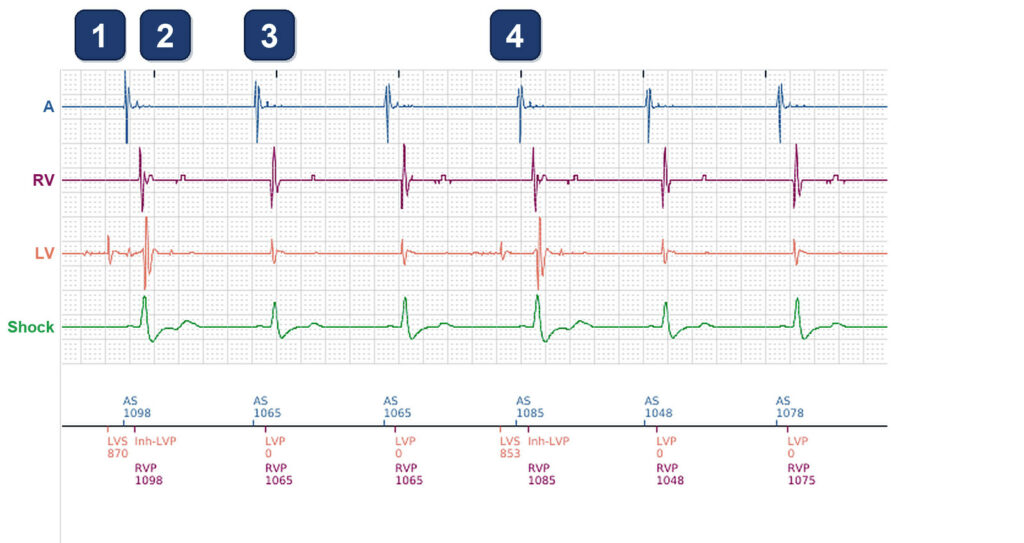
Trace
- Presenting EGM of the first report (channels A, RV, LV, Shock): atrial events sensed (AS) at about 55 bpm, each followed by an LV and RV pace. Here a sharp spike appears on the LV channel alone (nothing on the A, RV or Shock channels): noise, sensed as LVS 870
- At the end of the sensed AV delay the RV is paced (RVP 1098), but the LV pace due with it would come 228 ms after the LV sense, within the LV protection period: it is withheld (Inh-LVP). RV-only paced beat: the LV is activated late (large LV deflection) and the Shock EGM is wider, with a larger T wave
- For comparison, a BiV beat: AS 1065, then LVP 0 and RVP 1065 together (LV offset 0 ms) about 100 ms later; a small LV deflection right after the pace and a narrower Shock EGM
- Three beats later, the same: low-amplitude noise, then a spike sensed on the LV channel (LVS 853), RVP 1085 with Inh-LVP and another RV-only beat: the noise falls just before the next pace, and the LV pace is lost
- Trends of the same report, no alert: LV pacing impedance 750-1000 Ω over 6 months (839 Ω the day before the report), apart from one spike to about 1230 Ω some 6 weeks before the report
- Daily LV threshold (Daily Trend: the output stays at 3.0 V): 1.1-1.6 V for 4.5 months, then 1.4-1.9 V over the last 6 weeks, and 2.2 V once a few days before the report; 1.5 V @ 0.4 ms the day before the report
- Eight months later (second report): the daily LV R wave, about 5 mV at first (5.7 mV at the office visit), falls to 1-3 mV over the last 3.5 months, with isolated high values (up to 21 mV); 1.5 mV the day before the report
- LV pacing impedance 690-830 Ω for 2 months, then above 1000 Ω, above 3000 Ω on some days and, over the last 2.5 months, almost every day: the LV lead has failed
- LV threshold about 4.0 V (3.0-4.5 V) at first (3.3 V @ 0.4 ms at the office visit), then 4.0-5.0 V over the last 3.5 months; the day before the report the test gives no threshold but “fusion events”: it could not judge LV capture
Comments
Another example of noise artefacts heralding LV lead failure, this time in a RESONATE device. Noise on the LV channel is sensed (LVS) and withholds the next LV pace (Inh-LVP): beats paced from the RV alone amid BiV pacing. Eight months later the LV pacing impedance is above 3000 Ω almost every day: the LV lead has failed
Points to remember
- A beat marked Inh-LVP is paced from the RV alone: the LV channel sensed something shortly before the LV pace was due, and that pace was withheld. It is a lost CRT beat: the LV is activated late and the shock EGM changes
- Sharp signals on the LV channel alone, with nothing on the atrial, RV or shock EGM, are noise: they point to the LV lead or its connection
- In the counters these beats make the LV % fall below the RV % (97% against 98% the day before the first report): a small gap, easy to miss
- LV noise can come months before the lead measurements change: here the LV impedance (839 Ω) and threshold (1.5 V) were near normal, and eight months later the LV pacing impedance was above 3000 Ω almost every day. After LV noise, follow the LV lead closely, even when its values are normal
Take home message
Beats paced from the RV alone (Inh-LVP) are lost CRT beats: when noise on the LV channel causes them, suspect the LV lead, even if its impedance and threshold are still normal
Read more about related topics