LATITUDE remote transmission 7 months after implant: no alert, but the counters since implant give 99% RV pacing and only 86% LV pacing. Why the gap?
Loading Viewer…
Trace
Pacing percent, one value a day over the 6 months before the transmission: the RV is paced on 94-100% of beats (99% on the last day) but the LV only on 77-98% (87%), below the RV every day, with no AT/AF (the row of RV rate during AT/AF is empty): on some beats the RV is paced without the LV
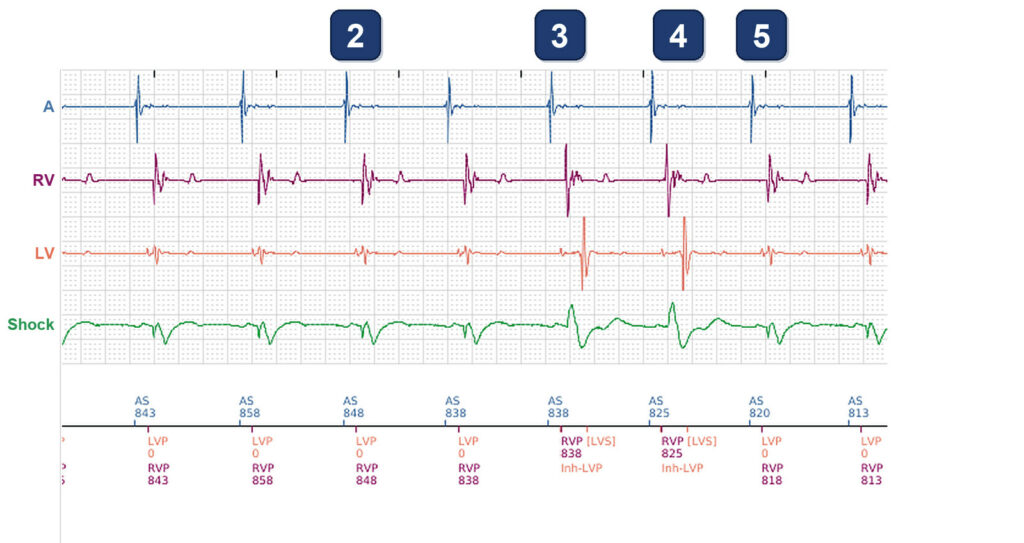
Presenting EGM of the transmission: sinus rhythm at about 70 bpm (AS 813-858 ms); about 100 ms after each AS, the LV and the RV are paced together (LVP 0, RVP 848; LV offset 0 ms): BiV beats, all alike
90-100 ms after the AS, before any ventricular activity, a small deflection on the LV channel is sensed: an orange LV marker just before the RVP, its label hidden under the RVP label. It opens the LV protection period: the LV pace due just after is withheld (Inh-LVP) and only the RV is paced (RVP 838)
The same on the next beat (RVP 825, Inh-LVP). These beats are paced from the RV alone: the RV and shock EGMs change, and the LV is activated late, a large LV deflection about 200 ms after the RVP, sensed in the LV refractory period ([LVS])
The next beats are BiV paced again (LVP 0, RVP 818): the LV sense comes and goes; 6 of the 36 beats of the 30-s presenting EGM are paced from the RV alone
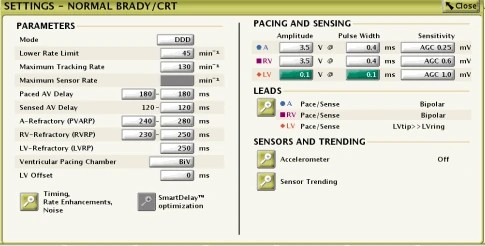
Settings: sensed AV delay 95-110 ms: the ventricles are paced 95-110 ms after each AS, so an LV signal sensed 90-100 ms after the AS falls just before the pace. With a shorter sensed AV delay the LV pace comes first, and the signal falls in the LV refractory period that follows it (LVRP 250 ms, three rows down)
Right column: the LV is sensed between LVTip1 and LVRing2 (LV sensitivity AGC 1.0 mV, higher up) and paced LVTip1>>RV; this sensing bipole picks up the signal before the RVP. Another LV sensing vector is the other setting to try
Comments
Beats paced from the RV alone in sinus rhythm: the LV lead senses a signal at the end of the sensed AV delay, probably the atrial event (far field), and the LV pace is withheld (Inh-LVP)
Points to remember
Compare the LV % with the RV %: an LV % below the RV % (here 86-87% against 99%) means beats paced from the RV alone. No alert reports it: look for Inh-LVP on the EGMs
Inh-LVP means that the LV channel sensed something shortly before the LV pace was due: that pace is withheld, the RV is paced alone and the LV is activated late. Each such beat is a lost CRT beat
An LV sense 90-100 ms after the atrial sense, before any ventricular activity, is not a ventricular event: here it is probably the atrial event (atrial far field) picked up by the LV lead (sensing LVTip1>>LVRing2)
Fix: shorten the sensed AV delay, so that the LV is paced before the atrial signal reaches the LV lead (the atrial signal then falls in the refractory period after the pace), or change the LV sensing vector. Then check that the LV % comes back up to the RV %
Programmer screen, Settings – Normal Brady/CRT (an example): under LEADS the pacing and sensing configuration of each lead is set; there the LV sensing vector can be changed, and LV sensing can even be switched off
Take home message
If oversensing of atrial (far-field) signals on the LV channel is suspected, get a chest X-ray to confirm the LV lead position and do a threshold test with an ECG. Remember that on a quadripolar lead the distal electrode, number 1, is the furthest from the atrium. If the lead is good, LV sensing may be switched off (on the programmer, under Leads, where the LV sensing vector can also be changed)