Extra LV sensed events in a CRT-D programmed VVI 40
Patient
Go to the casebook version optimized for the mobile experience
MOMENTUM X4 CRT-D, narrow QRS, programmed VVI 40 (BiV, LV offset 0 ms): 8% of beats paced; LV pacing LVRing4>>RV at a fixed 4.0 V @ 1.0 ms for an LV threshold of 2.7 V @ 1.0 ms; LV sensing LVRing2>>LVRing3
A remote report 3 years and 8 months after implant shows extra LV sensed events; a second report follows 8 months later (same settings, but a lower rate of 50 bpm). What are these LV events, and what do they mean?
Trace
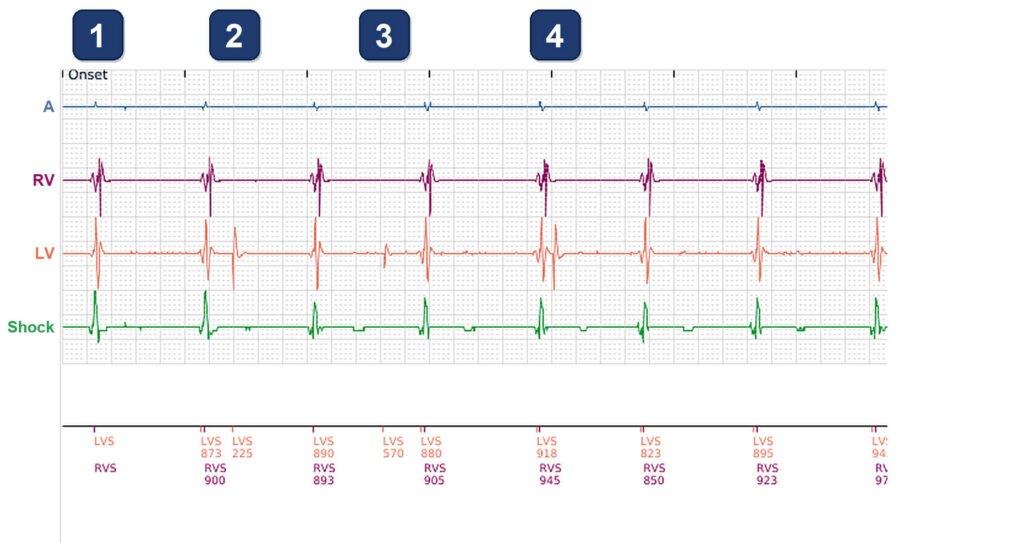
- Presenting EGM of the first report (channels A, RV, LV, Shock), VVI 40: intrinsic rhythm at about 65 bpm, no pacing. Each beat is sensed in the LV, then in the RV within 30 ms (next beat: LVS 873, RVS 900). This means one of two things: the QRS is narrow, so there is no delay between the RV and LV leads; or the LV lead lies close to the RV (in the first posterior branch, or in the great cardiac vein). The ECG and a chest X-ray answer this question
- A sharp spike on the LV channel alone, with nothing on the A, RV or Shock channels, is sensed: LVS 225, 225 ms after the RV sense (LV intervals are counted from the last RV event). No heartbeat looks like this: it is noise, LV oversensing
- A smaller LV-only spike is sensed again (LVS 570). In VVI 40, with a faster intrinsic rhythm, these LV senses change nothing: no pace is due, and an LV sense does not reset the ventricular timing, which runs on the RV
- Another sharp LV-only spike, shortly after this beat’s LV sense, gets no marker: it falls within the LV refractory period (LVRP 250 ms). Only the noise that falls outside it is sensed
- Lead table of the same report: LV pacing impedance 393 Ω in office and 367 Ω on the last daily measurement, LV R wave about 5 mV, LV threshold 2.7 V @ 1.0 ms (high); RV and shock values normal. Nothing yet points to the LV lead
- Eight months later (second report): LV pacing impedance (LVRing4>>RV) 2532 Ω in office, but 540 Ω in the daily measurement 6 days later (367 Ω at the first report); the RV (711/850 Ω) and shock (58/56 Ω) impedances are normal
- LV threshold 3.2 V @ 1.0 ms in office, against 2.7 V @ 1.0 ms at the first report: a high threshold, still rising, for a fixed LV output of 4.0 V @ 1.0 ms
- Daily LV R wave (sensed amplitude), 6 months of trends: about 4-5 mV for 4 months, then erratic over the last 2 months, from 1.4 to 16 mV
- Daily LV pacing impedance: 330-450 Ω for 4 months, then, over the last 2 months, above 3000 Ω on many days, alternating with normal values: the LV pacing circuit opens intermittently, the LV lead is failing. The shock impedance below stays stable; there is no LV threshold trend (fixed output)
Comments
Noise on the LV channel alone is sensed (LVS 225, LVS 570) but changes nothing in VVI 40. Eight months later the LV pacing impedance jumps intermittently above 3000 Ω and the LV threshold has risen: the LV lead is failing
Points to remember
- Sharp spikes on the LV channel alone, at random times and with nothing on the atrial, RV or shock EGM, are noise, not heartbeats: compare all the channels before reading an LV sense as a beat
- Here the noise changed nothing: the patient’s own rhythm was faster than VVI 40, so no pace was due. In a paced patient, LV noise shortly before an LV pace withholds that pace (the RV is still paced) and costs a CRT beat. This patient had a narrow QRS at implant and received CRT because the implanters feared a broad QRS later (for example in cardiac amyloidosis)
- LV noise can be the first sign of LV lead damage: eight months later the LV pacing impedance was above 3000 Ω on many days and the LV threshold had risen (2.7 → 3.2 V @ 1.0 ms). In many lead dysfunctions the first sign is noise: fast, sharp artefacts on the channel of the failing lead. Unfortunately LV sensing does not trigger the storage of fast events, which could give an early diagnosis of LV lead dysfunction, as RV lead noise does when it triggers stored NSVT episodes
- After LV noise, follow the LV lead closely (impedance and R wave trends, threshold). A failing lead can measure normal one day and above 3000 Ω the next, so one normal value (540 Ω) does not clear it: read the trend
Take home message
Noise on the LV channel can be the first sign of a failing LV lead, even when it does not disturb pacing: do not dismiss it, follow the LV lead closely
Read more about related topics