Exercise: sinus tachycardia in the VT-1 zone
Patient
Go to the casebook version optimized for the mobile experience
AUTOGEN CRT-D in a 64-year-old man with idiopathic dilated cardiomyopathy and a nonspecific intraventricular conduction delay, PR interval very slightly prolonged
Good exercise capacity; at interrogation, episodes diagnosed as VT-1 by the device (MTR programmed at 130 bpm)
Trace
- Fast sinus rhythm, AS 425 to 435 ms (about 140 bpm), above the programmed MTR (130 bpm): a ventricular pace tracking each atrial event would exceed the MTR, so the AV delay is stretched and spontaneous conduction comes first: RVS, then LVS 8 to 25 ms later. No BiV pacing
- The rhythm speeds up slightly: RV intervals of 428 ms are now marked VT-1, those of 430 ms or more stay RVS: the conducted ventricular rate reaches the VT-1 zone (about 140 bpm)
- The rhythm settles in the VT-1 zone (VT-1 420 to 428 ms). Each ventricular beat is compared with the stored reference (RhythmMatch): high similarity, C96% to C98%
- V-Epsd: after 8 cycles classified VT-1, the device declares a VT-1 episode
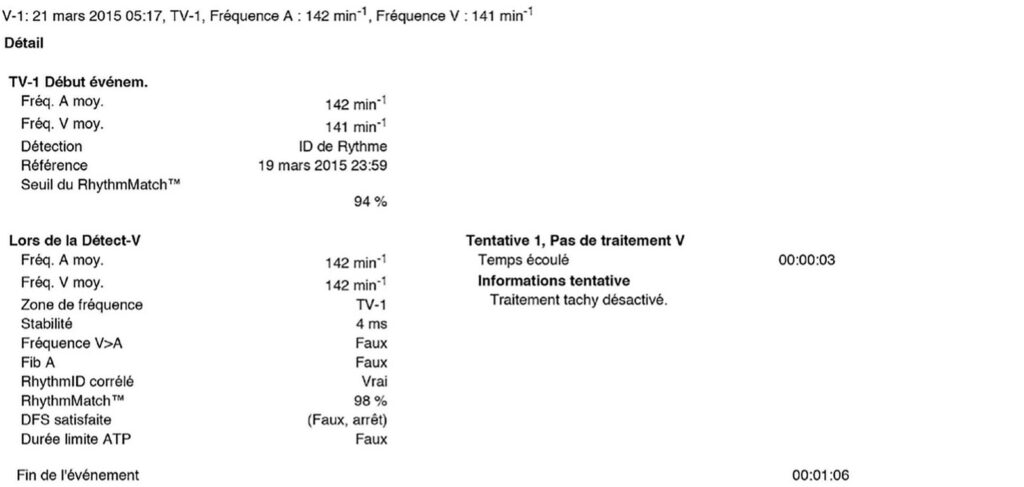
- End of the duration (V-Detect): still in the VT-1 zone, but Rhythm ID classifies the rhythm as supraventricular (episode report: RhythmMatch 98%, threshold 94%; RhythmID correlated: True; V rate > A rate: False). Attempt 1: no ventricular therapy (“Tachy therapy disabled”)
Comments
Sinus tachycardia on exertion at 142 bpm, above the MTR (130 bpm): BiV pacing is lost to the patient’s own conduction. The rate also reaches the VT-1 zone, where Rhythm ID correctly classifies the rhythm as supraventricular
Points to remember
- The device stored this sinus tachycardia because the ventricular rate reached the first VT zone. Four reasons: preserved AV conduction (PR only very slightly long), a good exercise capacity, an MTR set too low (130 bpm), and a VT zone within the patient’s normal sinus rates on exertion
- When the sinus rate exceeds the MTR at peak exercise, the device can no longer pace in step with each atrial event: the AV delay stretches, the patient’s own conduction takes over and BiV pacing is lost. It is rarely symptomatic, as the heart rate does not drop suddenly
- Reprogram anyway: raise the MTR, then check on a new exercise test that BiV pacing and capture hold at peak effort
- An exercise test is worth proposing to every CRT patient, to check: good atrial sensing (or a suitable rate response if the heart rate cannot rise), no 2:1 block on exertion, a suitable MTR or maximum sensor rate, and no arrhythmia on exertion
- With Boston devices the VT zones must sit above the MTR, so a high MTR makes slow VTs harder to treat. Here an MTR of 150 bpm and a treated VT zone at 170 bpm kept BiV pacing on exertion, while the patient’s only VT episode (190 bpm) stayed treatable
Take home message
An MTR set too low takes CRT away on exertion, often without symptoms. In an active patient, raise it (keeping the VT zone above it) and check on an exercise test that BiV pacing holds at peak effort
Read more about related topics