CRT drop in a patient with atrial ectopy
Patient
Go to the casebook version optimized for the mobile experience
RESONATE X4 CRT-D implanted 4 and a half years earlier, quadripolar LV lead (LV paced LVRing2>>RV); DDD 50-130 bpm, sensed AV delay fixed at 120 ms, paced AV delay 150 ms, PVARP 240-280 ms, BiV pacing with LV offset 0 ms; mode switch (ATR) to DDI above 170 bpm
A remote transmission; the settings were last reprogrammed 10 months before it. The question: why RVS 623 on the EGM, when the device paced at 460 ms a few beats earlier?
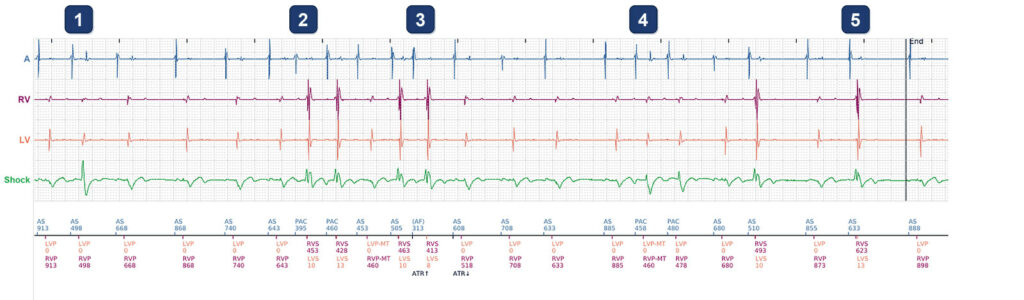
Trace
- Presenting EGM of the first transmission: sinus rhythm with PACs. A tracked atrial event is followed by BiV pacing 120 ms later (fixed sensed AV delay): AS 498 → LVP 0 and RVP 498, LV offset 0 ms
- PAC 395 ms after the previous atrial event: pacing 120 ms after it would give a V-V shorter than the MTR interval (460 ms, 130 bpm), so the pace has to wait; the patient’s own conduction comes first (RVS 453, LVS 10 ms later): no BiV pacing. The next PAC (460) does the same: RVS 428
- (AF) 313: an atrial event 207 ms after the RV sense, inside PVARP (240-280 ms) and faster than the ATR trigger rate (170 bpm): counted for the mode switch (ATR↑) but not tracked. It conducts: RVS 413, LVS 8. BiV Trigger is Off in normal mode (settings report), so no LV pace follows the RV sense
- The device can pace this fast: this PAC (458 ms) is tracked and both ventricles are paced at the MTR interval, 460 ms after the previous beat (LVP-MT, RVP-MT 460)
- Why RVS 623, when the device paced at 460 ms a few beats earlier? The MTR only limits tracking; the pace is due 120 ms after the AS. Here the RV is sensed about 110 ms after the AS (AS 633 → RVS 623, LVS 13): conduction beats the sensed AV delay and BiV pacing is lost; the same at AS 510 → RVS 493 (about 105 ms)
- First report, 6 months of trends: the heart rate climbs in the last days, max 147, mean 104, min 83 bpm the day before the transmission; the night heart rate (90 bpm) and the respiratory rate (24/min) rise with it. The counters give 14.4 million PACs since they were last reset, over 4 years earlier
- Pacing percent the day before the transmission: RV 69%, LV 69% (atrial 0%). BiV pacing ran at about 90-100% for months and falls in the last days, as the heart rate rises
6 months later
The patient was put on beta-blockers (nebivolol). See below the transmission 6 months later, on nebivolol, with the same settings
- Presenting EGM of the second transmission: sinus rhythm at about 55-75 bpm, each atrial event sensed (AS) and followed by LVP 0 and RVP together: BiV pacing
- PACs are still there (PAC 588 ms after the atrial event before it), but at this heart rate they are tracked: both ventricles are paced after them (LVP 0, RVP 588)
- The same for PAC 483: still longer than the MTR interval (460 ms), so tracked and BiV paced. A clean EGM: every beat BiV paced
- The 6 months of trends after the first transmission: the heart rate comes down within two weeks of it (max 160 → about 110 bpm); max 94, mean 76, min 66 bpm the day before this transmission
- BiV pacing is back above 90% within two weeks and settles at 95-100% after about six weeks: 98% the day before the second transmission (RV 98%, LV 98%), no loss of CRT
Comments
Frequent PACs and a fast heart rate cut BiV pacing to 69%: PACs too early for the MTR or in PVARP, and atrial events conducted before the end of the 120-ms sensed AV delay. Six months later, on nebivolol and with no reprogramming, BiV pacing was back at 98%
Points to remember
- Every beat the patient conducts before the device paces is lost for CRT. Frequent PACs cause this in three ways: a PAC so early that pacing after it would exceed the MTR, a PAC in PVARP (not tracked), or an atrial event that conducts before the end of the sensed AV delay
- The MTR is only a speed limit: a tracked atrial event is paced at the end of the sensed AV delay, unless the patient’s own beat comes first. Here it came 105-110 ms after some atrial events, before the end of the fixed 120-ms sensed AV delay: a shorter or rate-adaptive sensed AV delay keeps the pace ahead
- BiV Trigger was Off here (On only during mode switch). Turning it on would add an LV pace after each RV sense, but the RV has already been activated by the patient’s own beat: this is not true BiV pacing
- Treat the cause first: on nebivolol, with no reprogramming, the heart rate came down and BiV pacing was back above 90% within two weeks, then at 95-100%. Follow the effect on the daily trend
Take home message
The problem is not the device but the frequent PACs and the fast heart rate: treat them first. Here beta-blockers alone, with no reprogramming, brought BiV pacing back from 69% to 98%
Read more about related topics