RESONATE X4 CRT-D implanted 6 years earlier; DDD 50-155 bpm, BiV with LV offset 0 ms, mode switch (ATR) to VDI, BiV Trigger and VRR on. Remote report: new AF for the last 5 days (now 24 h a day, mean V rate 93 bpm), daily LV pacing still 92-96%; LV output 3.5 V @ 0.6 ms, LV threshold 2.6 V @ 0.6 ms
Second report 15 months later, same settings but LV output 4.0 V @ 0.6 ms. AF for 7 weeks, ending about 4 months before this report, and again for the last 2 weeks; at the last office visit, 3 months before, in sinus rhythm: RV threshold 0.5 V @ 0.4 ms, LV 2.9 V @ 0.6 ms
Loading Viewer…
Trace
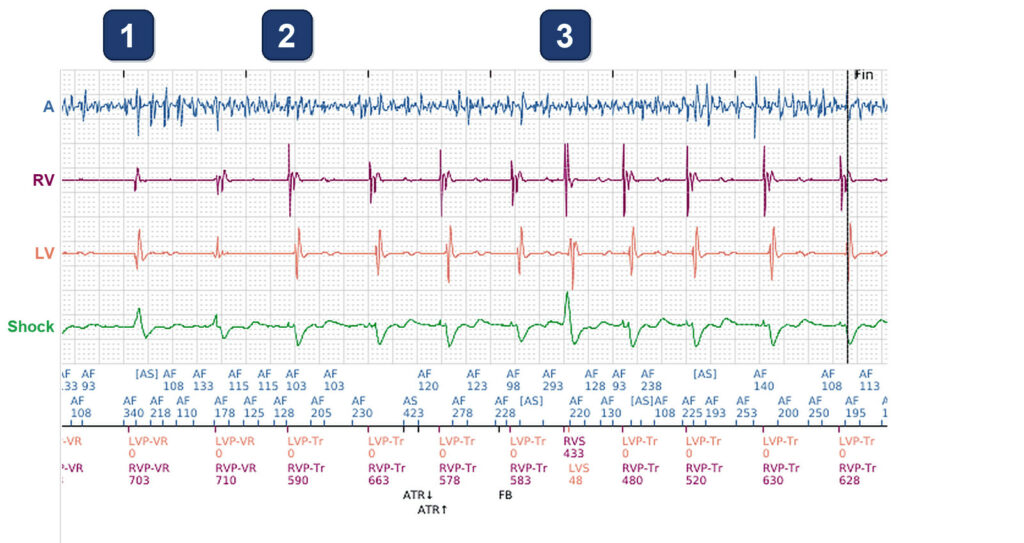
Channels: atrial, RV, LV, shock EGM. AF with mode switch (ATR) to VDI: no atrial tracking. With no conducted beat in time, VRR paces both ventricles together (LVP-VR, RVP-VR 703 ms, LV offset 0 ms): a true BiV beat
A conducted AF beat reaches the RV lead and is sensed there. The markers read LVP-Tr and RVP-Tr (590 ms), but paradoxically the RV is not paced: the RV sense triggers the LV pace. The RV was already activated by the patient’s own beat (native RV EGM under the spike; the shock EGM differs from the VRR beats), so the beat counts as RV sensed, LV paced: a missed beat for CRT
RVS 433 ms (139 bpm), above the BiV Trigger maximum pacing rate (nominal 130 bpm): not triggered; the LV is sensed 48 ms later (LVS 48) and gets no pace: RVS-LVS, a missed beat. The next beat, at 480 ms (125 bpm), is triggered again
15 months later, second report, 6 months of trends: the bars of RV rate during AT/AF show the AF periods, 7 weeks in the first half and again for the last 2 weeks (mean 93, max 195 bpm, above the VT zone line at 185)
Pacing on the last day of the trends: RV 36% but LV 83%. The RV % drops only in AF: triggered beats count as RV sensed and LV paced, only untriggered paces (VRR) count in both, so in AF the RV % is the share of true BiV beats. Check on the 30-s EGM of the report, the next day: 16 of its 40 beats are VRR beats (40%), 14 are triggered and 10 sensed with no pacing
Same report, three trend rows under one date axis: the AF bars (top, as in 4), then the RV and LV automatic thresholds. The RV threshold rises, up to 4.5 V, only on AF days (above 1 V on 19 of 63); on the 121 sinus days it stays at 0.4-0.7 V, and at the office visit 3 months before the report, in sinus rhythm, it was 0.5 V @ 0.4 ms. A threshold measured in fast AF is worth rechecking in office before acting on it
And the LV lead? Its threshold shows no AF pattern: 2.2-4.0 V, median 3.2 V @ 0.6 ms on AF and sinus days alike, and 2.9 V @ 0.6 ms in office in sinus rhythm (1.5 V @ 0.4 ms at implant). This rise is real: with the LV output at 4.0 V @ 0.6 ms the margin is thin, and nil on the 20 days the test reads 4.0 V
Real-time EGM of the second report, still in AF: the VRR paces (LVP-VR, RVP-VR 775 ms) look alike on every channel; they count as RV paced and LV paced
Conducted beat sensed in the RV: LVP-Tr and RVP-Tr at once (565 ms). Again the RV is not paced: the spike sits on a large native RV EGM and the shock EGM differs from the VRR beats; the RV sense has triggered the LV pace, and the beat counts as RV sensed, LV paced: a missed beat for CRT
Here the LV is sensed first (orange LV marker half hidden under RVP-Tr), about 80 ms before the RV. The RV sense still shows RVP-Tr 530, but the LV pace is withheld (Inh-LVP, LV protection period): no LV pacing and no real RV pacing: a missed beat, like an RVS-LVS beat
Comments
In conducted AF most beats are triggered (RV sensed, LV paced) or sensed: missed beats for CRT, although the triggered ones count as LV paced; only the VRR beats are true BiV. 15 months later CRT reaches only 36-40% of beats (RV 36%, LV 83%); the RV threshold rises only on AF days, while the LV threshold rise is real
Points to remember
In AF, sort the beats into three kinds: VRR beats (RVP-VR, LVP-VR) are true BiV beats; triggered beats (RVP-Tr, LVP-Tr) are the patient’s own conducted beats, whose RV sense triggers an LV pace, with no real RV pacing despite the RVP-Tr marker: missed beats; sensed beats (RVS-LVS, or Inh-LVP when the LV is sensed first) get no pacing at all: missed beats too
So in AF the RV pacing % is the % of CRT: only the VRR beats count as RV paced, while the LV % also counts the triggered beats. Check it on the 30-s EGM: 16 of 40 beats were VRR beats (40%), close to the RV 36%, while the LV counter read 83%
At the first report daily LV pacing was 92-96%, yet only 6 of the 45 beats on the 30-s EGM were true BiV beats (13%). VRR helps a little by pacing slightly faster; restoring CRT means dealing with the conducted AF itself (rhythm or rate control)
The RV automatic threshold rose (up to 4.5 V) only on AF days and was 0.5 V in office in sinus rhythm: a threshold measured in fast AF should be rechecked in office before acting on it
The LV threshold rise is real, in AF and in sinus rhythm alike: 1.5 V @ 0.4 ms at implant, 2.6 V @ 0.6 ms at the first report, 2.9 V @ 0.6 ms in office a year later, and 4.0 V @ 0.6 ms, the output itself, on 20 of the last 184 days. Here the daily test only records the threshold (Daily Trend) and does not change the output: check the margin and follow the lead closely
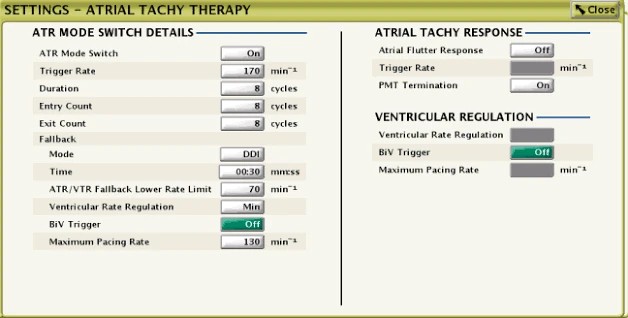
Programmer screen, Settings – Atrial Tachy Therapy (an example, not this patient’s settings): Ventricular Rate Regulation (VRR) and BiV Trigger are programmed separately for ATR fallback (left) and for normal mode (right, Ventricular Regulation), each with its own maximum pacing rate
Take home message
The problem here is not the LV lead, even though its high threshold must be watched closely: it is the conducted AF, which leaves most beats without true BiV pacing, whatever the LV counter says