ATP during charging and acceleration of tachycardia
Patient
Go to the casebook version optimized for the mobile experience
Male patient implanted with a single-chamber Ellipse defibrillator for secondary prevention in the context of ischemic cardiomyopathy
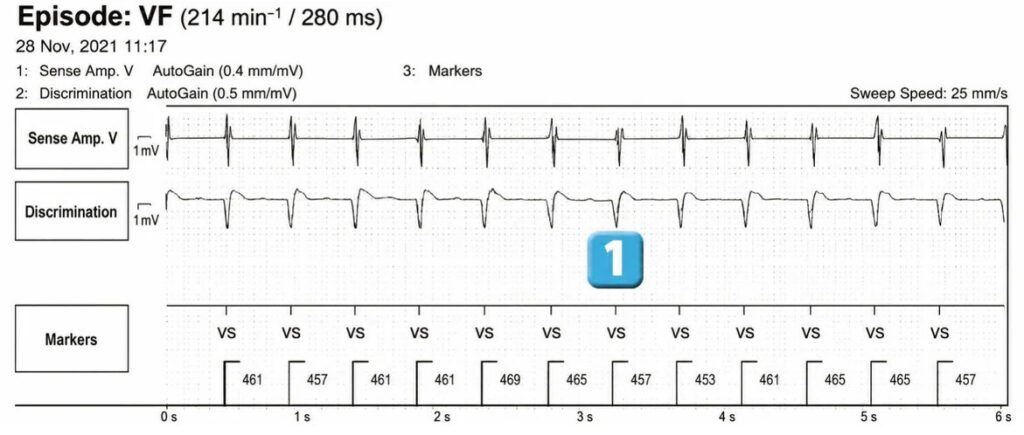
Trace
Episode 1
- sinus rhythm
- rapid, monomorphic tachycardia detected in the VF zone
- diagnosis of VF; start of capacitor charging and simultaneous emission of a burst of 8 complexes at a fixed frequency
- Acceleration of arrhythmia with identical morphology
- at the end of charging, confirmation followed by a 36-joules electric shock
- diagnosis of end of episode after 3 cycles classified as VS
Episode 2
- Sinus rhythm with PVC
- Rapid tachycardia, detected alternating between the VF zone and the VT2 zone
- diagnosis of VF after 30 cycles classified as F; start of capacitor charging and simultaneous emission of a burst of 10 complexes at a fixed frequency
- acceleration of arrhythmia with different morphology
- at the end of charging, confirmation then 30 jouless electric shock
- diagnosis of sinus return after 3 cycles classified as VS
Comments
Episode of VF treated with a burst and a 36-joules electric shock
Episode of VF treated with a burst and a 30-joules electric shock
Points to remember
- Acceleration of VT and deterioration into VF are well-documented complications following a sequence of anti-tachycardia pacing, with an incidence of around 1 to 5%, justifying the absolute necessity of programming electrical shocks asbackup in the VF zone; the effectiveness and safety of anti-tachycardia pacing are inversely related; a greater number of tachycardias can be reduced with a more aggressive protocol (short pacing intervals, more cycles per sequence, more sequences) but with an increased risk of acceleration
- •Anti-tachycardia pacing can 1) accelerate the tachycardia with a morphology identical to the previous one (first example), 2) accelerate the tachycardia with a different morphology (second example), or 3)cause organized tachycardia to degenerate into VF
- To reduce the risk of accelerating the tachycardia, the maximum stimulation frequency is programmable; the characteristics of the sequence (coupling, number of stimuli) correspond to those of the sequence programmed in the VT2 zone
- ATP before or during the load will not be delivered after treatment in another zone (e.g., accelerated VT2 in the VF zone).
Read more about related topics