

Microport - Programming during exercise
Content
Frequency control
The stimulation threshold corresponds to the smallest electrical impulse, delivered outside all natural refractory periods, capable of generating the propagation of a depolarization. It can be measured in voltage (volts) or pulse width (milliseconds).
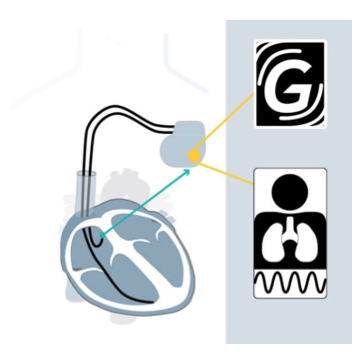
When both sensors are used:
The stimulation frequency is initially controlled by the accelerometer (G), which is the first sensor to react at the start of exercise. Then, minute ventilation (MV) takes over for the entire duration of the effort. Cross-checking of the two sensors: control only continues if both sensors are active. The G sensor detects the end of the effort, and the frequency then gradually returns to the base frequency.
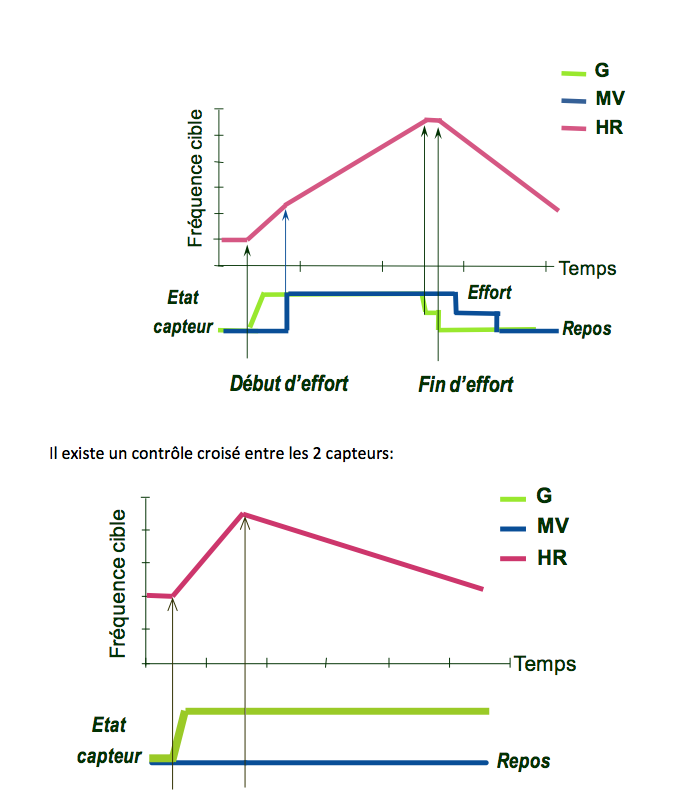
Any acceleration detected by one sensor that is not confirmed by the second sensor causes a return to the base frequency. The example above shows an incorrect activation of the G sensor corrected by minute ventilation.
Various parameters can be programmed:
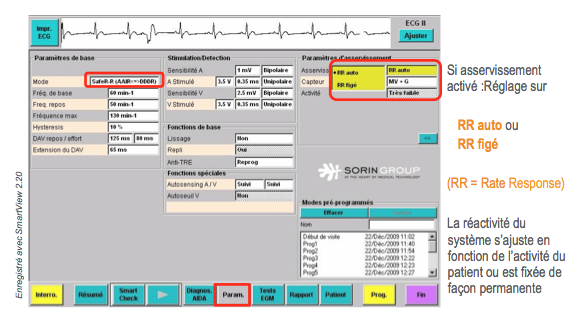
If Servo Control is set to RR fixed:
- The estimated level of the patient’s physical activity is accessible and programmable
- The responsiveness of the system is permanently fixed
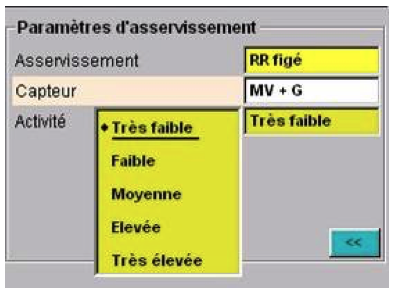
The Activity setting must correspond to the patient’s physical activity. A sedentary patient should have their Activity setting set to Low or Very low. The system is then very responsive. Light physical activity causes a rapid increase in the stimulation frequency, close to the maximum stimulation frequency.
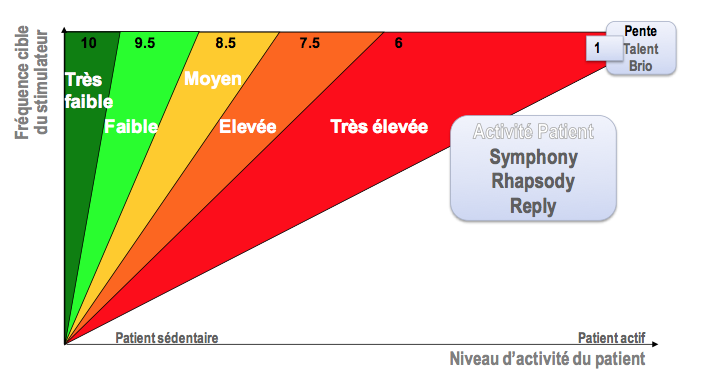
If Servo is set to RR auto (RR = Rate Response):
The estimated level of the patient’s physical activity is not accessible
The responsiveness of the system automatically adjusts according to the patient’s physical activity
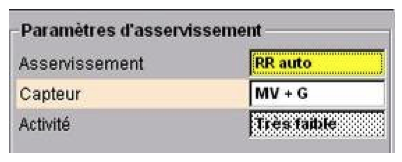
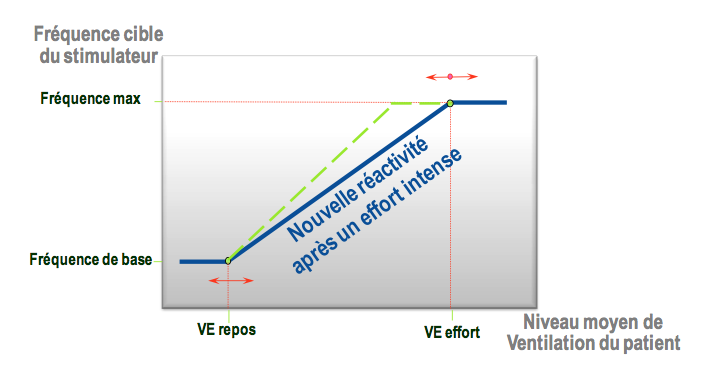
The system continuously assesses the patient’s level of physical activity. In the following example, the level of ventilation during exercise has been increased following greater exertion in terms of ventilation. Any exertion above the current level of ventilation leads to an increase in the Activity parameter (i.e., it tends toward the Very high value). Conversely, the level of ventilation during exertion is automatically reduced by a few percent each day. Thus, a patient who becomes inactive will see their Activity parameter spontaneously tend towards the Very low value within a few days. The level of ventilation at rest corresponds to the average level of ventilation during the day.