


Microport - Counters
Content
Introduction
In this first chapter dedicated to counting, the first two tracings pertain to ventricular fibrillation, the first involving an induction performed in the electrophysiology room at the time of defibrillator implantation, which will allow discussing the indication, advantages and disadvantages of the induction of ventricular fibrillation. The second is the spontaneous occurrence of ventricular fibrillation, enabling to explain the basic counting process of ventricular events.
The following cases illustrate the methods used to count ventricular events when entering the different programmed zones in order to explain the reasons for the observed delays in analysis of the tachycardias and the type of therapy generated according to the counting mode.
Indeed, counting is the most important phase of the diagnosis, even before application of the discrimination rules. Likewise, in the event of failure of a given therapy, the counting rules during the redetection phase, in addition to influencing the progression of the therapies already performed, also influence the therapies that will follow.
The interpretation of the various tracings will allow explaining the sequence of therapies available in MicroPort defibrillators. We will begin with the VF zone, followed by explanation of the therapies in the VT zone, then those in the Slow VT zone. After presenting the first cases, we will not systematically comment the counting of the cycles in the ensuing cycles, nor necessarily address the discrimination.
At the end of this chapter, the reader should be able to understand the process of events counting and the sequence of therapies based on the tachycardia zones and programmed therapies. At each tracing, the authors will endeavour to provide not only technical comments, but also a clinical analysis of the given situations encountered.
Fundamentals on the counting of ventricular events with MicroPort™ defibrillators
Rule n°1: Eight consecutive sliding cycles are analysed to determine « a majority rhythm » or « Majority ». This is the basic unit for incrementing counters. The algorithm tests the conditions listed below in order. The first condition that is fulfilled will determine the type of rhythm for this group of 8 sliding cycles analysed:
- If 75% or more of these 8 cycles (at least 6) have coupling intervals less than or equal to the Fibrillation Detection Interval (ventricular cycles within the VF zone, including those within the Fast VT section (if enabled) of the VF zone), then the rhythm is classified “VF majority”.
- If 75% or more of these 8 cycles (at least 6) have coupling intervals lower than or equal to the Tachy Detection Interval (ventricular cycles within the Slow VT zone (if enabled), the VT zone and the VF zone), then the rhythm is classified “VT majority”.
- If less than 75% of these 8 cycles (less than 6) have coupling intervals less than or equal to the Tachy Detection Interval, and the majority rhythm is not classified as Slow, then the rhythm is classified as having “No majority”.
- If 75% or more of these 8 cycles (at least 6) exhibit coupling intervals greater than the Tachy Detection Interval or are paced, then the rhythm is classified as “Slow rhythm”.
Note, the first 2 coupling intervals in the VT zone and the pacing coupling intervals are not used for this analysis.
A majority rhythm is assessed on each cycle (sliding analysis over the last 8 cycles)
Rule n°2: When the majority rhythm is classified VT, the PARAD+ criteria for dual-chamber and resynchronization defibrillators, or the Stability+/Acc criteria for single-chamber defibrillators, intervene to formally classify this rhythm. The classification then becomes binary: VT (programmed therapy) or SVT/ST (no therapy).
PARAD+ criteria:
- RR stability (stability of V intervals)
- PR association (stability of PR “As-Vs” or AR “Ap-Vs” intervals)
- Association level (1:1 or N:1)
- A or V acceleration (origin of the first sudden acceleration)
- Long V cycle (medium term instability) (this is the + of PARAD+)
Stability+/Acc criteria:
- RR stability (stability of V intervals)
- Acceleration
- Long V cycle (medium term instability) (this is the + of Stability+/Acc)
These criteria will be specifically analysed in the chapter dedicated to discrimination.
Rule n°3: Persistence counters either increment, maintain or reset their value in the following manner depending on the “majority” rhythm assessed at each cycle.
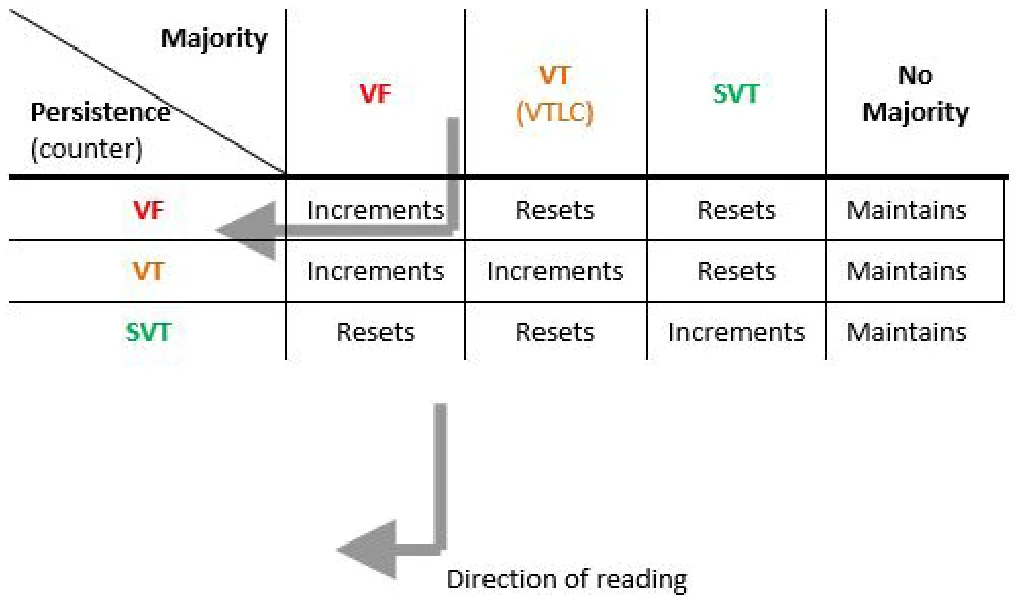
The incrementing of the counter for the fastest zone also increments the counter for slower zones.
Rule n°4: Once the first VT or VF majority rhythm is determined, a persistence phase begins (programmed in number of cycles per programmed zone).
The persistence counters for the VT and VF zones are independent. The classification of the episode (VF, VT, Slow VT, VT->SVT/ST or SVT/ST) occurs when the first persistence criterion is fulfilled for the first time. Even if the rhythm evolves and a different classification is obtained thereafter, the classification of the episode will remain that of the initial classification.
Therapies are triggered (delivered in the case of ATP) when the « arrhythmia persistence » counter has reached the programmed threshold.
Rule n°5: The classification of the episode (VF, VT, Slow VT, VT->SVT/ST or SVT/ST) occurs when the first persistence criterion is fulfilled for the first time. The tachycardia rate is determined once the persistence is reached, and calculated as the average of the last 4 cycles available in the Tachy/VF zone. This rate determines the type of action triggered according to the programming of the zones.
1 – Example for a VF: the VF majority is obtained after 6 consecutive cycles, and if the latter continues for a programmable number of persistence cycles (6 in this instance) for the VF zone (persistence fulfilled), the defibrillator starts charging the capacitors (which is the therapy programmed for a VF rate greater than 240/min in this example). If the tachycardia rate in the VF zone had been between 200 and 240/min, then a Fast VT therapy would have been induced.
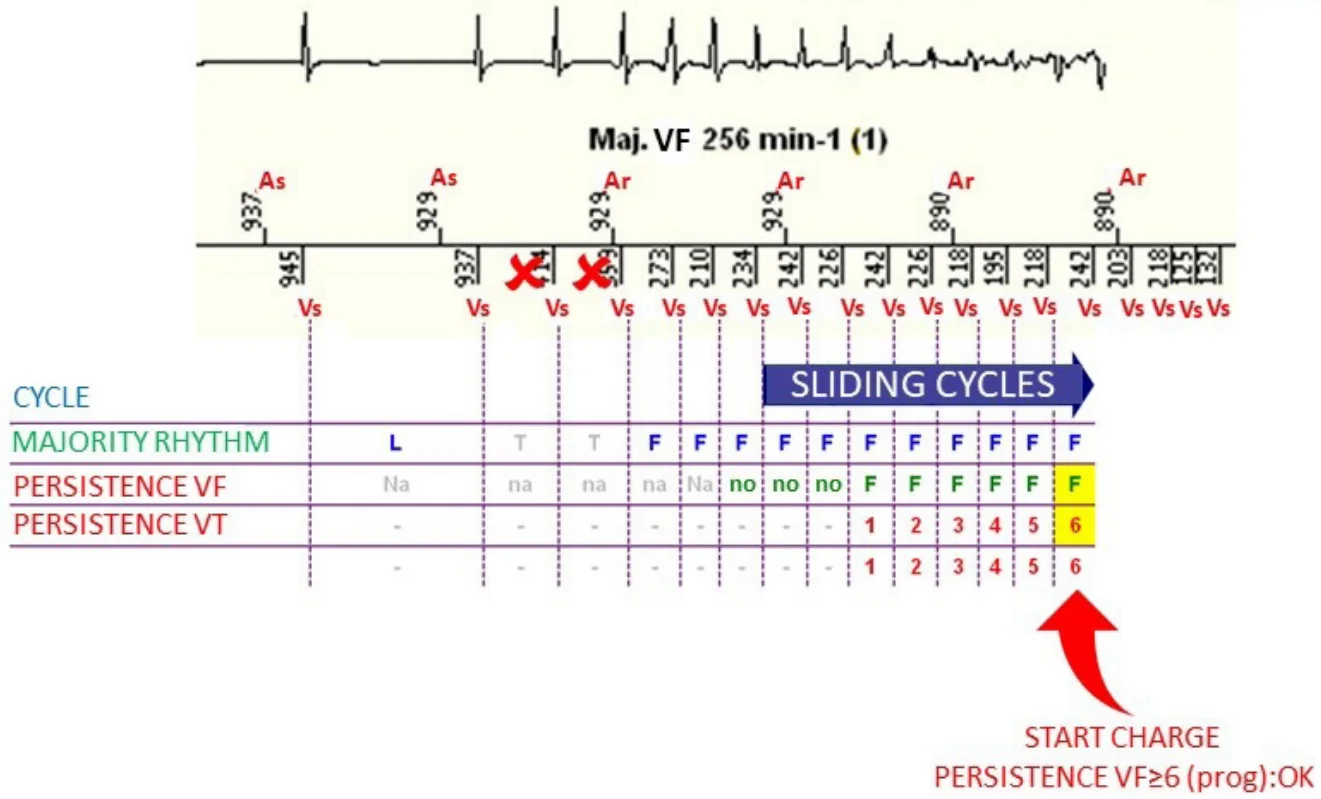
Note 1: In this example, the two first cycles are detected in the VT zone, and are not considered (see note of rule n°1), whereas the next cycles are in the VF zone and are all used for the diagnosis of VF. No VF cycles are excluded in the counting process of VF.
Note 2: Once the very first majority is obtained and displayed (in this instance: VF Maj.) on the markers, as long as the diagnosis of the majority rhythm remains unchanged, there is no new repetitive display of the majorities (VF Maj.) at each cycle.
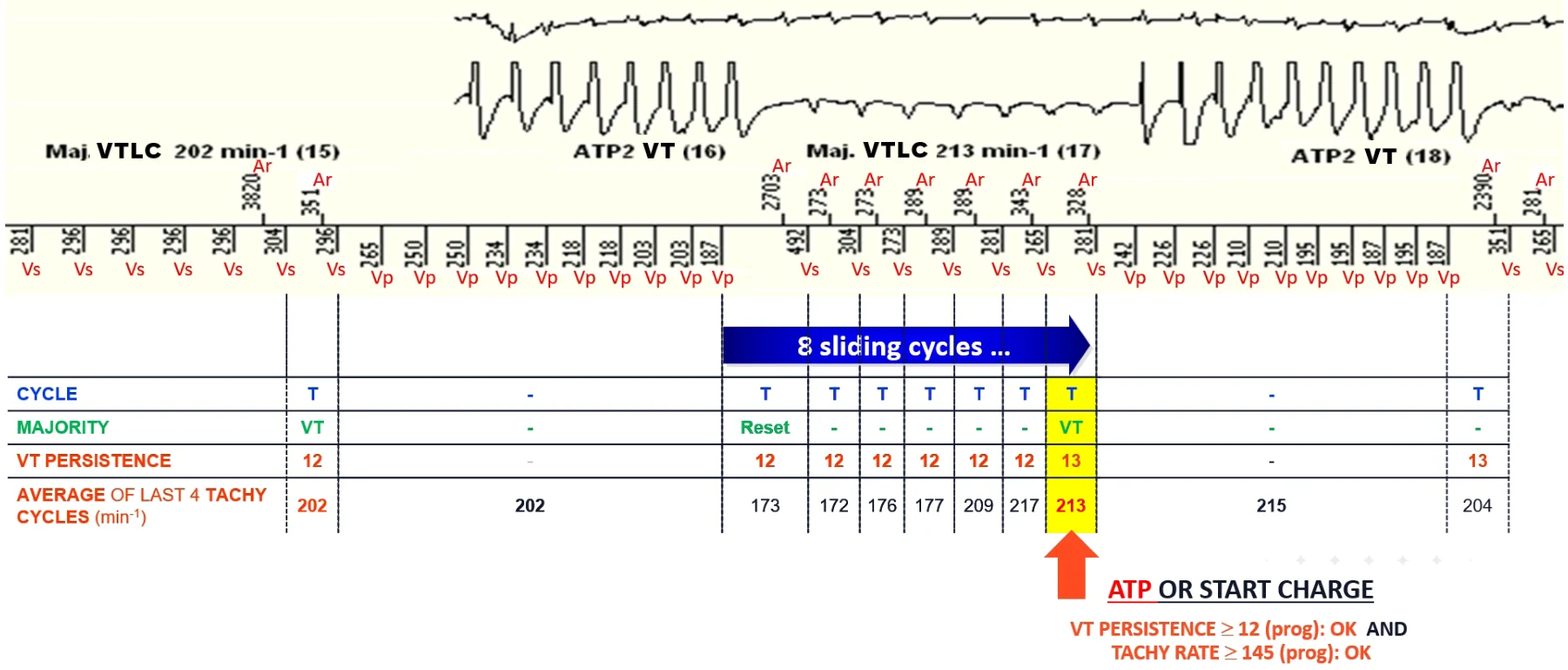
2 – Example for a VT: the VT majority is obtained after 8 cycles and if this majority continues for a programmable number of persistence cycles (12) for the VT zone (persistence fulfilled), the defibrillator initiates the ATP. At this stage, at least 6 of the last 8 cycles (8/8) are in the VT zone, have coupling intervals lower than or equal to the Tachy Detection Interval, the persistence is reached in the VT zone and the averaged rate of the last 4 Tachy/VF cycles is in the VT zone. It is therefore the first programmed therapy of the VT zone that is induced (an ATP sequence).
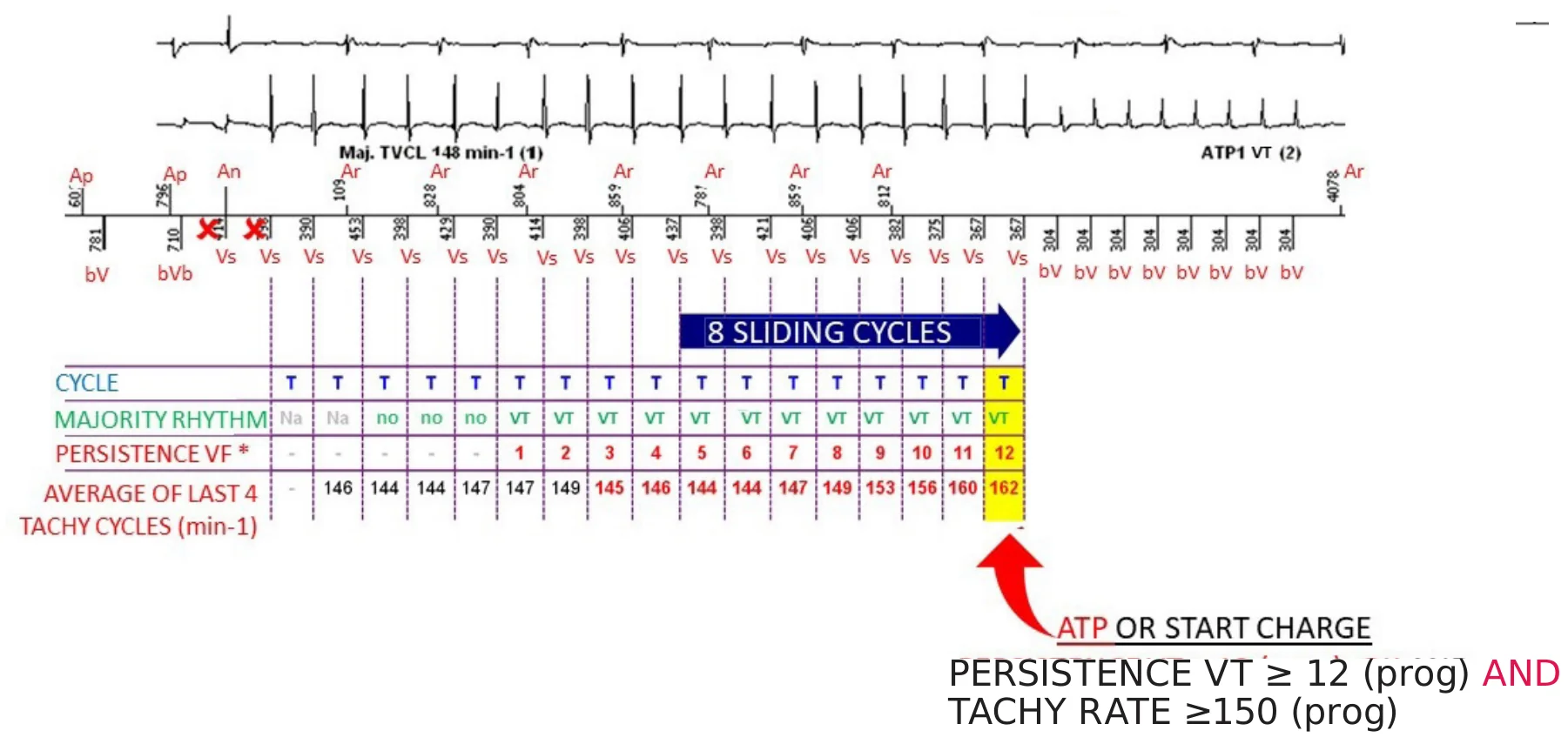
Note: Once the very first majority is obtained and displayed (VT Maj. in this instance) on the markers, given that the diagnosis of the majority rhythm remains unchanged, there is no new repetitive display of the majorities (VT Maj.) at each cycle.
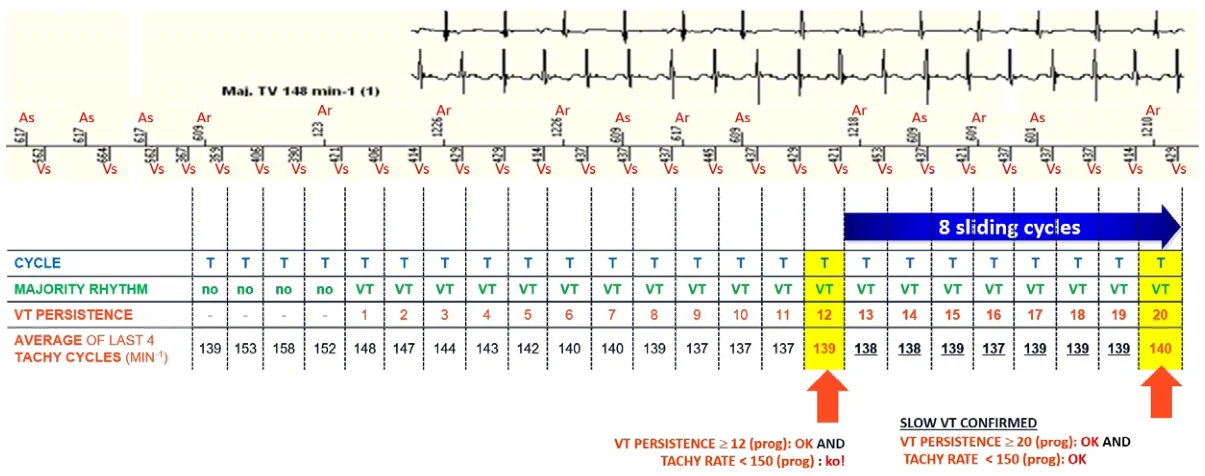
3- Example for a Slow VT: the VT majority is obtained after 8 cycles, and the majority counter continues during the persistence, although at the end of this persistence, the tachycardia rate is not in the VT zone, but in the Slow VT zone: the Slow VT persistence continues to the programmed number of cycles (20 in this instance) which fulfils the persistence in the Slow VT zone. Upon completion, the VT majority is still detected and the average of the last 4 intervals is in the Slow VT zone, the persistence is fulfilled, the defibrillator just starts recording the episode without delivering therapy because no therapy is programmed in the slow VT zone in this example. Otherwise, the therapies available in this area would have been applied.
Rule n°6: After a therapy, a redetection phase is initiated. The majority criterion is then reset to 0, although the persistence counters are not reset. Their value remains that of the persistence values prior to the therapy. A new VT or VF majority (at least 6 out of 8 cycles) is therefore required to deliver the next therapy while respecting the other stated rules, namely the number of programmed persistence cycles, the averaged rate of the last 4 Tachy/VF cycles in the VT zone, and the zone-specific programmed therapies. Note that the first post-ATP cycle in the VT zone is not used.
1 – Example of tachycardia redetection in the VT zone. The first cycle is not taken into account after the therapy, thereafter the 6/8 cycles criterion fulfills the VT majority, the persistence is maintained at 12 (not reset after the therapy) and is incremented on the last cycle regaining the majority rhythm, with the averaged rate of the last 4 Tachy/VF cycles is in the VT zone; the second available therapy programmed for the VT zone is triggered.
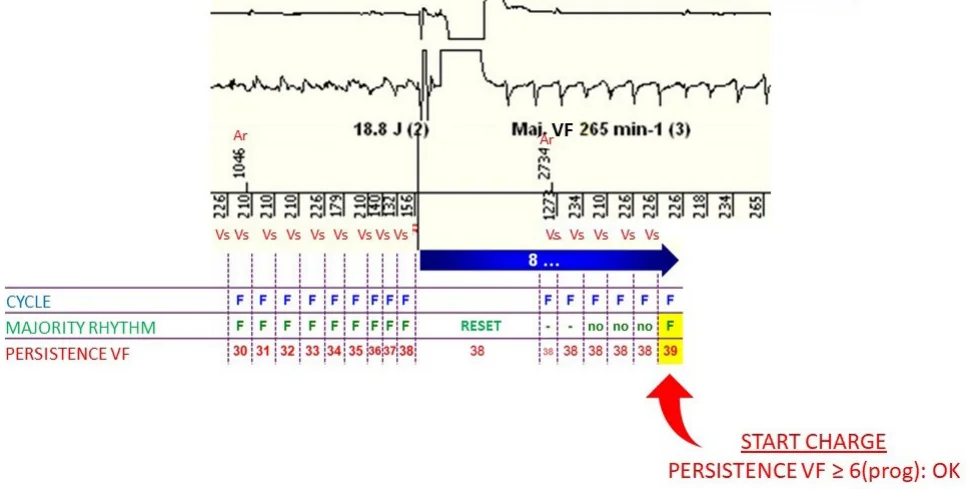
2 – Example of a VF majority redetection in the Fast VT zone (150 – 240 bpm): After delivery of the shock due to ventricular fibrillation, a tachycardia appears. After the post-shock blanking period (1s), a VF majority appears immediately following 6 VF cycles. The persistence is the same as that observed before the shock and is maintained. Then, the averaged rate of the last 4 Tachy/VF cycles is in the Fast VT zone; hence it is the next therapy programmed in the Fast VT zone that is triggered, i.e. a shock.
3 – In detection or redetection, when the Slow Rhythm majority criterion is fulfilled, the episode is considered terminated, and all tachycardia and fibrillation counters are reset. The current status of the therapy programs is also reset.
Conclusion and reminder
- The prevailing element in the counting of ventricular events by MicroPort defibrillators is a basic analysis on 8 sliding cycles with a search for the majority rhythm (or diagnosis) (at least 6 out of 8 cycles).
- The duration of a persistence phase (programmed in number of cycles) is dependent on the zone in which the tachycardia was diagnosed. During the course of obtaining this persistence, the diagnosis can evolve, with this analysis of majority cycles in the fastest zone also leading to the counting in slower zones.
- If 3 zones have been programmed (Slow VT, VT, and VF), a VF majority also causes incrementation of the counters in the slower zones of the Slow VT and VT. A VT or Slow VT majority also causes the increment of the VT or Slow VT zone counter, but resets to 0 the VF zone counter.
- The first attained persistence carries the definite diagnosis of tachycardia, and consequently the eventual programmed therapy.
- A diagnosis of SVT/ST during VT or VF persistence resets the persistence counter to zero, which resumes only if a new diagnosis of Slow VT, or VT, or VF has been established and for the required number of cycles corresponding to the zone of the new tachycardia event.
The delivery of a therapy, in particular a shock, is subject to conditions (a verification cycle):
- At the time of delivering the VF therapy, the VF persistence counter is always equal or higher than the programmed threshold, the majority rhythm analysis is still VF and the current cycle is in the VF zone.
- At the time of delivering the VT therapy, the VT persistence counter is always equal or higher than the programmed threshold, the majority rhythm analysis is still VT and the current cycle is in the VT zone.
If these conditions are not fulfilled, the device will verify the next cycle in order to deliver its programmed therapy.
For more information on Counters in MicroPort ICDs, please see: 4. Counters – MicroPort Academy.