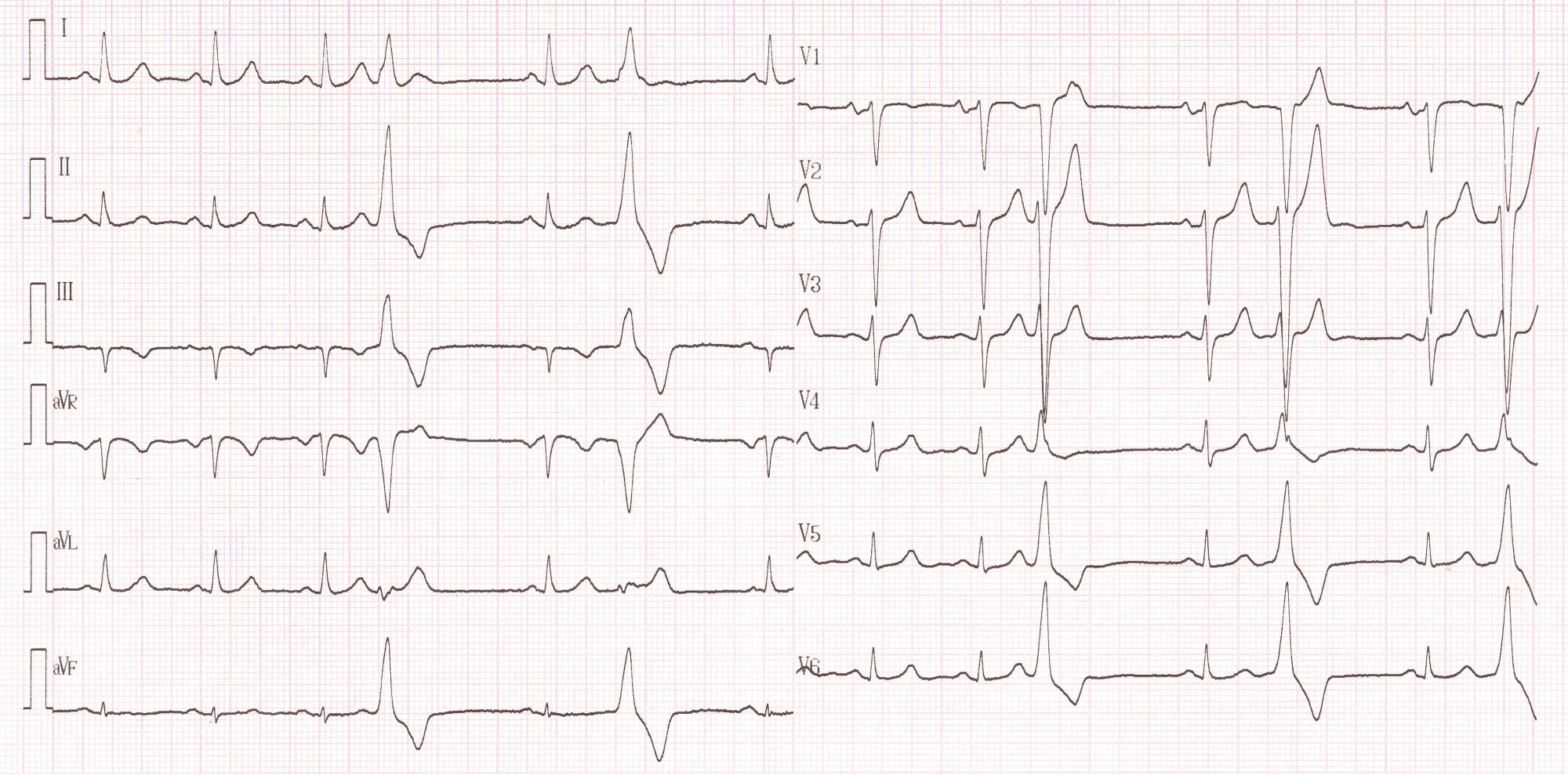
Homme de 42 ans suivi par son cardiologue pour des signes d'extrasystoles ventriculaires ; sensations de palpitations survenant pendant la phase de récupération après un effort physique ;
Description de l'ECG
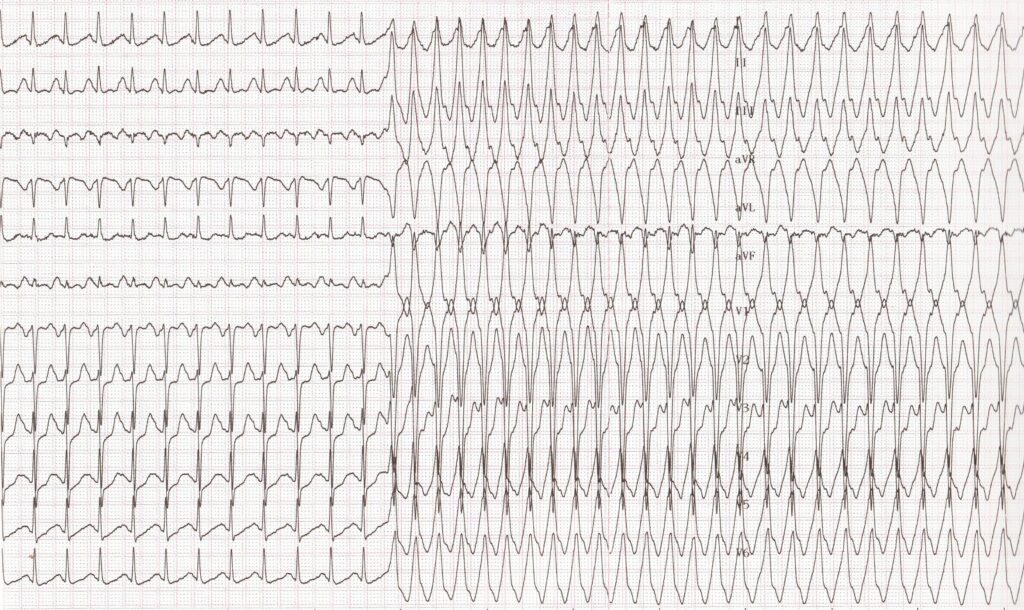
Un bilan complet est réalisé (échocardiographie, potentiels tardifs ventriculaires, test d'effort, IRM) sans qu'aucune anomalie ne soit détectée ; un test à l'isoprotérénol est effectué : pendant la phase de récupération, une tachycardie sinusale suivie d'une tachycardie à 200 bpm présentant une morphologie identique à celle des extrasystoles ; reproduction clinique de la symptomatologie ressentie par le patient au moment des palpitations ; hémodynamique préservée et arrêt spontané après 20 secondes de tachycardie ;
Explication
Ce patient a donc présenté des épisodes de tachycardie ventriculaire infundibulaire droite. Ce type de tachycardie est considéré comme bénin et s’observe classiquement chez de jeunes patients, âgés en moyenne de 20 à 40 ans, ne présentant pas de cardiopathie, sans prédominance masculine ou féminine. Le tableau clinique varie, allant de patients parfaitement asymptomatiques à des patients décrivant des palpitations, des lipothymies et, plus rarement, des syncopes. Deux types de distribution des arythmies ont été décrits, tous deux associés à une évolution clinique généralement favorable : des épisodes isolés mais incessants, ou des épisodes soutenus, paroxystiques et récurrents. Une composante adrénergique dans la survenue des arythmies a été mise en évidence chez certains patients, la majorité des épisodes survenant pendant ou juste après un effort physique. Le stress, la caféine ou certaines phases du cycle menstruel chez les femmes peuvent également favoriser leur apparition. La tachycardie ventriculaire infundibulaire est généralement bien tolérée puisqu’elle survient chez des patients ne présentant pas de cardiomyopathie. La description de certains cas isolés de mort subite pourrait remettre en cause sa nature prétendument bénigne, mais doit avant tout inciter à reconsidérer, dans ce contexte, un diagnostic différentiel tel que la dysplasie ventriculaire droite.
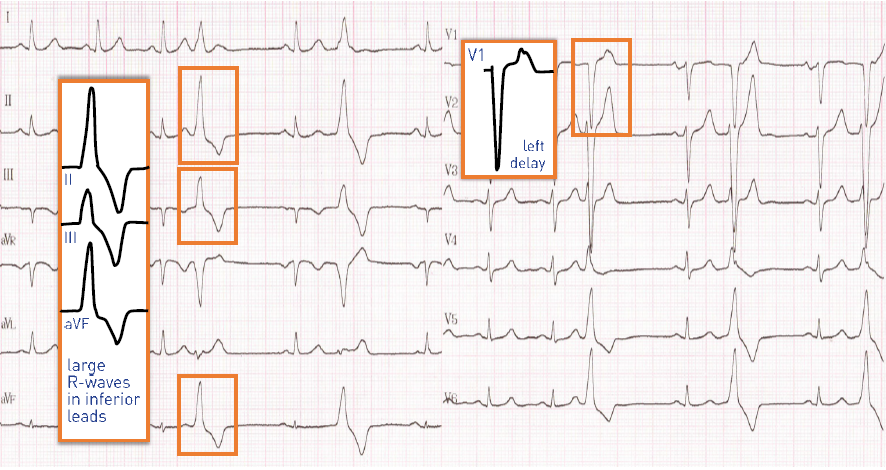
Les tachycardies infundibulaires bénignes présentent certaines caractéristiques électrocardiographiques :
• retard gauche et axe inférieur ;
• l'activité auriculaire est souvent dissociée, même en cas de conduction rétrograde de type 1:1 ;
• La durée du QRS n’est généralement que modérément allongée (type 1) et se manifeste en V3 ou V4, alors qu’elle survient souvent plus tôt lorsqu’elle trouve son origine dans la voie d’éjection du ventricule gauche ou au niveau d’une cuspide coronaire ; bien que la plupart de ces tachycardies présentent un retard gauche, certains cas de retard droit ont été décrits, l’origine ventriculaire gauche ne faisant alors plus aucun doute ;
• hormis la tachycardie, l’électrocardiogramme est le plus souvent normal, bien qu’environ 10% de ces patients présentent un bloc de branche droit complet ou incomplet ; dans le cadre du diagnostic différentiel, il est important de rechercher les signes évocateurs d’une dysplasie ventriculaire droite arythmogène (ondes T négatives en V1-V3, onde epsilon, polymorphisme des extrasystoles, etc.) ;
Le diagnostic de tachycardie ventriculaire idiopathique chez un cœur sain doit être posé après avoir écarté certaines pathologies. Comme expliqué plus haut, dans le cas d’une tachycardie ventriculaire avec retard gauche, le principal diagnostic différentiel est la dysplasie arythmogène du ventricule droit : l’évaluation consiste donc à réaliser des potentiels tardifs (le plus souvent négatifs), une échocardiographie (absence de cardiopathie), un dosage normal du BNP, ainsi qu’un test à l’isoprotérénol pouvant favoriser l’apparition d’arythmies, mais sans polymorphisme identifié (morphologies multiples). La réalisation d’une IRM constitue actuellement l’examen de référence pour exclure le diagnostic de dysplasie, car elle permet une analyse morphologique et dynamique détaillée du ventricule droit.
Commentaire
Contrairement à un grand nombre de tachycardies ventriculaires (post-infarctus, fasciculaires, dysplasiques, etc.), le mécanisme impliqué dans cette arythmie n’est pas une réentrée, mais une activité déclenchée sensible à l’AMPc, associée à des potentiels post-potentiels tardifs (oscillation du potentiel membranaire au cours de la phase 4 du potentiel d’action). L’apparition de ces activités déclenchées est favorisée par l’élévation de la concentration intracellulaire en calcium ou par une libération de catécholamines. Au niveau cellulaire, c’est l’élévation de la concentration plasmatique en AMPc qui constitue le facteur déterminant, ce qui aura un impact significatif sur les traitements thérapeutiques à proposer. Toute situation entraînant une augmentation de la concentration intracellulaire d’AMPc a un effet proarythmique (l’isoprotérénol, par exemple). À l’inverse, toute situation entraînant une diminution de cette concentration a un effet antiarythmique (les bêtabloquants, le vérapamil).
La décision de traiter doit tenir compte de la présence de symptômes et de leur gravité, le pronostic de ces patients étant a priori inchangée. L'efficacité à long terme des bêtabloquants ou du vérapamil est modeste. Lorsque le traitement médical est peu efficace ou mal toléré, une ablation par radiofréquence peut être proposée. L’induction de la tachycardie est plus souvent réalisée par injection d’isoprotérénol que par stimulation ventriculaire programmée (il ne s’agit pas d’une réentrée). Le taux de réussite est élevé et le taux de récidive et de complications est limité.
Description du tracé
Un bilan complet est réalisé (échocardiographie, potentiels tardifs ventriculaires, test d'effort, IRM) sans qu'aucune anomalie ne soit détectée ; un test à l'isoprotérénol est effectué : pendant la phase de récupération, une tachycardie sinusale suivie d'une tachycardie à 200 bpm présentant une morphologie identique à celle des extrasystoles ; reproduction clinique de la symptomatologie ressentie par le patient au moment des palpitations ; hémodynamique préservée et arrêt spontané après 20 secondes de tachycardie ;
À retenir
La tachycardie ventriculaire d'origine dans la voie d'éjection ventriculaire droite survient de préférence chez un patient jeune ne présentant pas de cardiopathie, avec un tracé électrocardiographique caractéristique : tachycardie monomorphe, complexe QRS légèrement élargi, retard gauche et axe inférieur, dissociation auriculo-ventriculaire. Une transition précordiale tardive (R/S > 1) (dans les dérivations V3, V4 ou V5) suggère une origine au niveau de la voie d'éjection du VD.