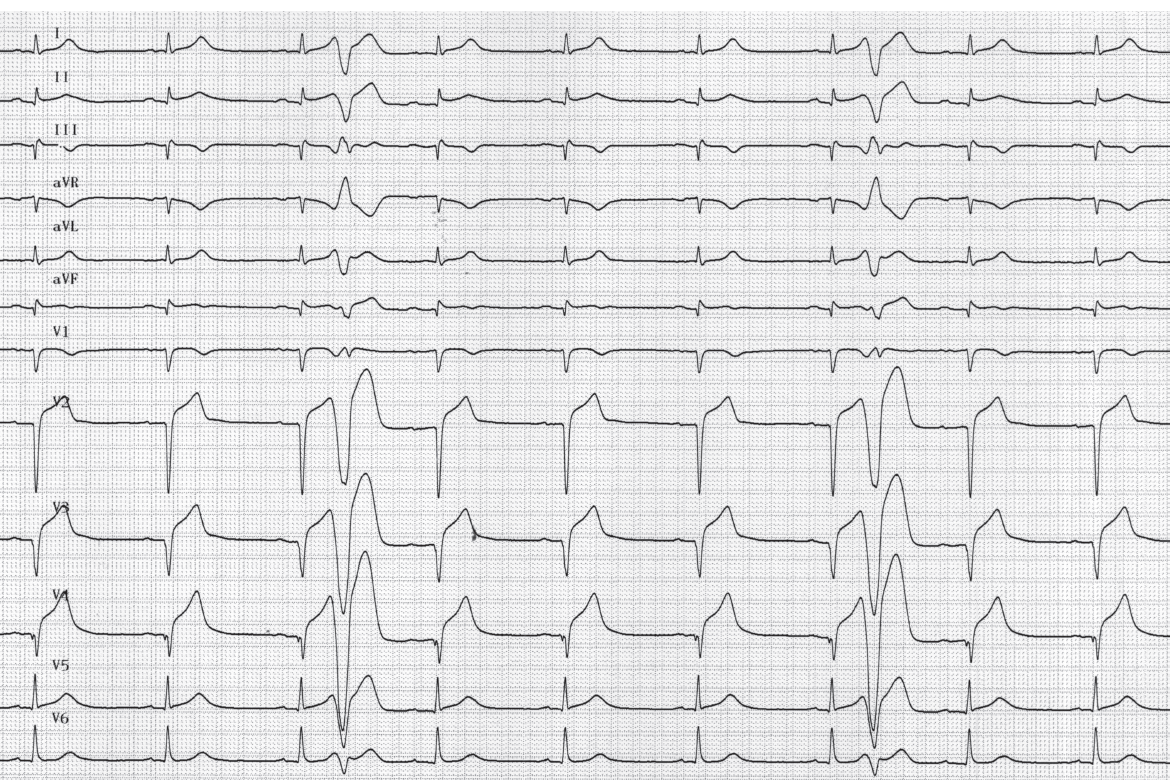
Tracé 8.10 : Fibrillation ventriculaire ischémique
Informations destinées aux patients
Homme de 61 ans présentant des facteurs de risque (tabagisme actif et dyslipidémie), admis en unité de soins intensifs pour un syndrome coronarien antérieur aigu ; une angioplastie avec pose d’un stent a été réalisée au niveau de l’artère coronaire interventriculaire antérieure 12 heures après l’apparition des symptômes ; fraction d’éjection ventriculaire gauche fortement réduite (30%) ; 10 jours après cet épisode, nouvelle hospitalisation pour une mort subite dont il s'est remis ;
ECG
Question
Quel(s) est (sont) le(s) diagnostic(s) possible(s) d'après cet ECG ?
Commentaires
Description de l'ECG
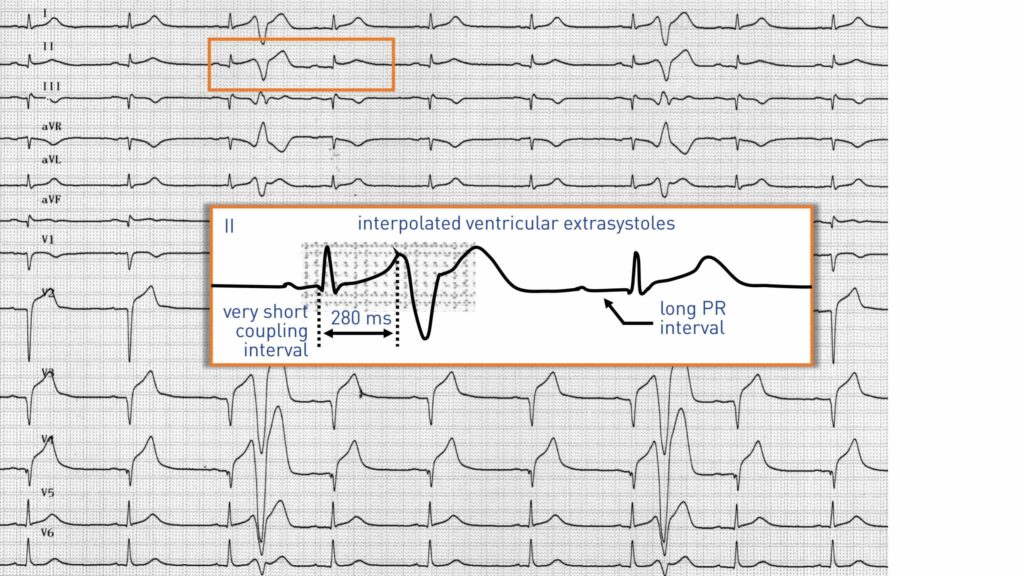
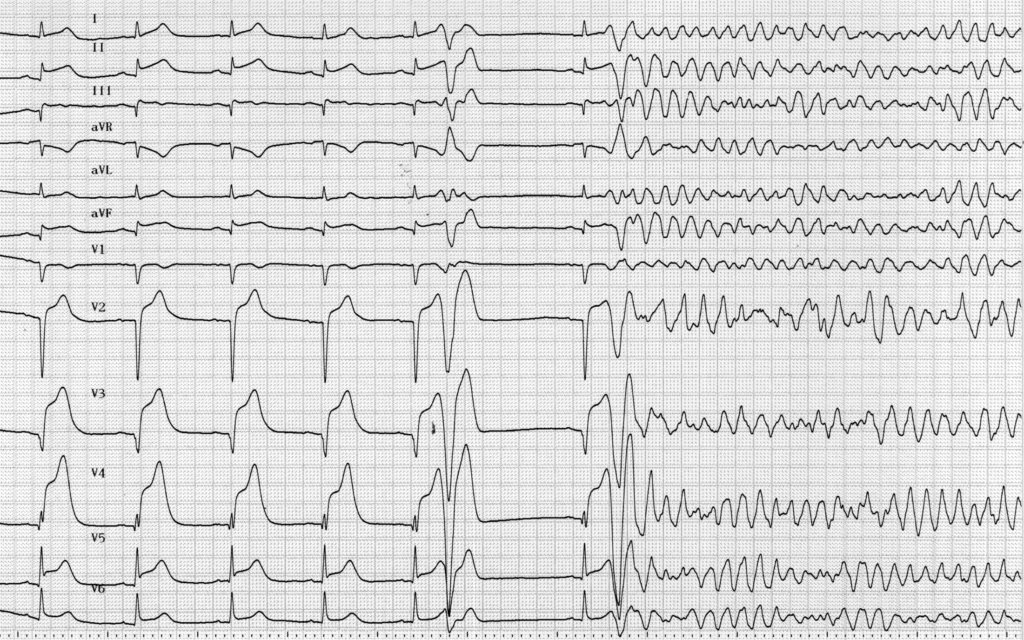
Rythme sinusal ; signes d'un infarctus antérieur étendu (onde Q des dérivations V1 à V4 et dans les dérivations inférieures) ; persistance d'une élévation du segment ST indiquant une reperfusion incomplète ou tardive ; deux extrasystoles ventriculaires interpolées (sans variation du rythme sinusal) avec un intervalle de couplage très court (couplage de 280 ms) ; ces extrasystoles proviennent de la paroi septo-apicale du ventricule gauche ; les ondes P qui suivent sont conduites avec un intervalle PR long (conduction masquée de l’extrasystole) ;
Explication
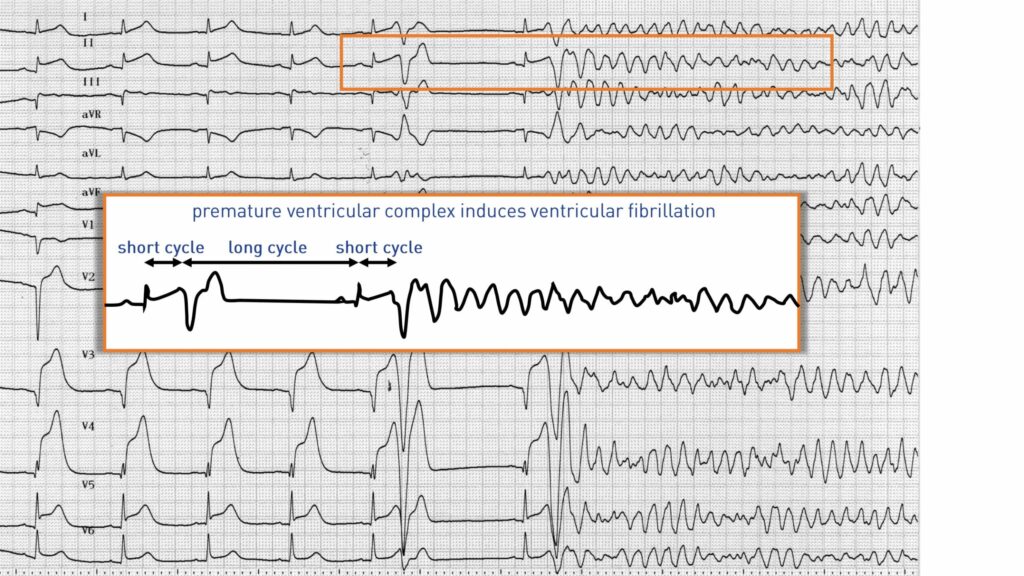
Les causes de la mort subite à la suite d’un infarctus du myocarde sont multifactorielles et varient en fonction du délai écoulé depuis l’apparition des symptômes. Une fibrillation ventriculaire d’origine ischémique est responsable de la plupart des décès survenant pendant la phase préhospitalière. L’incidence diminue ensuite progressivement, bien que le risque reste présent, en particulier lorsque l’infarctus est étendu et que la reperfusion est tardive. Des épisodes de fibrillation ventriculaire peuvent également survenir à un stade tardif de l’hospitalisation chez les patients présentant une nécrose étendue touchant principalement la région antérieure. Une télémétrie prolongée est donc recommandée chez les patients présentant une nécrose étendue avec reperfusion tardive, d’autant plus que l’on observe fréquemment des extrasystoles ventriculaires précoces et polymorphes. L’apparition d’une fibrillation ventriculaire se produit le plus souvent selon une succession de cycles courts (extrasystole ventriculaire) – cycles longs (pause compensatoire) – cycles courts (nouvelle extrasystole). Ce patient a présenté de multiples épisodes de fibrillation ventriculaire quelques jours après un infarctus du myocarde étendu avec reperfusion tardive, malgré un traitement par bêtabloquants et une sédation temporaire. Une angiographie coronarienne de contrôle n’a révélé aucune resténose intra-stent. Une ablation a été réalisée, mettant en évidence un potentiel de Purkinje au milieu de la cicatrice. Les épisodes d’arythmie étaient déclenchés par l’apparition d’extrasystoles ventriculaires provenant des fibres de Purkinje qui avaient survécu dans des conditions anaérobies. L’intervention d’ablation a permis de remédier à une situation très compromise, caractérisée par des épisodes récurrents d’arythmies ventriculaires polymorphes qui conduisaient quasi systématiquement au décès. Dans ce contexte, le rôle majeur du système de Purkinje et des cellules situées dans la zone limitrophe a été démontré et validé par la diminution, voire la disparition, des arythmies après une ablation localisée.
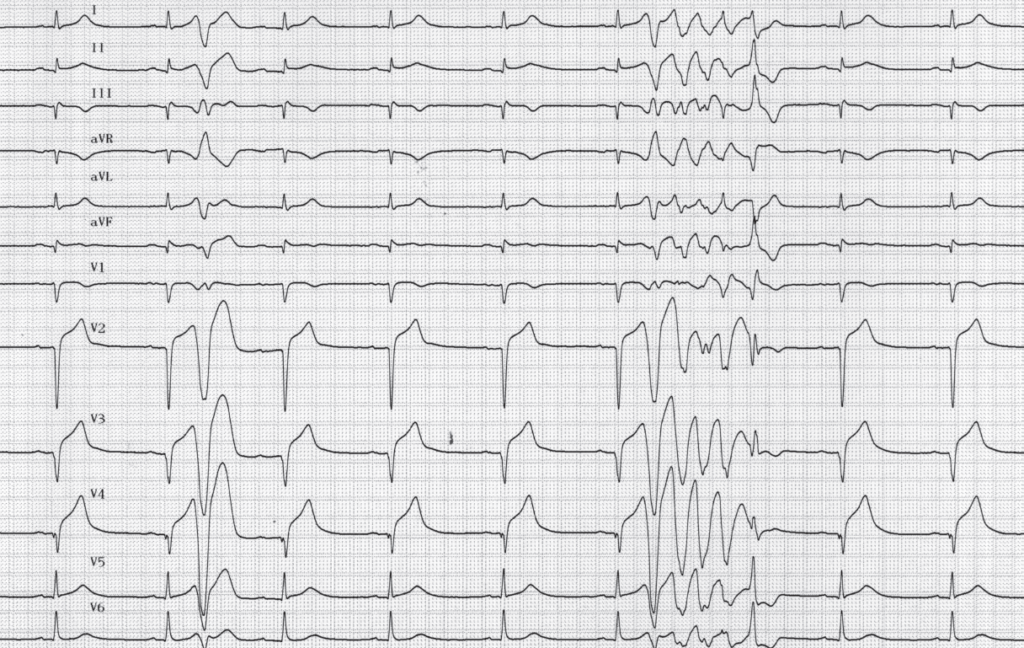
Description du tracé
Morphologie identique de l'extrasystole ventriculaire ; extrasystole déclenchant une salve de tachycardie ventriculaire polymorphe non soutenue ;
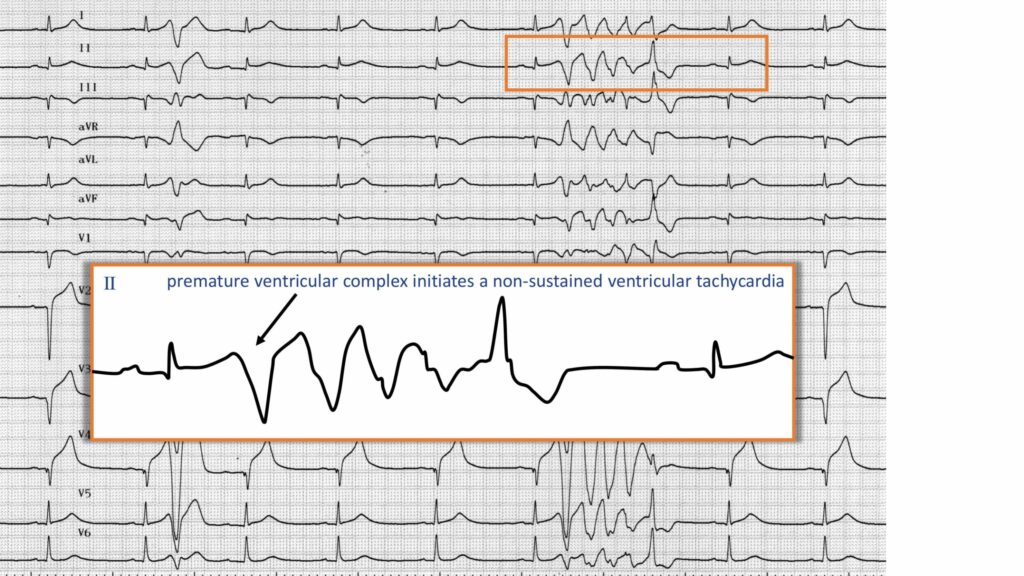
Description du tracé
Extrasystole ventriculaire présentant une morphologie légèrement différente ; conduction auriculaire rétrograde et pause compensatoire après l'extrasystole ; une deuxième extrasystole ventriculaire provoquant un épisode de fibrillation ventriculaire (tachycardie à QRS large, irrégulière, polymorphe, désorganisée, avec des oscillations hautes et une perte d’alternance entre les systoles et les diastoles) ; apparition soudaine de l'arythmie après une extrasystole ventriculaire et une séquence cycle court-cycle long-cycle court ; un choc électrique a été nécessaire pour rétablir le rythme sinusal ;
À retenir
À la suite d'une cicatrice myocardique, la survie des fibres de Purkinje dans des conditions anaérobies pourrait contribuer à l'apparition d'une fibrillation ventriculaire et d'une mort subite.