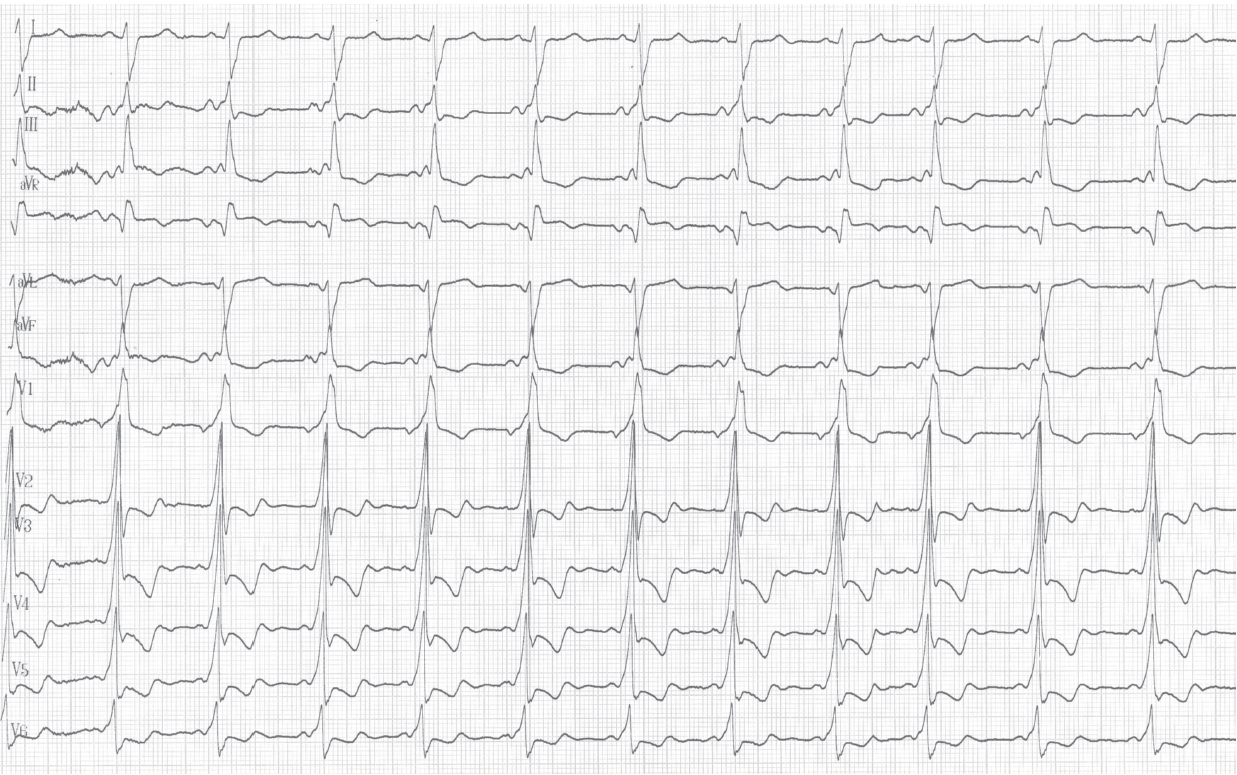
Tracé 7.10 : Syndrome de Wolff-Parkinson-White et bloc AV
Informations destinées aux patients
Homme de 79 ans, sans antécédents connus ni symptômes de palpitations, hospitalisé pour plusieurs épisodes de lipothymie ;
ECG
Question
Quel(s) est (sont) le(s) diagnostic(s) possible(s) d'après cet ECG ?
Commentaires
Description de l'ECG
Ce tracé, réalisé dès l'arrivée aux urgences, présente un tracé typique d'une voie accessoire latérale gauche (PR court et onde delta) avec un schéma de pré-excitation important et un complexe QRS très large ;
Explication
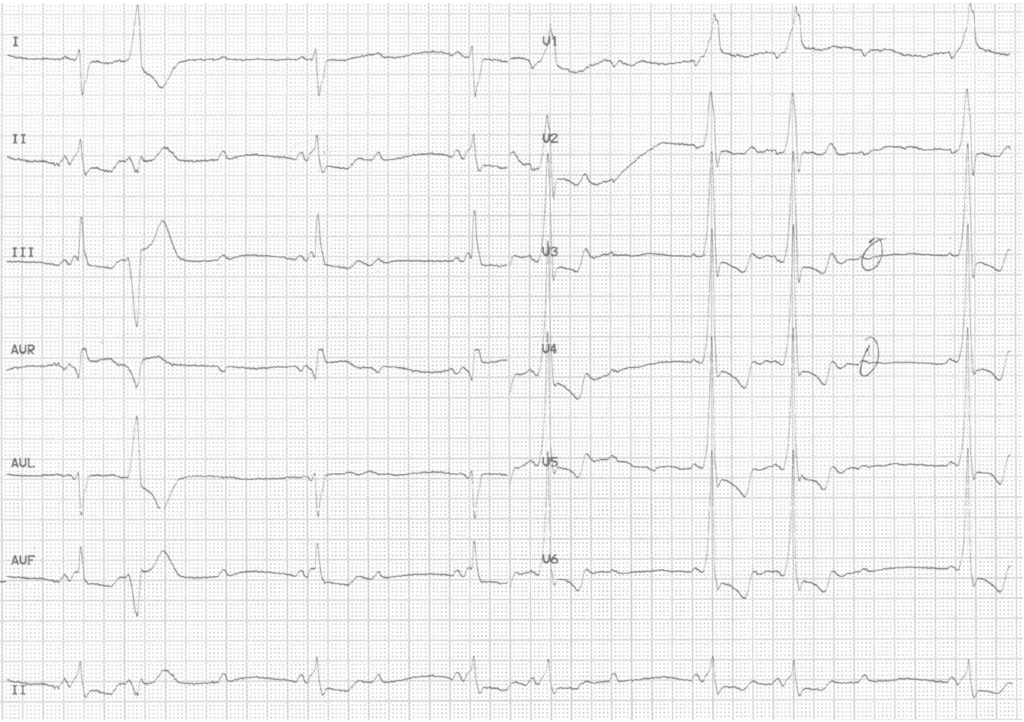
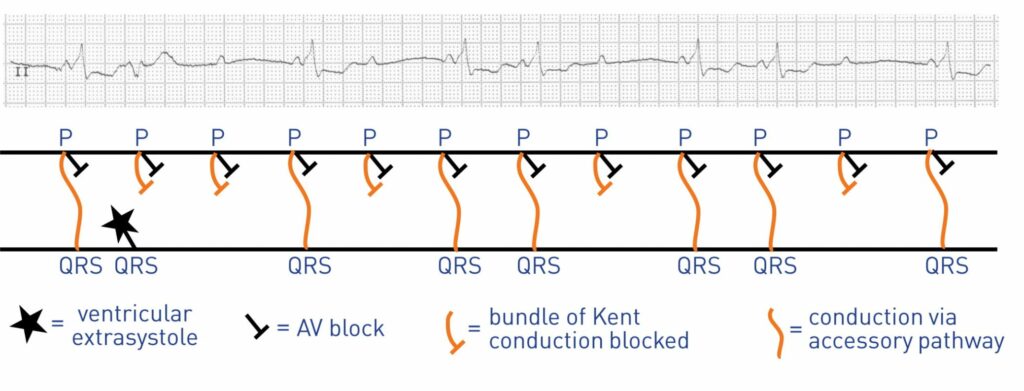
Chez un patient atteint du syndrome de Wolff-Parkinson-White, le rythme sinusal est généralement transmis aux ventricules par deux voies distinctes : le nœud auriculo-ventriculaire et le faisceau de Kent ; le complexe QRS reflète la fusion de ces deux activations. Le cas présent illustre un cas rare de bloc auriculo-ventriculaire complet sur la voie de His associé à un bloc du deuxième degré sur la voie accessoire. La conduction antérograde est donc interrompue de manière paroxystique, ce qui entraîne l'apparition de vertiges. On pouvait déjà suspecter un bloc auriculo-ventriculaire complet compte tenu du tracé présentant une pré-excitation totale sur le premier enregistrement, ce qui est rare dans le contexte d’une voie accessoire latérale gauche. Les patients atteints du syndrome de Wolff-Parkinson-White se plaignent beaucoup plus de palpitations et d’épisodes de tachycardie que de problèmes liés à la bradycardie. En effet, la voie accessoire exerce normalement un effet protecteur en cas de bloc de conduction sur la voie nodale-hisienne. En présence d’un épisode syncopal, on soupçonne généralement l’apparition d’une tachycardie rapide (orthodromique, antidromique ou fibrillation auriculaire). Chez ce patient, un trouble de la conduction touchant les deux voies était à l’origine des symptômes décrits. Un stimulateur cardiaque double chambre a été implanté et les contrôles effectués à distance ont montré un pourcentage élevé de stimulation ventriculaire, indiquant la présence d’un trouble de la conduction permanent.
Description du tracé
Sur ce deuxième tracé, on observe des ondes P sinusales bloquées et des ondes P suivies d'une pré-excitation ventriculaire identique à celles du tracé précédent ; ce tracé suggère la présence d'un bloc complet des voies de conduction auriculo-ventriculaires normales, ce qui explique le schéma de pré-excitation maximale (conduction exclusive par la voie accessoire) et un bloc du faisceau de Kent du deuxième degré (alternance entre ondes P conduites et ondes P bloquées) ;
À retenir
Un patient présentant une voie accessoire perméable antérograde présente un schéma de pré-excitation complète (pré-excitation maximale) à la suite d'un bloc de conduction sur la voie nodohisienne. Dans ce contexte, la voie accessoire exerce généralement un effet protecteur.