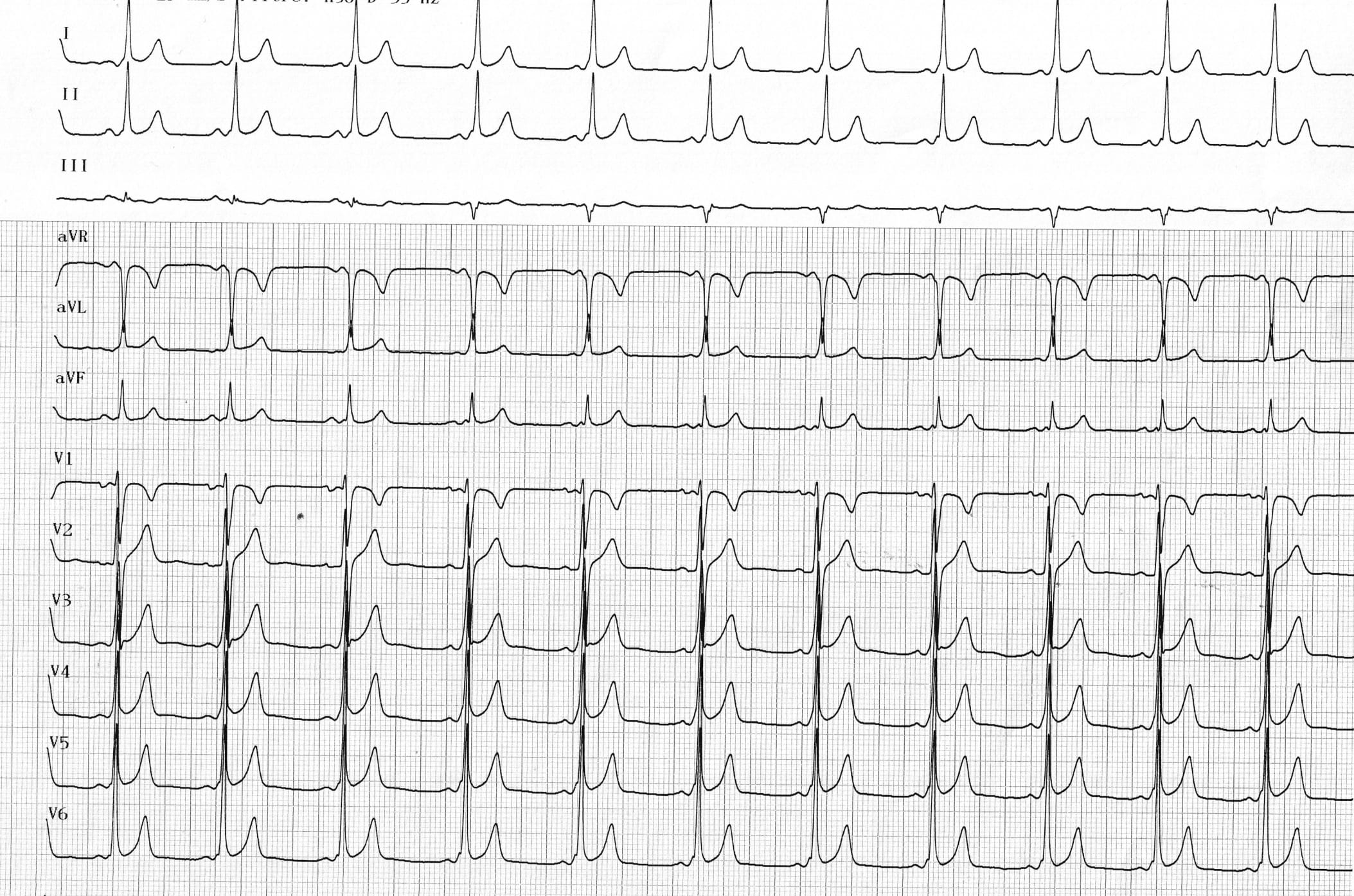
Trace 7.1 : Voie accessoire, faisceau de Kent, syndrome de Wolff-Parkinson-White
Informations destinées aux patients
Jeune homme de 21 ans, candidat à un poste de pompier professionnel, orienté vers notre service pour l'examen d'un tracé cardiaque anormal ; il présentait des épisodes de tachycardie d'apparition et de disparition soudaines ;
ECG
Question
Quel(s) est (sont) le(s) diagnostic(s) possible(s) d'après cet ECG ?
Commentaires
Description de l'ECG
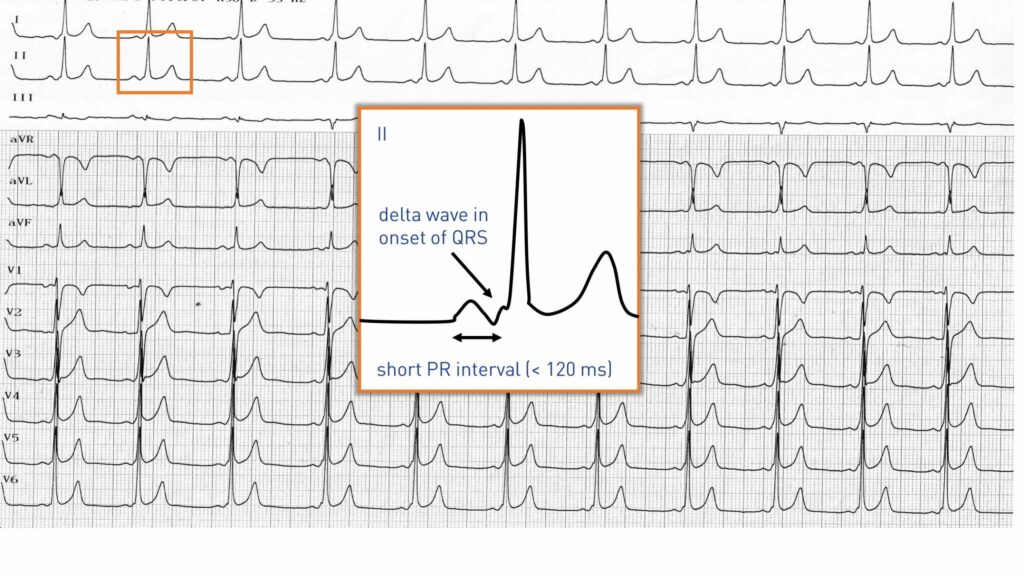
Cet électrocardiogramme présente un tracé typique de pré-excitation ventriculaire : intervalle PR court (< 120 ms), onde delta au début du complexe QRS, délai PJ non prolongé, partie terminale du complexe QRS sans anomalie ;
Explication
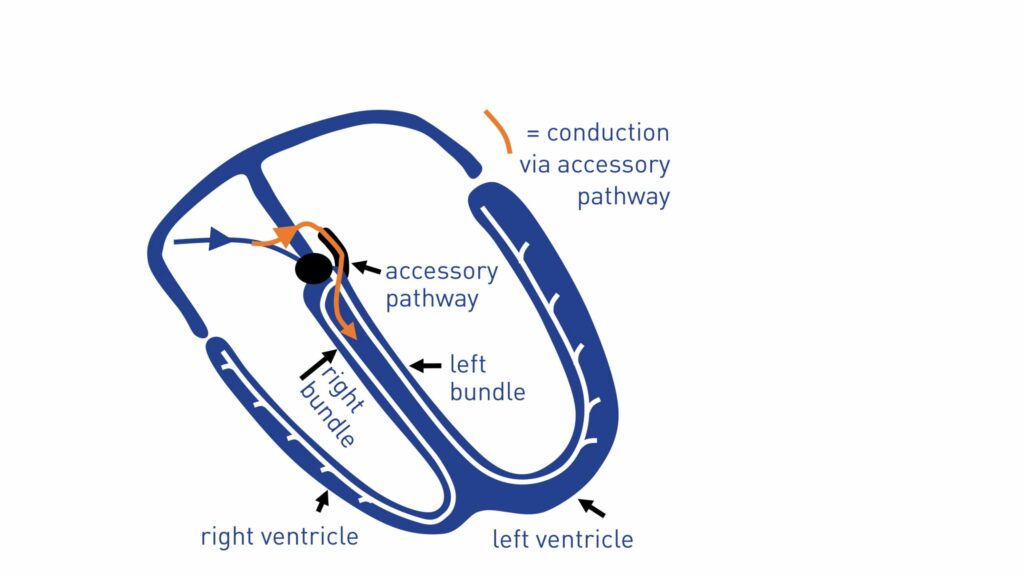
Ce jeune patient présente une voie accessoire avec une conduction antérograde intermittente. La conduction dans une voie accessoire fonctionne selon le principe du « tout ou rien » : soit le faisceau est en période réfractaire, soit il ne l’est pas, et l’impulsion est transmise ou non aux ventricules. La période réfractaire antérograde de cette voie est longue ; une activité auriculaire lente est donc nécessaire pour que la pré-excitation devienne visible. À une fréquence cardiaque plus élevée, l’électrocardiogramme est normal (bloc de phase 3). Ce type de voie accessoire est considéré comme bénin, car une longue période réfractaire protège le patient du risque de mort subite secondaire à une fibrillation auriculaire rapide conduite par cette voie. En revanche, ce profil particulier est associé à une période réfractaire rétrograde courte de la voie, et ce patient présentait une tachycardie par réentrée orthodromique (bonne conduction rétrograde) accompagnée d’une symptomatologie invalidante. Compte tenu de la fréquence des crises (tachycardies quotidiennes), le patient a subi une ablation d’une voie antéro-septale.
Commentaire
Une conduction antérograde est parfois présente mais difficile à visualiser (phénomène de Kent masqué). Dans le cas d’une voie latérale gauche, le temps nécessaire à l’impulsion pour se propager du nœud sinusal à l’oreillette gauche est plus long que le temps de transit vers la voie nodo-hissienne, ce qui explique la présence d’une onde delta minime. L’absence d’onde q septale dans les dérivations V5-V6 doit faire penser à une voie accessoire chez un patient présentant des palpitations. Si la présence d’une voie accessoire cachée (absence de conduction antérograde) n’expose pas le patient au risque de mort subite due à une fibrillation auriculaire rapide, ce n’est pas le cas d’une voie accessoire dissimulée ; en effet, la difficulté à visualiser la voie accessoire est due à une distance importante entre le nœud sinusal et la voie, et non à une longue période réfractaire.
Description du tracé
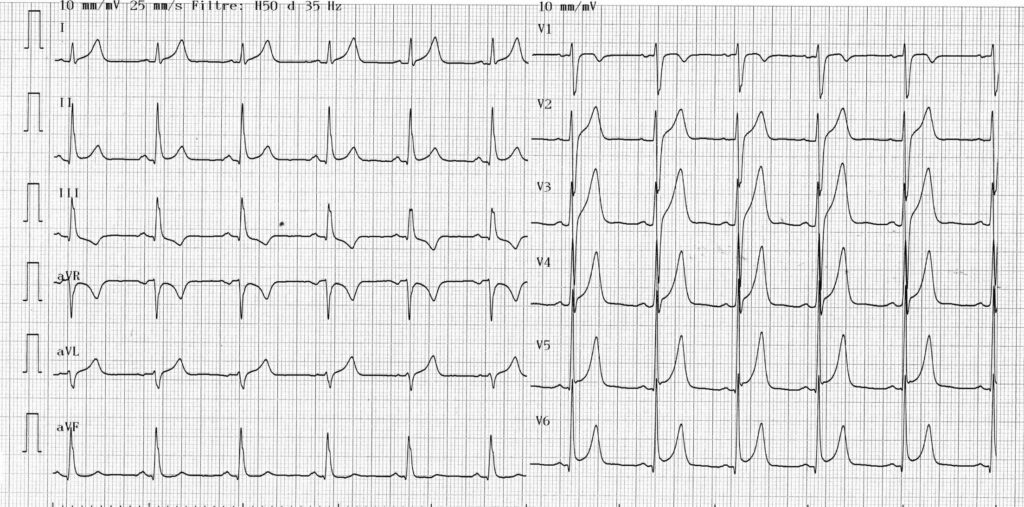
Ce jeune patient a subi une ablation d'une voie accessoire postéro-septale gauche ; l'intervalle PR s'est normalisé, avec disparition de l'onde delta (ralentissement plus marqué au début du complexe QRS) et apparition d'une onde q septale physiologique en V5-V6 ; on observe un profil de repolarisation précoce qui pourrait éventuellement se normaliser à long terme après l'ablation ;
À retenir
Le syndrome de Wolff-Parkinson-White se caractérise par la combinaison d'une pré-excitation auriculo-ventriculaire (faisceau de Kent) et de tachycardies supraventriculaires paroxystiques. Le diagnostic de pré-excitation auriculo-ventriculaire en rythme sinusal repose sur l'association d'un intervalle PR court, d'un complexe QRS large, d'une onde delta, d'une partie terminale normale du complexe QRS et de troubles fréquents de la repolarisation.