


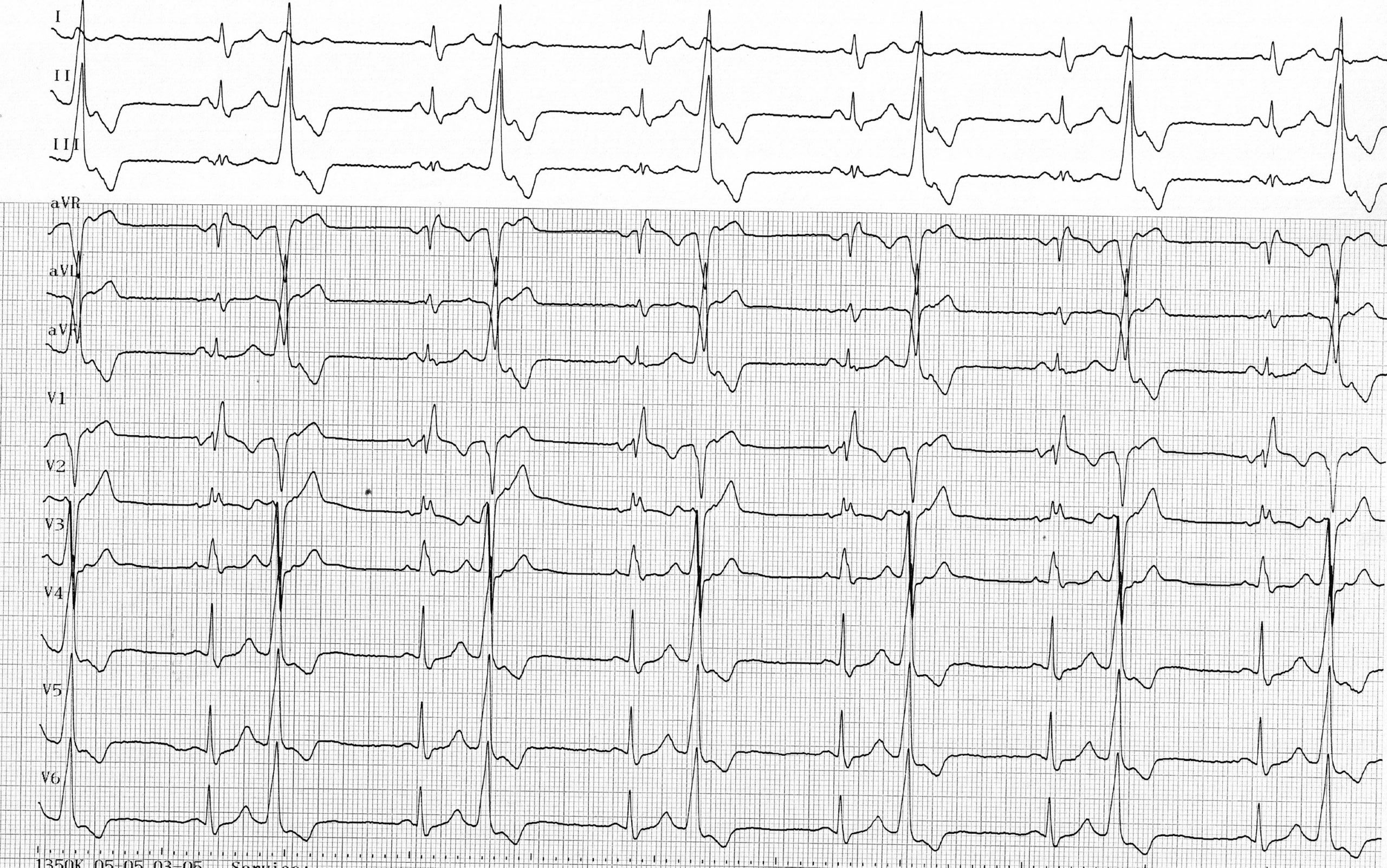
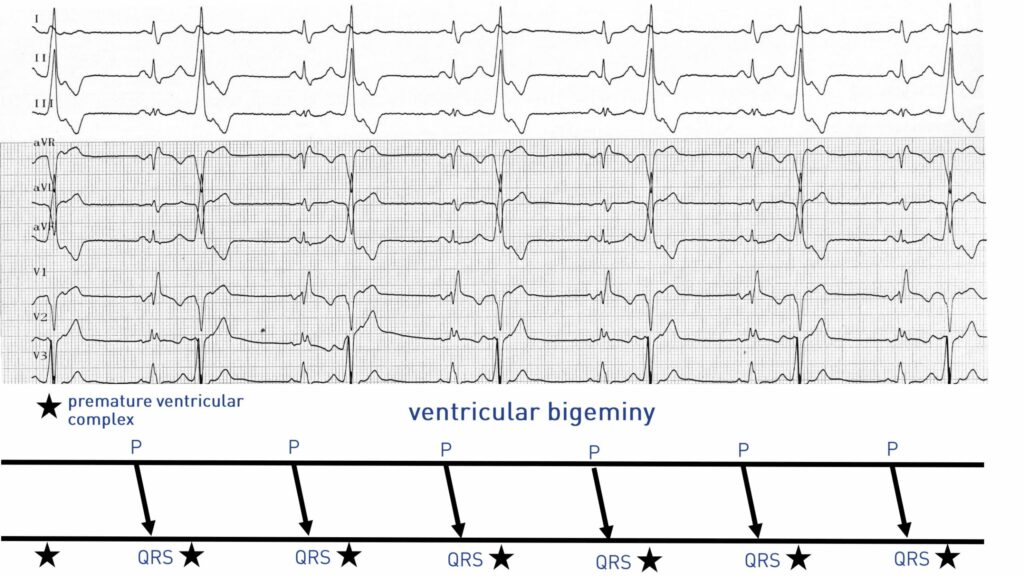
Les patients présentant des complexes ventriculaires prématurés peuvent être parfaitement asymptomatiques ; le diagnostic est alors posé lors de la prise du pouls, qui révèle une irrégularité et la présence de battements prématurés. Comme chez ce patient, la prise du pouls peut permettre de poser le diagnostic de bradysphygmie, qui correspond à un ralentissement du pouls dû à l'inefficacité hémodynamique des extrasystoles, le pouls restant normal si le complexe prématuré est bigéminé. Cette bradycardie effective peut entraîner une symptomatologie de type asthénie ou de type dyspnée d'effort.
Le nombre de complexes ventriculaires précoces observés au cours d’une même journée ne constitue pas un facteur pronostique majeur (évaluation du risque de mort subite). En revanche, il peut avoir un impact sur la fonction cardiaque. La bigéminie observée chez ce patient, si elle persiste à long terme, pourrait être à l’origine de l’apparition d’une arythmie cardiaque. La caractérisation du complexe ventriculaire prématuré peut donc être complétée par la réalisation d’un Holter-ECG de 24 à 48 heures, qui permet non seulement une évaluation quantitative sur 24 à 48 heures, mais aussi une évaluation qualitative comprenant l’analyse du nombre de morphologies différentes (extrasystoles monomorphes ou polymorphes), de l’intervalle de couplage, de l’existence de formes répétitives (présence de couplets, de triplets et/ou de salves), du lien avec la fréquence cardiaque (mécanisme catécholaminergique, vagal ou indéterminé) et de l’alternance jour-nuit (répartition nocturne et diurne). Plus que le nombre absolu de complexes ventriculaires prématurés, il semblerait que la présence d’activités répétitives avec un intervalle de couplage très court permette d’identifier les patients les plus à risque.
English English English French English English English French