


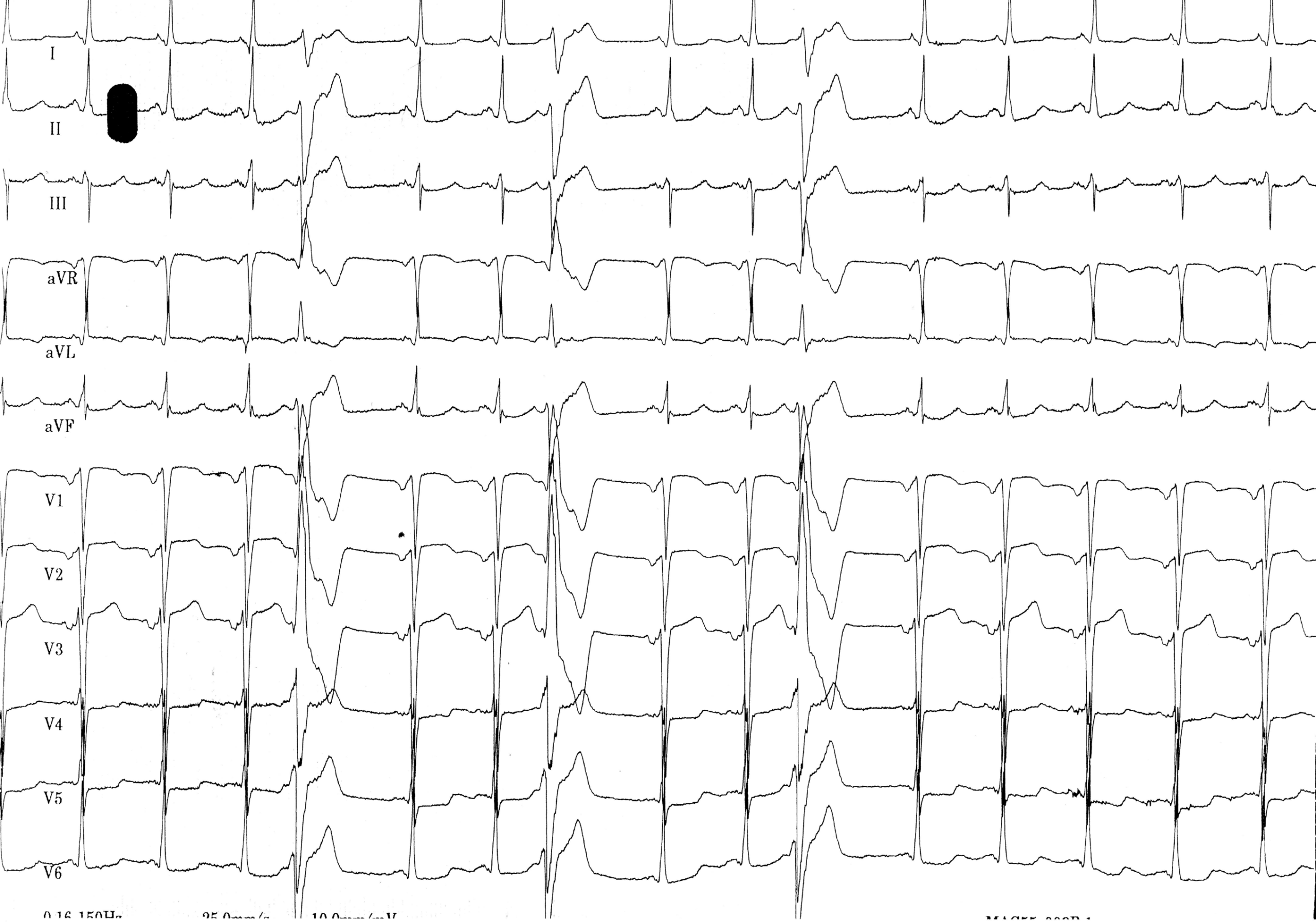
Un complexe ventriculaire précoce correspond à une excitation précoce provenant du myocarde ventriculaire ou du tissu de conduction ventriculaire, à partir d'un point situé en aval de la bifurcation des branches droite et gauche du faisceau de His. La prévalence des complexes ventriculaires prématurés est d’environ 3% lors de la réalisation d’un ECG unique, alors qu’elle peut atteindre 50% chez des sujets sains en cas d’enregistrement continu sur plusieurs jours. La prise en charge des complexes ventriculaires précoces constitue un motif fréquent de consultation, le contexte de leur découverte étant très variable : simple examen de dépistage lors de la réalisation d’un ECG chez un patient asymptomatique dans le cadre d’un bilan médical pour un certificat d’aptitude sportive, ou examen de suivi en cas de palpitations, de syncope ou de mort subite réanimée. Les complexes ventriculaires prématurés doivent être considérés de préférence comme un marqueur de risque devant orienter la recherche d’une cardiopathie, et non comme un facteur de risque indépendant sur lequel il convient d’intervenir. La recherche d’une cardiopathie causale est donc un élément essentiel de la prise en charge.
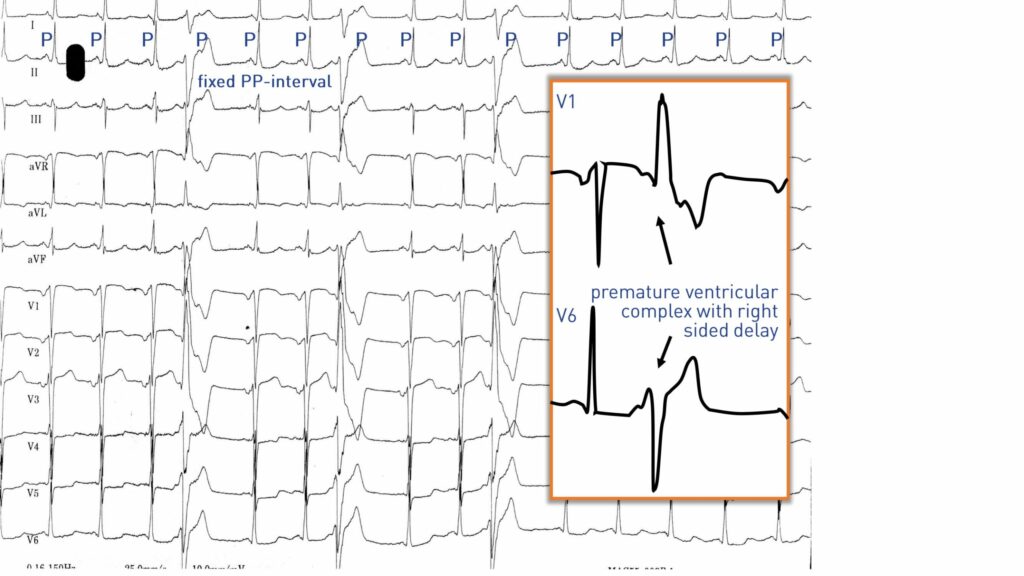
Sur l'électrocardiogramme, un complexe ventriculaire prématuré se caractérise par la présence d'un QRS ectopique et prématuré, avec un QRS large (> 120 ms), sans association avec une activité auriculaire préalable.
Chez ce patient :
1. L'analyse du tracé QRS, qui repose sur une activité sinusale (onde P), plaide fortement en faveur de la présence d'une cardiopathie ischémique. On observe en effet des signes d'hypertrophie de l'oreillette gauche, mais aussi des signes d'un antécédent d'infarctus antérieur, confirmés par l'anamnèse et l'analyse des antécédents médicaux du patient ;
2. La morphologie des complexes précoces suggère également la présence d’une pathologie cardiaque. La largeur des complexes QRS ectopiques est importante et dépasse 180 ms, ce qui est évocateur d’une pathologie cardiaque, étant donné que les complexes ventriculaires précoces bénins observés dans un cœur sain sont généralement beaucoup plus étroits (de l’ordre de 140 ms). Les extrasystoles présentent un tracé en crête, polyphasique, avec une amplitude relativement faible, ce qui exclut également une nature bénigne. La fragmentation des extrasystoles est considérée comme un facteur péjoratif, car elle reflète une propagation des impulsions électriques à travers un myocarde ventriculaire présentant des propriétés de conduction altérées, ou dans un myocarde cicatrisé ou fibrotique. Chez les patients atteints de cardiomyopathie ischémique, le retard et l’axe des complexes précoces sont souvent dictés par la localisation des séquelles de la nécrose, car ces complexes ventriculaires précoces sont soit le reflet d’une activité anormale de cellules dont le fonctionnement est altéré par l’ischémie, soit le résultat d’un retour d’impulsion autour de voies à conduction lente au sein des zones cicatricelles.
English English English French English English English French