Trace 2.6 : Diagnostic différentiel des troubles fonctionnels des sinus
Informations destinées aux patients
Un homme de 67 ans, présentant des antécédents de fibrillation auriculaire, a été orienté vers notre service suite à la mise en évidence d'une bradycardie irrégulière laissant supposer la nécessité de la pose d'un stimulateur cardiaque ;
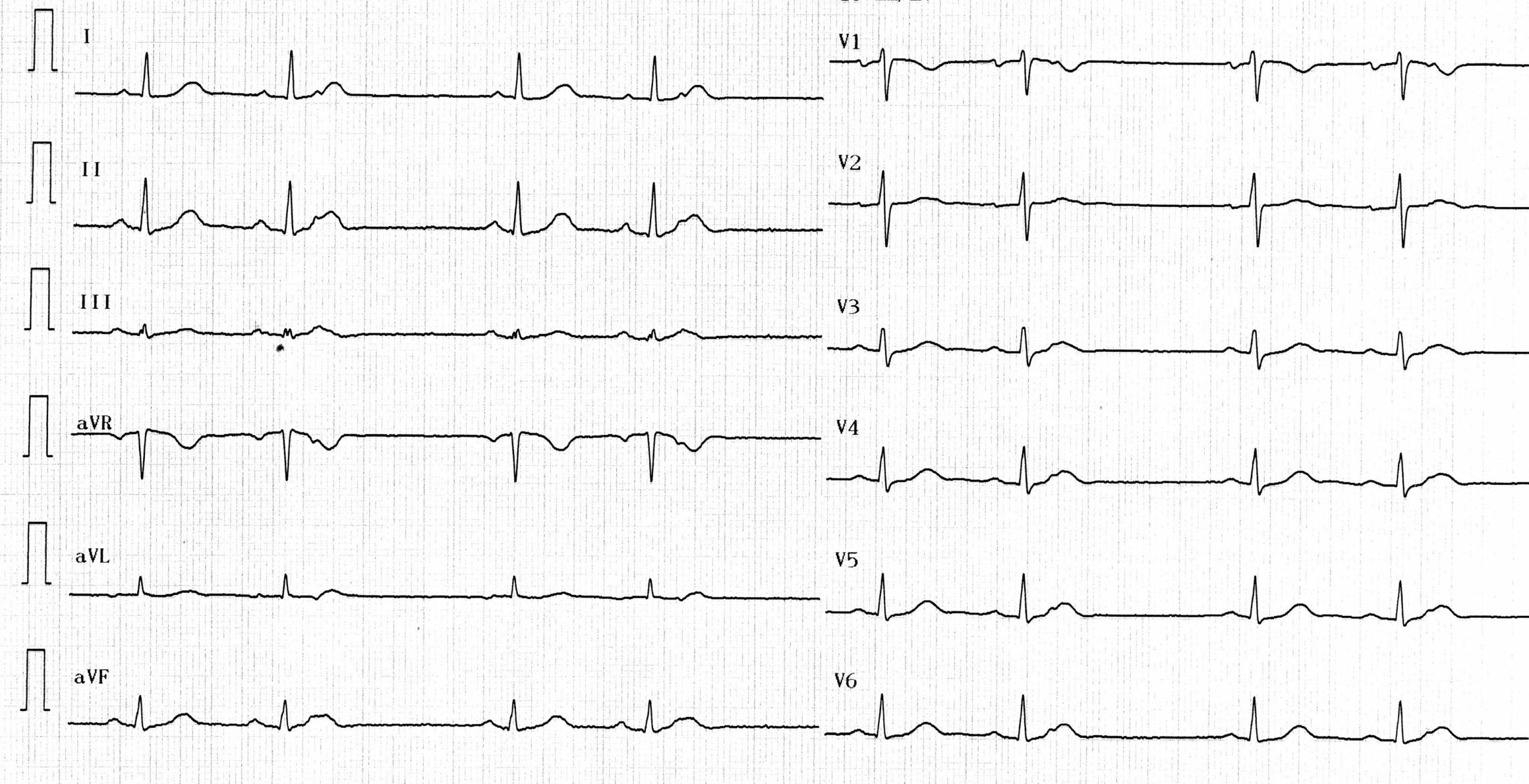
ECG
Question
En ce qui concerne cet ECG, quelle(s) réponse(s) est (sont) correcte(s) ?
Commentaires
Description de l'ECG
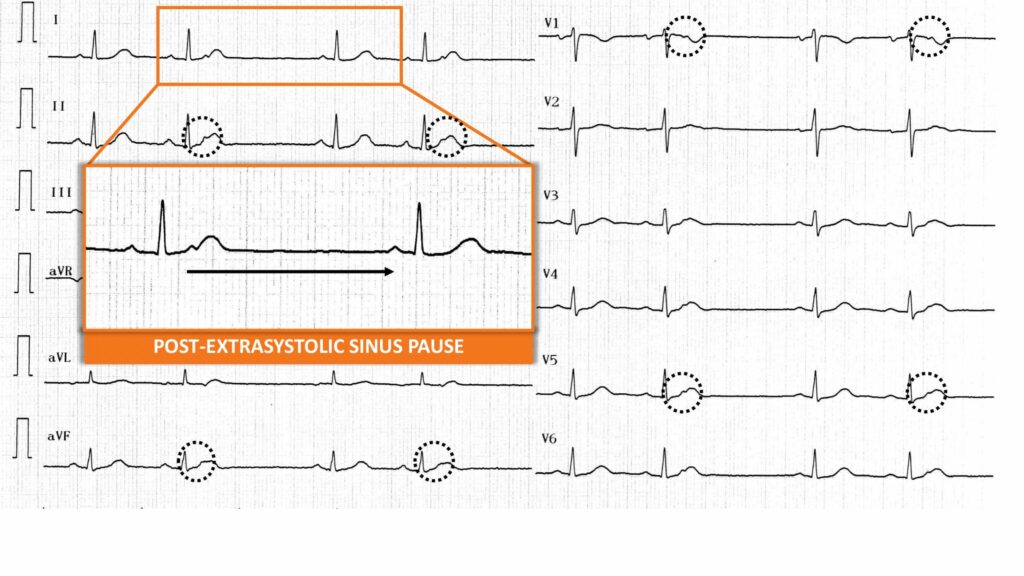
Activité sinusale (positive dans les dérivations I, II, V5, V6 et négative dans la dérivation aVR) avec une variabilité significative de l'intervalle RR ; dans la partie initiale de l'onde T, on observe une activité auriculaire ectopique correspondant à une extrasystole auriculaire bloquée (non suivie d'un complexe QRS) avec une pause sinusale post-extrasystolique expliquant la pseudo-bradycardie sinusale ;
Explication
Ce patient a été orienté vers notre service en raison d'un rythme cardiaque irrégulier et de “ pauses sinusales ”. Un examen attentif du tracé permet de mettre en évidence une encoche dans l'onde T précédant la pause, correspondant à une extrasystole auriculaire bloquée, ce qui explique la pause post-extrasystolique qui s'ensuit. Il ne s’agit donc pas d’un problème d’automatisme réduit (dysfonctionnement du nœud sinusal et discussion sur la nécessité d’une implantation d’un stimulateur cardiaque), mais plutôt d’un hyperautomatisme (extrasystole auriculaire et discussion sur la pertinence d’un traitement antiarythmique). Une extrasystole auriculaire bloquée fait donc partie du diagnostic différentiel du dysfonctionnement du nœud sinusal et doit être systématiquement recherchée en présence d’une pause, les conséquences thérapeutiques étant diamétralement opposées.
À retenir
Un complexe prématuré auriculaire 1) peut être difficile à identifier sur l'électrocardiogramme car il peut être “ masqué ” par l'onde T et ne pas être conduit, 2) évoque le diagnostic différentiel d’une pause sinusale, 3) peut provenir d’un foyer situé au niveau de l’ostium d’une des veines pulmonaires et constituer le déclencheur d’épisodes d’arythmie auriculaire.