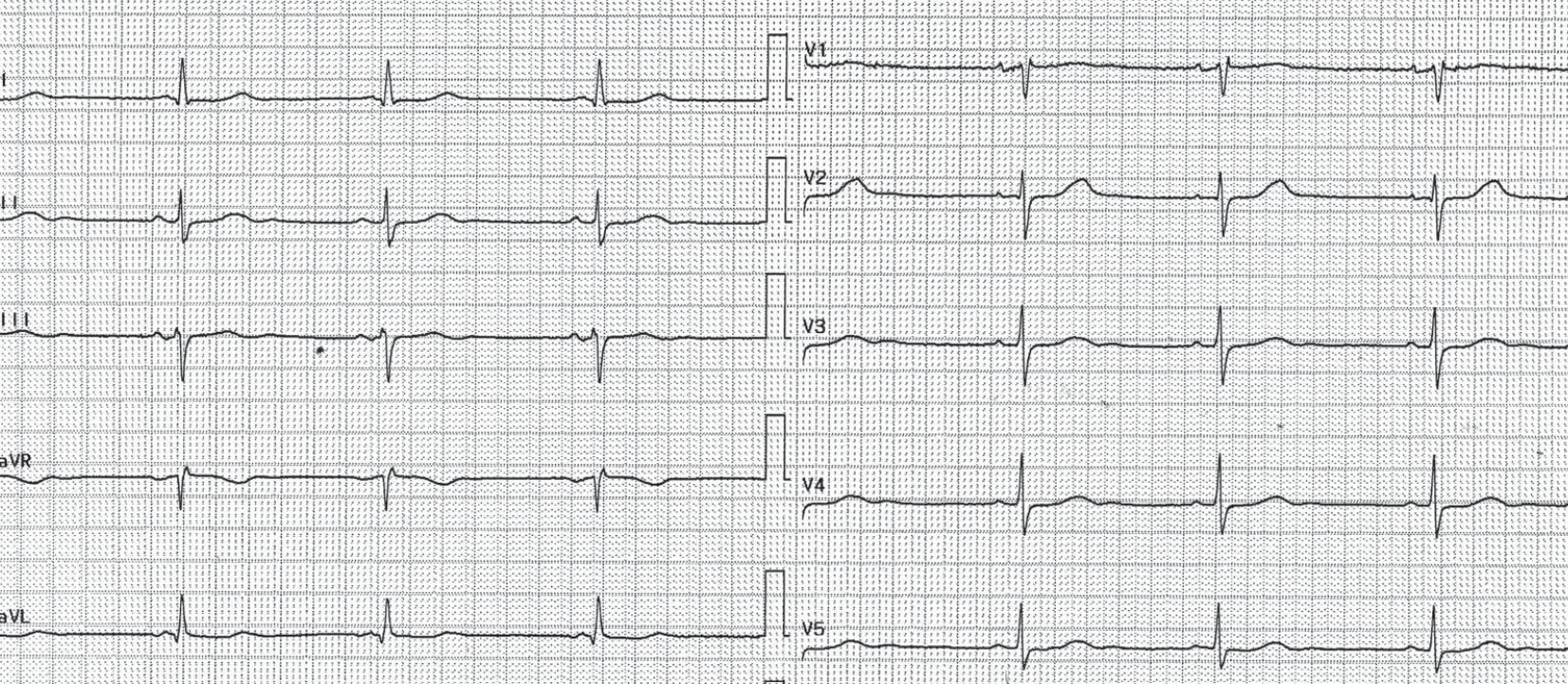
Tracé 2.1 : Bradycardie sinusale
Informations destinées aux patients
Homme de 64 ans, hypertendu sous traitement à l'amlodipine ; ECG de contrôle ; patient asymptomatique ;
ECG
Question
En ce qui concerne cet ECG, quelle(s) réponse(s) est (sont) correcte(s) ?
Commentaires
Description de l'ECG
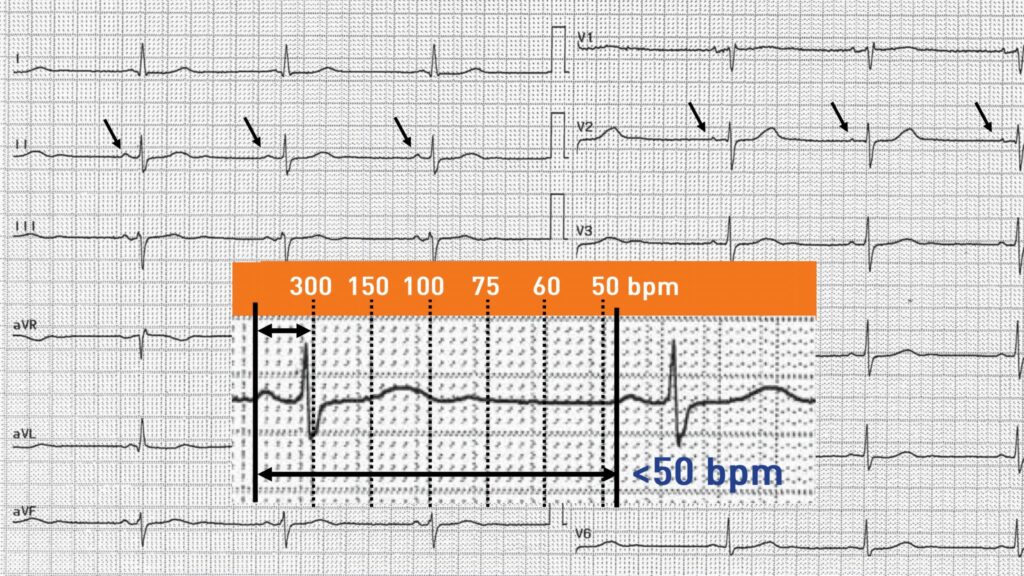
Activité sinusale auriculaire (ondes P positives dans les dérivations I, II, V5, V6 et négatives dans la dérivation aVR) ; bradycardie sinusale avec une fréquence de 45 bpm, intervalle PR normal, complexe QRS étroit ;
Explication
Ce patient présente une bradycardie sinusale se traduisant par une fréquence cardiaque inférieure à 50 ou 60 bpm (selon les définitions) au repos. Il peut être difficile de faire la distinction entre une bradycardie physiologique et une bradycardie pathologique. En effet, une hypertonie vagale, fréquemment observée chez les patients sportifs, peut expliquer une bradycardie physiologique sans nécessiter d’examens particuliers ni de traitement. Une étiologie médicamenteuse est également fréquente (bêtabloquants, digoxine, amiodarone, inhibiteurs calciques, etc.). La nature pathologique et la réponse thérapeutique (implantation d’un stimulateur cardiaque) sont donc déterminées par la présence de symptômes dont la gravité et la spécificité peuvent varier (syncope, lipothymie, asthénie, vertige). Une incompétence chronotrope (définie comme l’incapacité à atteindre, à l’effort, une fréquence cardiaque supérieure à 70, 80 ou 85 % de la fréquence maximale théorique, selon les définitions) peut s’accompagner de symptômes n’apparaissant qu’à l’effort (limitation de la capacité d’effort, dyspnée d’effort).
Il a été décidé de ne pas poser de stimulateur cardiaque à ce patient asymptomatique présentant une fonction chronotrope préservée (accélération normale de la fréquence cardiaque à l'effort), mais de le suivre à l'aide d'enregistrements réguliers par Holter-ECG afin de dépister d'éventuelles bradycardies paroxystiques plus marquées. Un traitement par bêtabloquants ou par inhibiteurs calciques ne devrait pas être recommandé pour traiter son hypertension.
À retenir
La présence d'une bradycardie sinusale modérée n'est pas pathologique en soi. Dans ce contexte, la pose d'un stimulateur cardiaque n'est justifiée qu'en cas de symptômes.