


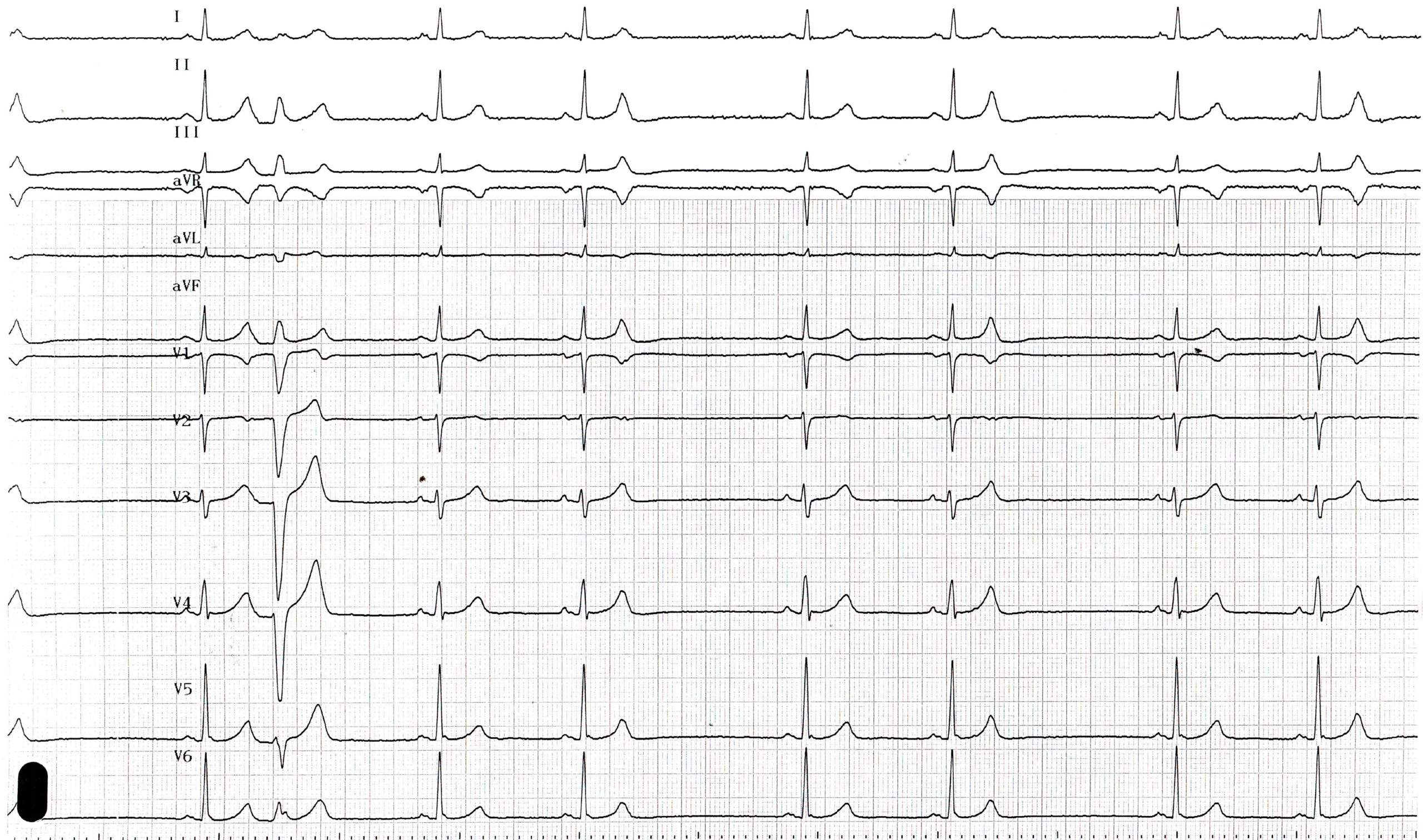
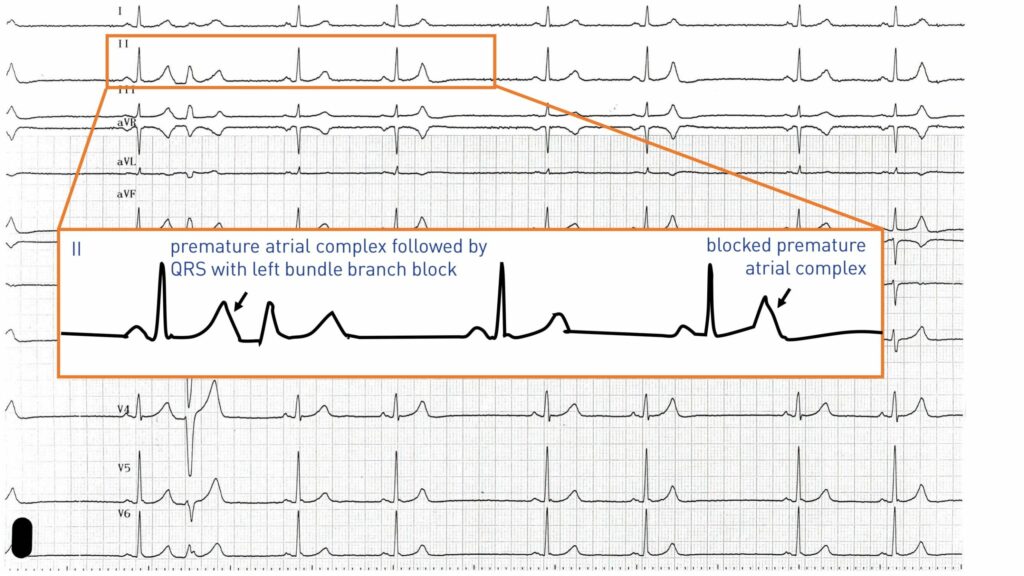
A premature complex with narrow QRS virtually eliminates the diagnosis of premature ventricular complex (certain premature ventricular complexes originating from the septum may have a QRS < 120 ms). On the other hand, when the QRS is wide, multiple options are possible (premature ventricular complex, atrial or junctional premature complexes with permanent or functional complete bundle branch block). The refractory periods of the two branches may differ, explaining that a premature impulse may encounter only one of the two branches in the refractory period (left or right bundle branch block). The bundle branch block may be complete (as on this tracing), incomplete or fascicular (block located more distal). When the bundle branch block occurs on a premature complex (for example, an extrasystole as on this tracing), this is called a phase 3 block or Ashman phenomenon. Following a premature atrial complex, a functional right bundle branch block is more common than a left bundle branch block, with the refractory period of the right bundle branch being typically longer. This is not an absolute rule, however, as demonstrated on this tracing. In contrast, when the block occurs as a result of a slowing in rate, this is called a phase 4 block; in this instance, the left bundle branch block is more frequent.
English English English French English English English French