


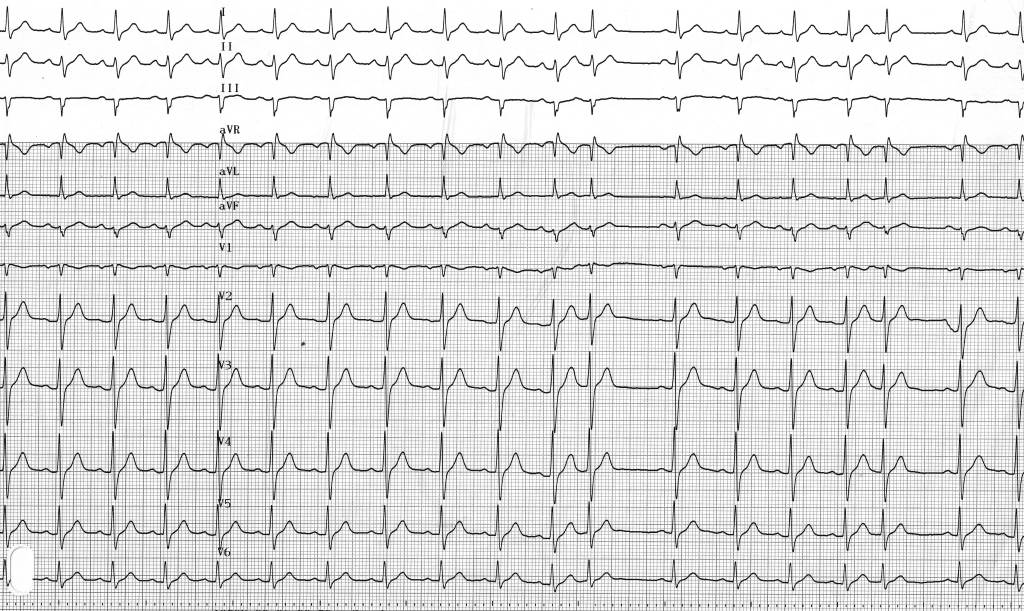
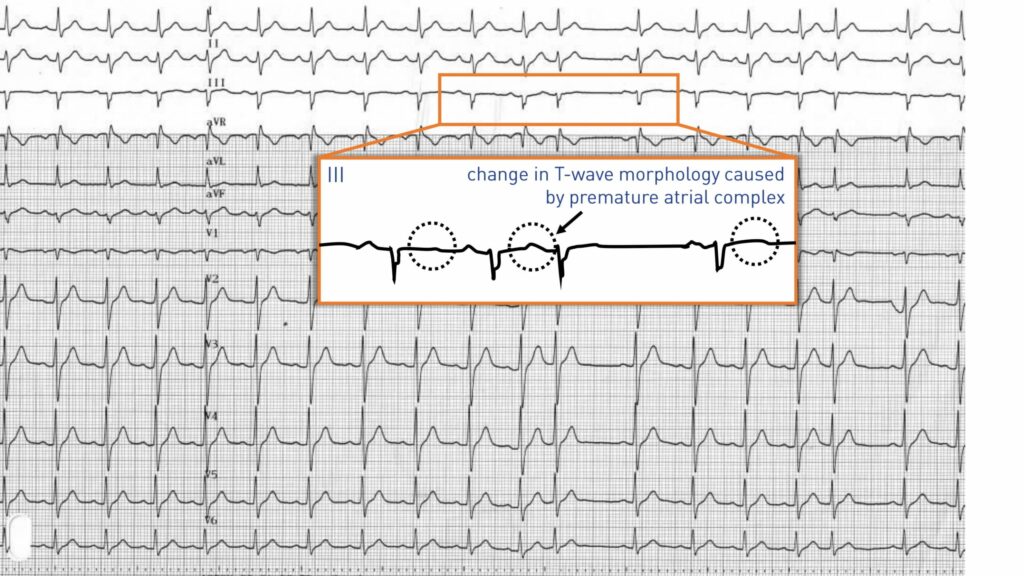
A premature atrial complex may occur, as on this tracing, during ventricular repolarization (on the T wave following the preceding QRS complex). The surface electrocardiogram registers on the skin, all of the potentials generated by the heart. Due to a lower mass, the amplitude of the signals generated by the atria is much weaker than that of the signals generated by the ventricles (QRS complex or T wave). In addition, the gentle slope of these two signals (P wave and T wave) is relatively similar and significantly differs from a QRS complex (steep slope). Diagnosing a premature atrial complex may therefore at times be difficult and careful analysis of all leads is necessary.
Focal atrial arrhythmias have been shown to be associated with the initiation of atrial fibrillation. Indeed, the type of premature atrial complexes observed on this tracing, with a characteristic P-on-T pattern and arising mainly from the ostium of the pulmonary veins, represents the initiating trigger necessary for the induction of atrial arrhythmias. The therapeutic implication is straightforward since these premature beats are accessible to radical ablation treatment (disconnection of the pulmonary veins). It is therefore necessary to identify this type of “hidden” premature atrial complexes in the T wave and to differentiate the latter from junctional ectopy which represent the differential diagnosis for a premature beat with narrow QRS.
English English English French English English English French