


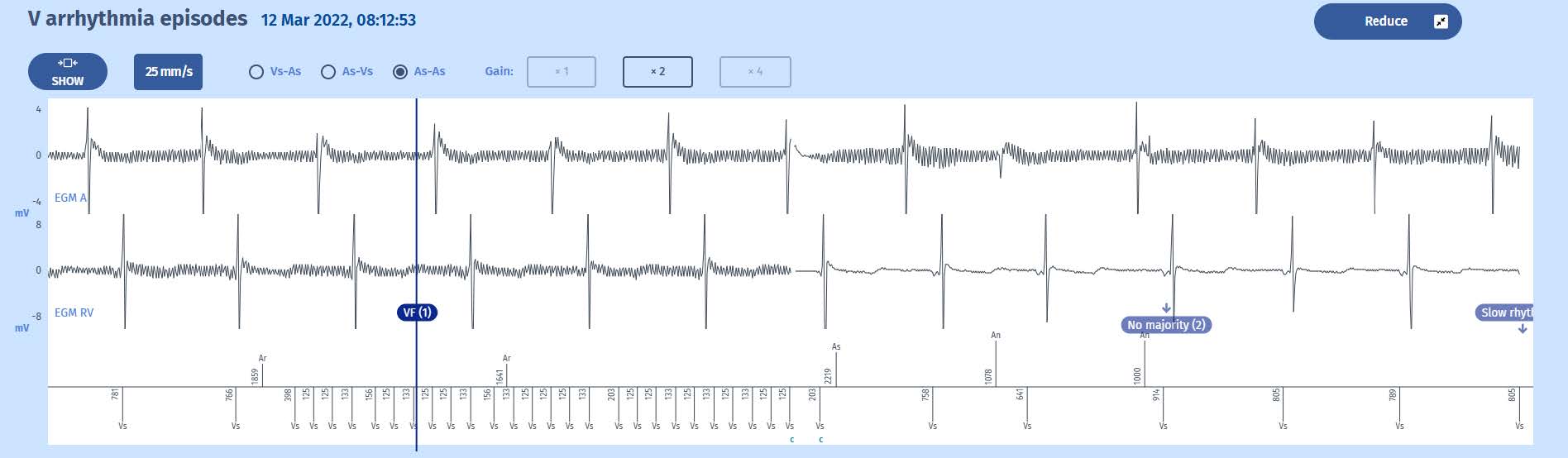
This episode corresponds to the sensing of a 50Hz line current. It is noted that the current is mainly sensed by the ventricular lead with signals detected at the limit of the post-ventricular
ventricular blanking value, i.e. 125 ms. The atrial channel reveals the occurrence of the same interference, and moreover the sinus signals do not all appear to be detected they are properly
managed by relative retriggerable refractory periods of 30 ms since they do not always give rise to markers. The current generates low-amplitude signals and on both leads simultaneously.
A diagnosis of VF is initiated, which triggers the persistence followed by the start of a capacitor charge noted C. This is because the noise management function is automatically disabled (for
15 cycles) as soon as a cycle < 406 ms (and > 190ms) is sensed, in order to improve sensing and give priority to arrhythmia detection. After these 15 cycles, noise management is reactivated, i.e.
retriggerable refractory periods of 30 ms + Ventricular sensitivity interaction which suppressesthe oversensing on the chain of markers and thus prevents the inappropriate shock from being
delivered.