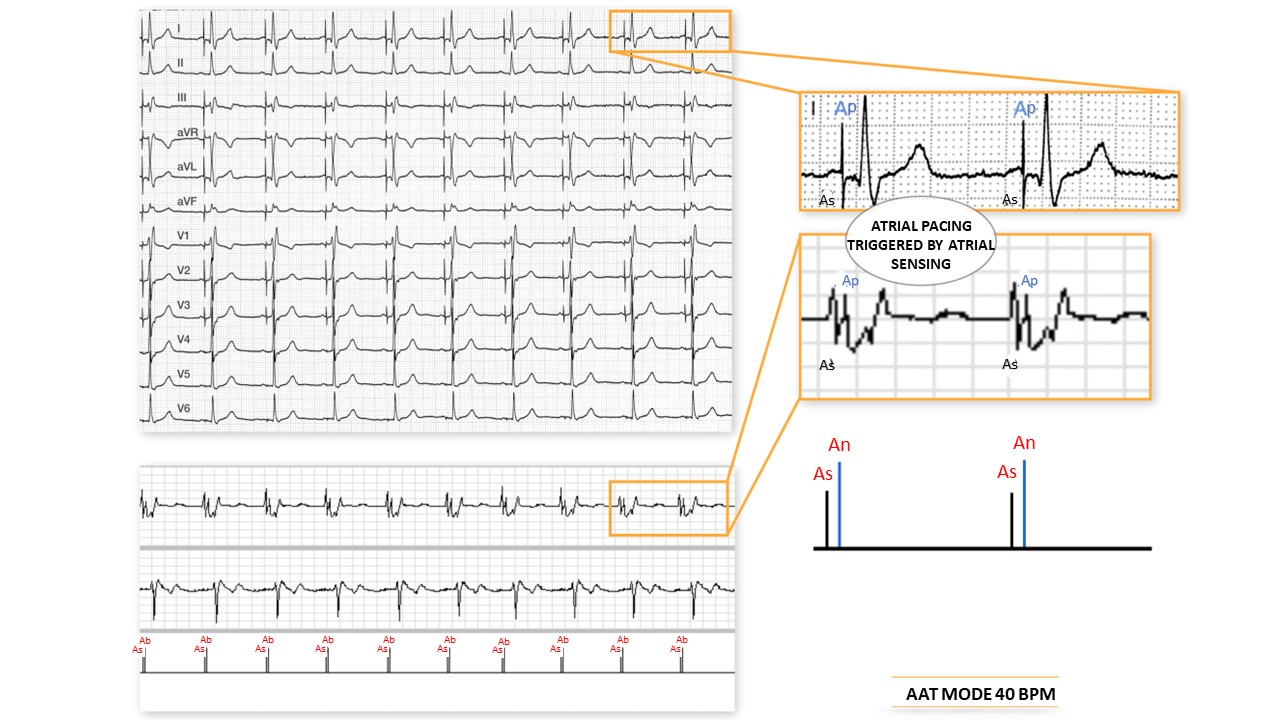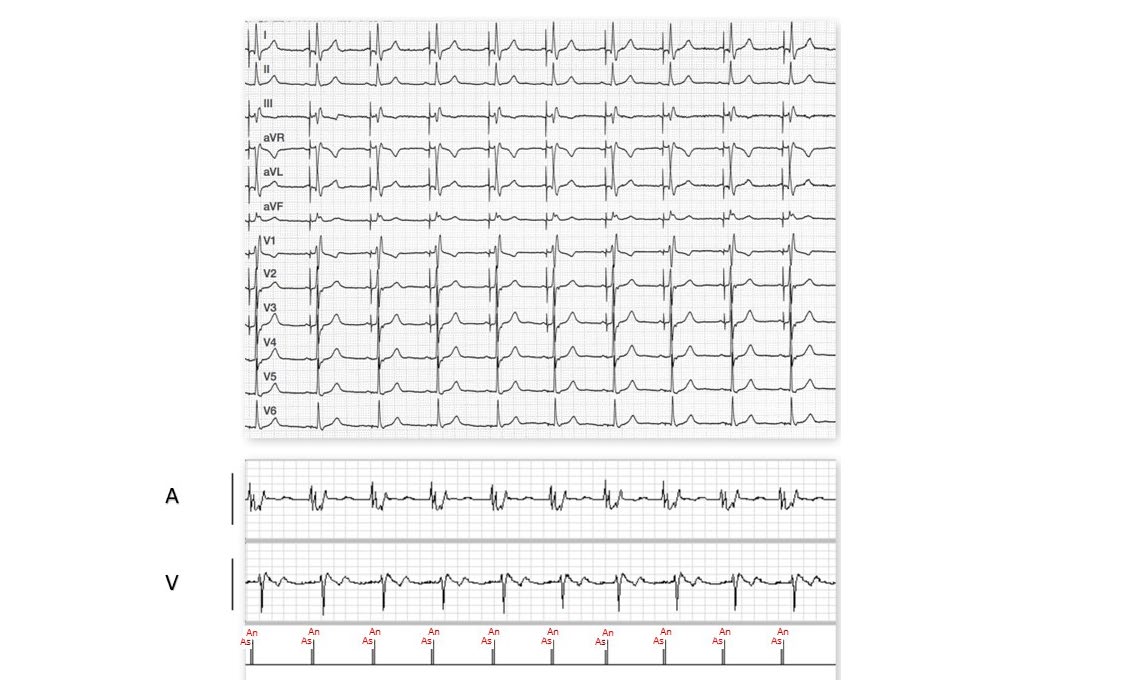
AAT mode 40 beats/minute: on this tracing, one can observe atrial pacing (An) triggered by atrial sensing (As); intrinsic ventricular activation;
In AAT and VVT modes, pacing occurs at the programmed minimum rate; however an event sensed outside the refractory periods triggers an immediate pacing in the corresponding chamber. This pacing is not dangerous since systematically occurring in the absolute natural refractory period of the atrial or ventricular myocardium. For MicroPort™ pacemakers, the 2 important parameters to program are the basic rate and the maximum rate. The only rate limitation is the nonprogrammable Fmax “hardware” (185 bpm). Typical electrocardiographic pattern (VVT): in the absence of intrinsic activity, pacing and fixed-interval ventricular capture. The occurrence of an intrinsic ventricular complex outside the refractory periods leads to the occurrence of a stimulus within the QRS. The pattern of the QRS is either identical to the intrinsic QRS (pseudo-fusion), or intermediate between the intrinsic QRS and the paced QRS (fusion). Note that the P wave is not sensed at the outset, but only after a few tens of ms. Detection is only possible when the atrial signal has passed under the lead dipole with a slope in the filter’s bandpass and an amplitude ≥ the programmed value. This type of pacing mode is rarely used today. Indeed, pacing during consumption with acceleration of battery depletion. AAT or VVT modes dependent patient presenting oversensing. They can also be used 2266
Typical electrocardiographic pattern (AAT): the same for the atrium. The triggered modes can be used in 2 particular instances: 1. upon sensing myopotentials or electromagnetic interference, the SST does not inhibit but rather induces pacing on each artifact sensed outside the refractory period. This avoids a pause in pacemaker-dependent patients. To prevent runaway pacing, it is possible to either extend the refractory period or to limit the maximum pacing rate depending on the model. This type of mode was of interest on older pacemaker models that were more sensitive to external interference since they only worked in unipolar mode. 2. this mode is used to evaluate sensing in the chamber under consideration, to verify that there is no crosstalk and that the extrasystoles are also properly sensed. sensing is associated with an unnecessary increase in energy can be used temporarily to avoid inhibition in a pacemakerto monitor the sensing quality during temporary tests.