CRT pacing alert at 57%, and 2 years later
Patient
Go to the casebook version optimized for the mobile experience
RESONATE X4 CRT-D implanted more than 5 years earlier, quadripolar LV lead (LV paced LVRing3>>RV); DDD 60-175 bpm, sensed AV delay 60-100 ms, BiV with LV offset 0 ms; sinus rhythm, no AF
Office visit (counters reset), then a remote transmission the same night with a CRT pacing alert
Trace
- Transmission the night after the office visit, 6 months of trends: sinus rhythm with no AF (AT/AF burden 0.0 h, row above); heart rate 81-112 bpm on the day of the visit (mean 92)
- Pacing: RV and LV together, between about 70 and 100% for months, then falling over the last 2 weeks to RV 59%, LV 57% on the day of the visit. The alert of this transmission: CRT pacing < 85%, 52% in the 8 hours after the counters were reset in the office
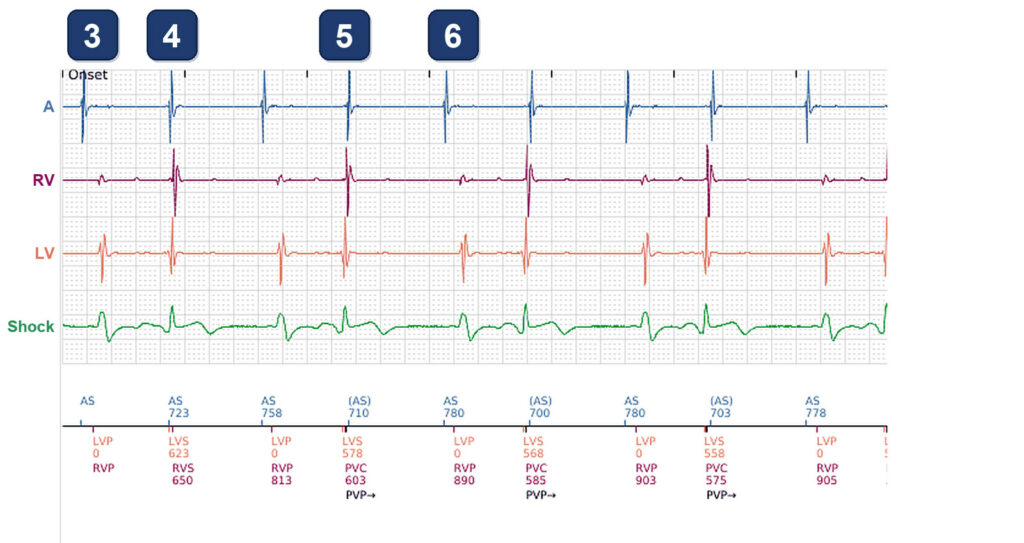
- Presenting EGM, channels A, RV, LV and shock: a sinus atrial event sensed (AS), then LVP 0 and RVP together: a BiV paced beat
- A PVC that falls with the atrial event: the LV is sensed with the atrial event (LVS 623, AS 723), the RV 27 ms later (RVS 650), with large native RV and LV EGMs and another shock EGM. As the AS comes first, the device marks it RVS, not PVC
- The next PVC comes just before the atrial event (LVS 578, then the RV at 603 ms): marked PVC, and the PVARP is extended for one cycle (PVP→). The sinus atrial event, sensed 30 ms later, falls in it: (AS) 710, not tracked
- The following atrial event is tracked: BiV pacing 890 ms after the PVC (AS 780, LVP 0, RVP 890). Then PVC, BiV, PVC, BiV: ventricular bigeminy, half of the beats without CRT
- Second report, two years and four months later, on metoprolol (0 → 100 mg): heart rate 64-109 bpm on the last day, mean 79 bpm (92 in the first report)
- Pacing: mostly 75-90% over these 6 months, close to 100% twice for about ten days, and RV 94%, LV 93% on the last day: better, but still below the 98% target. The alert stays on: 79% since the counters were reset at the office visit (report p1)
- Presenting EGM of this report, channels A, RV, LV and shock: sinus rhythm at about 70 bpm, each atrial event sensed (AS) and followed by LVP 0 and RVP: BiV pacing at every beat, and no PVC on these 16 beats (one beat in two before metoprolol)
Comments
Ventricular bigeminy: every second beat is a PVC, a beat without BiV pacing, so BiV pacing falls to 52-57%. On metoprolol, two years later, 94% on the last day, but still 79% since the reset, so the alert stays on
Points to remember
- In bigeminy every second beat is a PVC, a beat without BiV pacing: here 52-54% in the hours after the counter reset. The PVC counter (9,531) even underestimates them: a PVC that falls with the atrial event is marked RVS
- The CRT pacing alert compares BiV pacing since the last reset with 85%: just after a reset, a few hours of bigeminy are enough. The daily trend shows how it began: a fall over 2 weeks
- Treat the PVCs: two years after metoprolol, daily BiV pacing was 75-100% (94% on the last day), with a lower heart rate (mean 79 instead of 92 bpm). The PVCs were not gone: 8.4 million in 2 years and 4 months
- The cumulative counter lags behind: 79-82% since the reset keeps the alert on, even when the daily values are better, until the counters are reset
Take home message
Ventricular bigeminy halves CRT: every PVC is a beat without BiV pacing. The answer is to treat the PVCs (here metoprolol) and to judge the result on the daily BiV trend, not on the cumulative counter
Read more about related topics