A stored PMT episode at 130 min-1
Patient
Go to the casebook version optimized for the mobile experience
RESONATE X4 CRT-D implanted about 6 years earlier; sinus rhythm, BiV pacing with the LV paced 20 ms before the RV; maximum tracking rate (MTR) 130 bpm: paced V-V at the MTR 460 ms
LATITUDE Event Detail report of an event stored as a PMT (PMT-212)
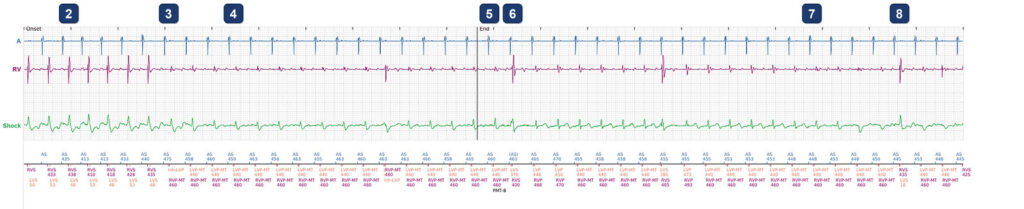
Trace
- Event Detail report: event PMT-212, stored as a PMT, with an average atrial and ventricular rate of 130 bpm, exactly the MTR
- Onset (channels: atrial, RV and shock EGM; no LV EGM in this episode). Sinus tachycardia, AS 413-440 ms (136-145 bpm), above the MTR: no pace may come within 460 ms of the last ventricular beat, so each atrial event conducts first, 130-145 ms after the AS (RVS 438, then LVS 48 ms later): no BiV pacing
- AS 475 (126 bpm): the sinus rate drops below the MTR and the ventricles are paced again, at the MTR interval (RVP-MT 460). But the LV pace, due 20 ms earlier, would come only 392 ms after the last LV sense (LVS 48): inside the LV protection period (nominal 400 ms), so it is withheld (Inh-LVP): RV-only beat
- Sinus rate at about 130 bpm (AS 450-463 ms): each atrial event is tracked and both ventricles are paced at the MTR interval (LVP-MT 440, RVP-MT 460: the LV 20 ms before the RV), with a stable delay from the AS to the pace (about 120-135 ms): BiV pacing at 130 bpm
- PMT-B under the 16th ventricular pace at the MTR in a row (RV-only beats included): 16 paces at the MTR after atrial sensed events with a stable V-A interval (within 32 ms) mean a PMT for the device. It logs the event and extends PVARP to 500 ms for one cycle
- The next atrial event falls in this long PVARP ((AS) 463) and is not tracked. A ventricular beat is then sensed, LV first (LVS 370, RVS 400 ms after the last pace), only 35-60 ms after that atrial event: no BiV pacing on this beat. The next atrial events are tracked again (LVP 448, RVP 468, then VP-MT): the sinus rate has not changed
- Later in the episode (after another sensed beat, LVS 380, RVS 405), the sinus rate creeps above 130 bpm (AS 445-455 ms): to keep the V-V at 460 ms, the device lengthens the delay from the AS to the pace beat after beat, from about 60 to 145 ms
- Until the patient’s own conduction comes first: AS 445 → RVS 435, LVS 18, about 130 ms after the AS: BiV pacing is lost again, and again at the end of the strip (RVS 425). The “PMT” is sinus tachycardia at the MTR, and every rise above 130 bpm costs CRT
Comments
A stored “PMT” at 130 bpm is in fact sinus tachycardia at the MTR. Above the MTR the atrial events conduct and BiV pacing is lost, and each PMT intervention costs one more beat
Points to remember
- Boston’s anti-PMT algorithm (PMT Termination) looks for 16 paced beats in a row at the MTR, each tracking an atrial event that comes at a stable interval after the previous pace; it then lengthens PVARP to 500 ms for one beat. It does not check that this is a real PMT, so sinus tachycardia at the MTR is often stored as “PMT”: atrial rate = ventricular rate = MTR
- Each intervention leaves one atrial event untracked: one beat without BiV pacing every 16 beats, for as long as the sinus rate stays at the MTR
- Above the MTR, the device delays each pace so as not to exceed the MTR; with good AV conduction, the patient’s own beat soon comes first and BiV pacing is lost, with no pause and no alert
- Read the stored PMT episodes: they show what happens to CRT at the patient’s highest sinus rates. Here the sinus rate goes above an MTR of 130 bpm: a higher MTR (with the VT zones kept above it) would keep BiV pacing at these rates and avoid false PMT interventions
Take home message
Loss of CRT during sinus tachycardia is an underappreciated problem in young and active patients. Many CRT candidates have preserved AV conduction and lose their CRT as soon as they cross the MTR (often left at 130 bpm). It is impossible to know: the % of CRT stays high and there are no episodes (unless a false positive PMT, as in this case)
Read more about related topics