
Biotronik - Left ventricular pacing
Content
Unipolar lead
The single electrode of a unipolar probe is called the LV tip. If a unipolar left ventricular probe is implanted, two configurations can be programmed on pacemakers or defibrillators: LV tip/lead and LV tip/proximal RV. It should be noted that for pacemakers or defibrillators in the Ilesto range, the proximal RV corresponds to the ring of the RV lead (proximal electrode), whereas for the new range of defibrillators, the RV electrode corresponds to the coil of the RV lead (the same applies to bipolar and quadripolar configurations).
Bipolar lead
The two electrodes are called the LV tip and LV ring. If a bipolar left ventricular probe is implanted, five programming options are available on triple-chamber defibrillators (shown in the following figure).
It should be noted that for triple-chamber pacemakers, one additional configuration (six in total) can be added: LV ring/lead.
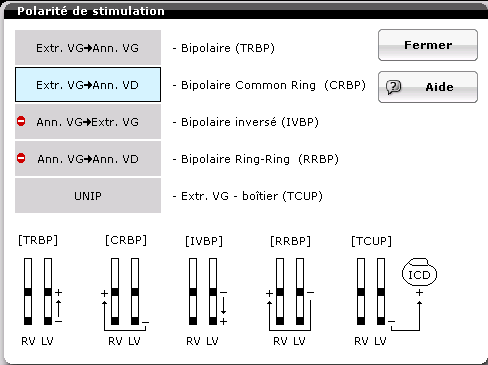
Available configurations for a triple-chamber defibrillator
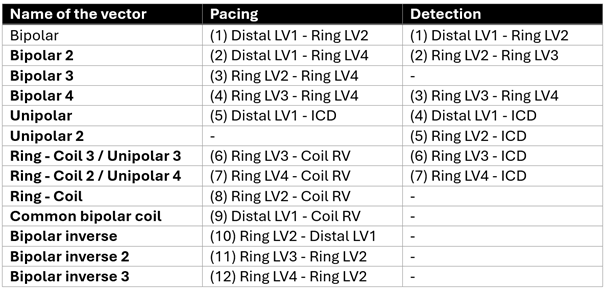
Quadripolar probe
Twelve different configurations are available.
Automatic LV threshold
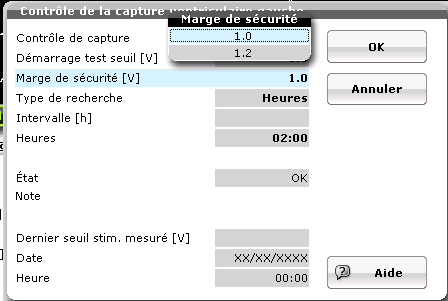
The threshold measurement is based on the analysis of the evoked response, but there is no cycle-by-cycle control of the capture. The threshold is measured once a day, at the programmed time (default 2:00 AM). Threshold assessment starts at the programmed start amplitude (default 3.0 V) with a decrease in amplitude in steps of 0.6 V and then in steps of 0.1 V. During threshold measurement, the VV delay is programmed to 50 ms (left pre-excitation). When a loss of left ventricular capture is diagnosed, right pacing occurs at the end of the VV delay (to avoid the absence of ventricular capture on one cycle in dependent patients).
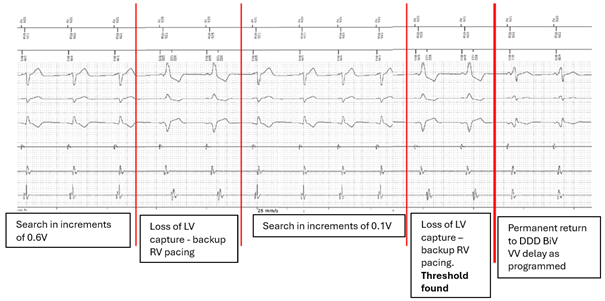
Once the VG stimulation threshold has been determined, a margin is programmed for the next 24 hours.