


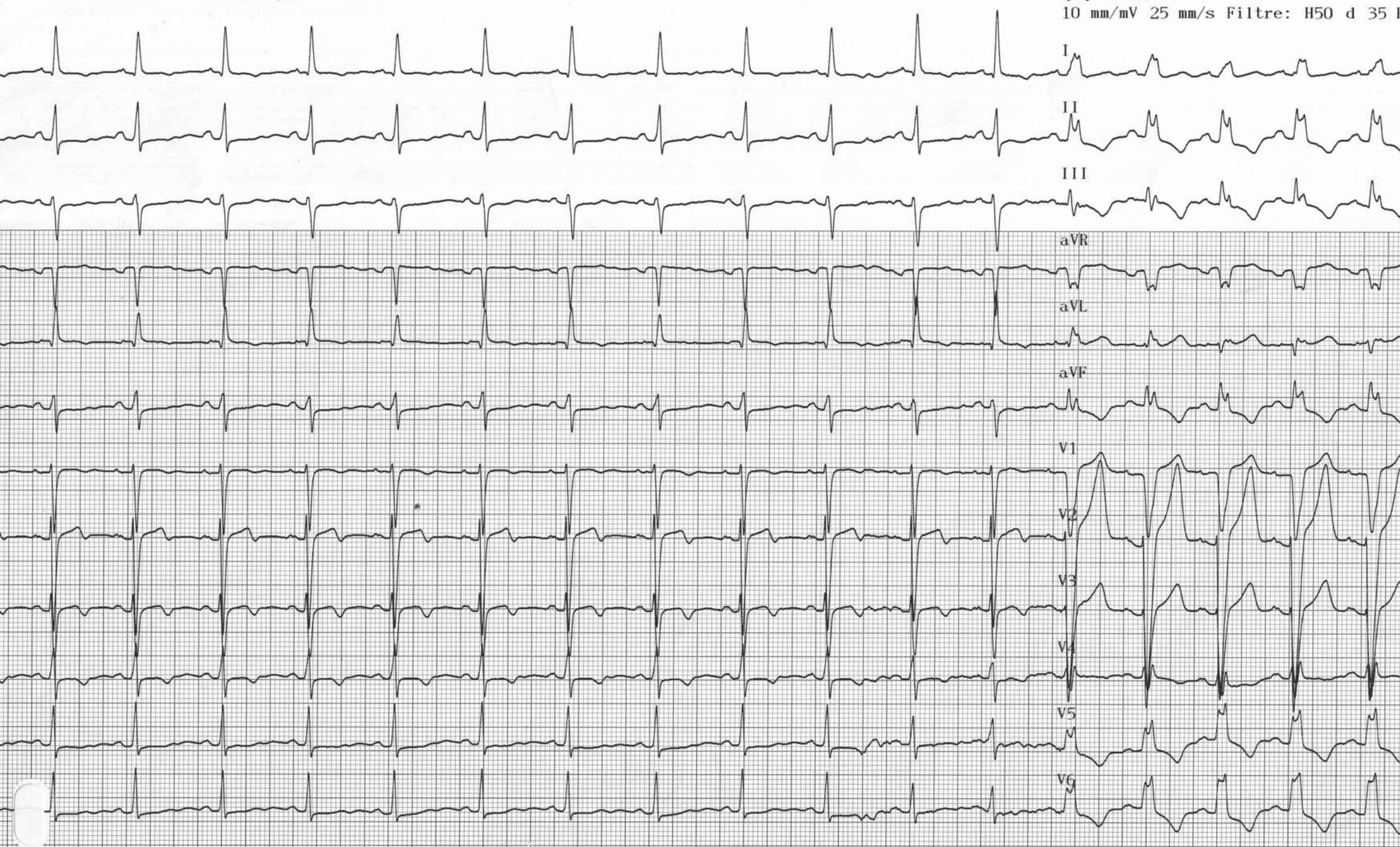
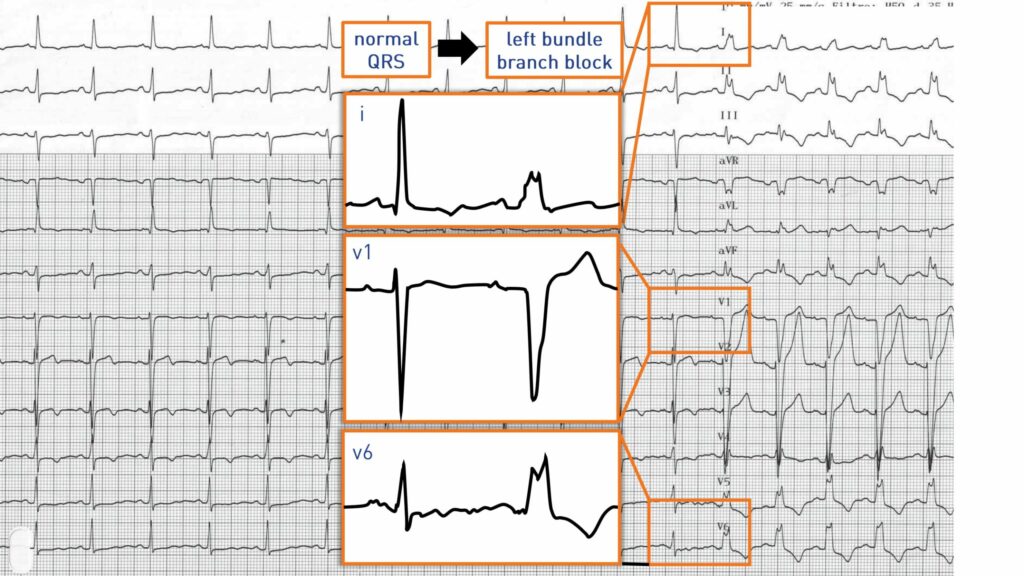
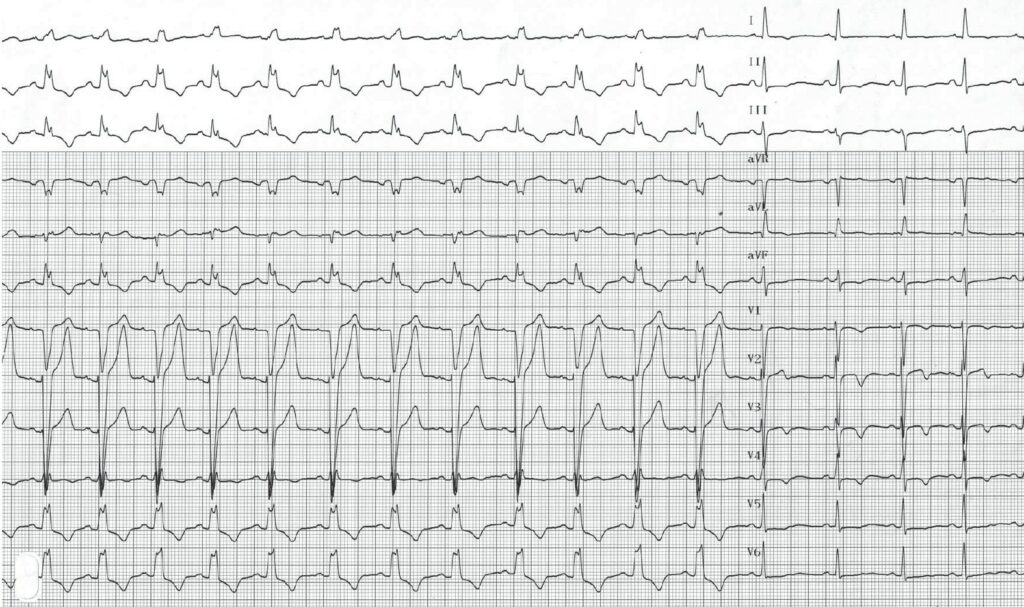
Description du tracé
Autres tracés : lors d'un léger ralentissement de la fréquence cardiaque, disparition du bloc de branche gauche et réapparition de complexes QRS étroits ;
Commentaire
Ce jeune patient présentait des douleurs thoraciques typiques, sans antécédents ni facteurs de risque. Ces épisodes douloureux survenaient lors d'un effort relativement modéré. L'électrocardiogramme réalisé au repos montrait des complexes QRS étroits, de morphologie et de durée normales, ainsi qu'une repolarisation sans anomalie. Un ECG d'effort a été réalisé, mettant en évidence une augmentation limitée de la fréquence cardiaque et un tracé typique de bloc de branche gauche concomitant à l'apparition de la douleur. À l'arrêt de l'effort, la normalisation du tracé s'est accompagnée de la disparition de la douleur. L'échocardiographie était normale. La coronarographie a révélé des artères coronaires saines, sans signe de spasme.
Le diagnostic final a donc été celui d’un bloc de branche gauche douloureux induit par l’effort, compte tenu de l’association entre une douleur thoracique survenant en même temps que l’apparition d’un bloc gauche et disparaissant avec la normalisation de l’ECG, ainsi que de l’absence d’anomalie au niveau des artères coronaires. Les mécanismes impliqués dans la genèse de la douleur sont encore mal compris. Différentes hypothèses ont été avancées : asynchrone ventriculaire, ischémie septale liée à une hypoperfusion septale ou à une hyperperfusion latérale relative. L’évolution est variable selon les patients. Le bloc de branche peut devenir permanent avec disparition de la douleur. En l’absence de maladie coronarienne, il semblerait que le pronostic de ces patients reste favorable.
English English French