


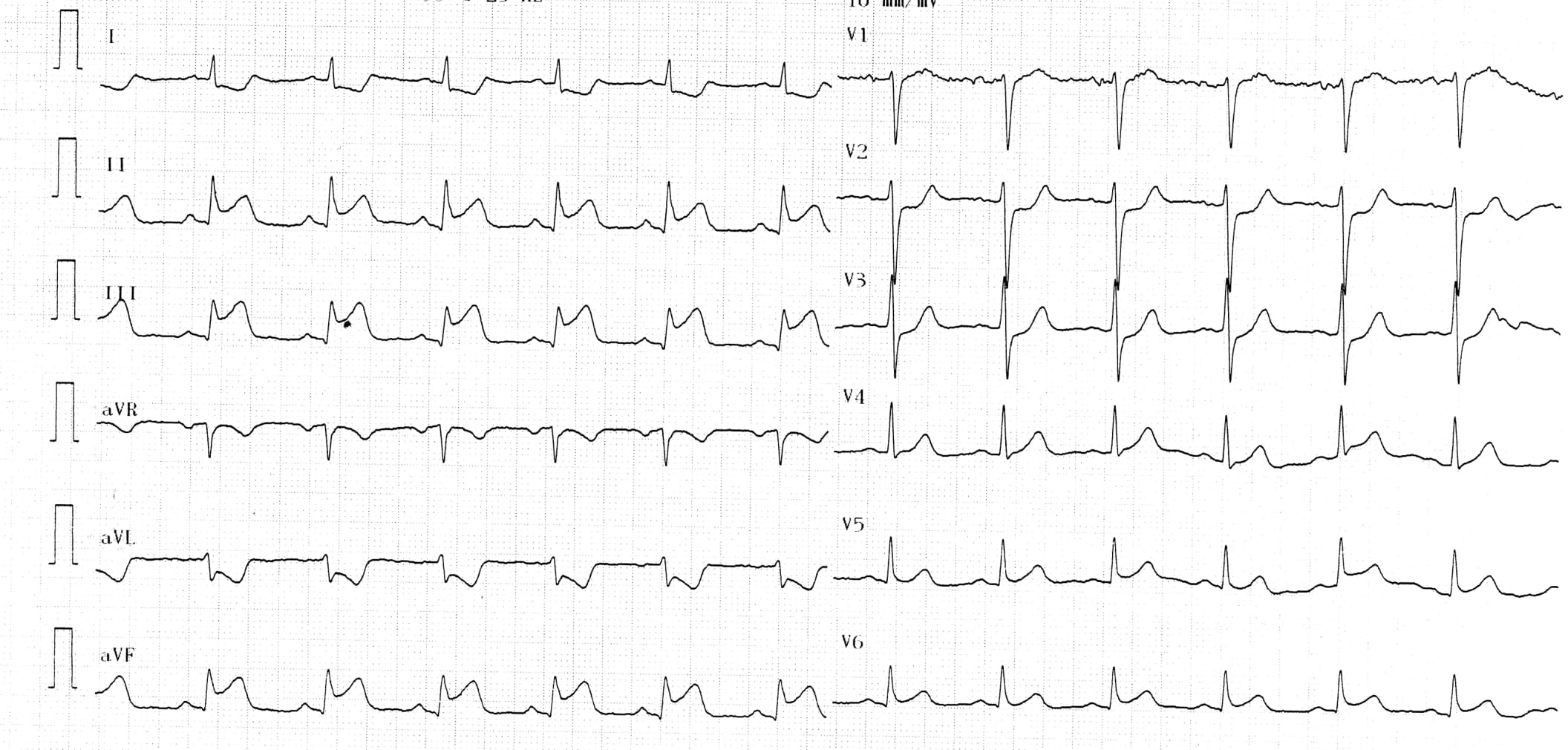
Deuxième tracé obtenu quelques minutes plus tard…
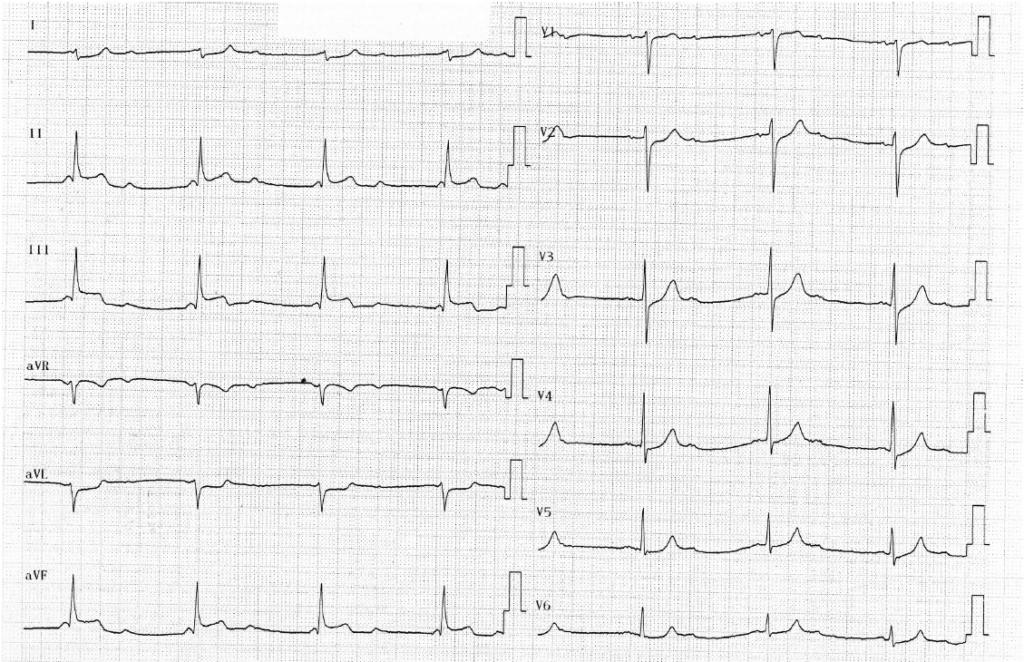
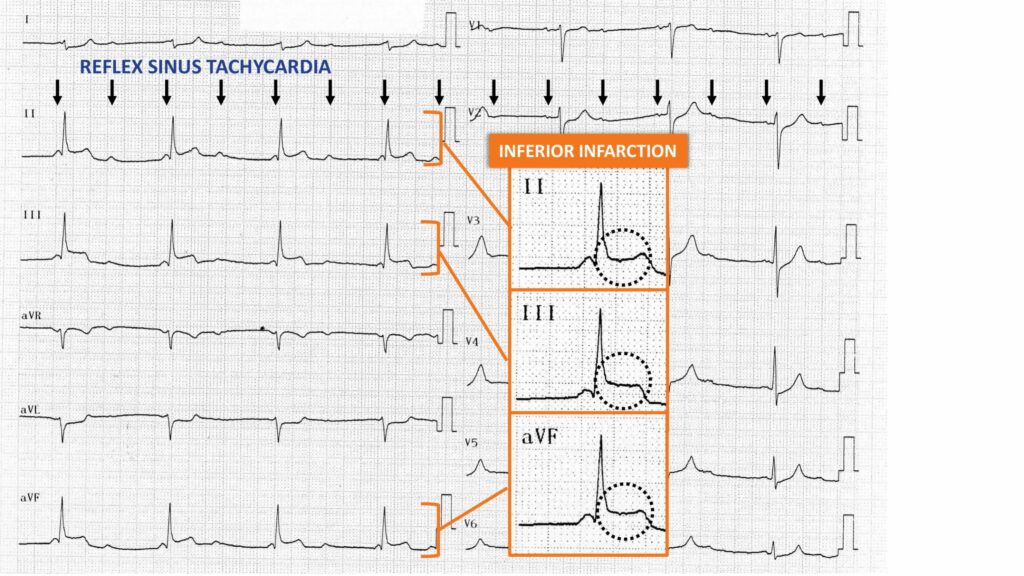
Description du tracé
Deuxième tracé obtenu quelques minutes plus tard ; dissociation auriculo-ventriculaire avec persistance d'une élévation du segment ST ; bloc AV complet dû à un infarctus inférieur ;
Commentaire
L'incidence du bloc auriculo-ventriculaire complet dans le cadre d'un infarctus aigu a considérablement diminué depuis la mise en œuvre des techniques de reperfusion (thrombolyse ou angioplastie d'urgence), même si elle reste néanmoins non négligeable (environ 3 à 5%). Selon la localisation de l’infarctus (antérieur ou inférieur/postérieur), l’évolution et les caractéristiques anatomiques et morphologiques du bloc diffèrent les unes des autres.
Dans le cas d'un infarctus inférieur/postérieur, le site du bloc se situe généralement au niveau du nœud auriculo-ventriculaire, la fréquence ventriculaire reste relativement normale (entre 40 et 60 battements/minute) et les complexes QRS sont étroits. Ce trouble de la conduction régresse le plus souvent spontanément en l’espace de quelques jours en raison de la nature réversible des voies de conduction (inflammatoires et/ou œdémateuses).
En cas d'infarctus antérieur, le bloc survient le plus souvent à la suite d'une nécrose irréversible des deux branches du faisceau de His. Les complexes QRS sont larges, la fréquence du rythme d'échappement est lente (moins de 40 battements/minute) et souvent instable. Ce bloc témoigne d'une nécrose étendue associée à une mortalité élevée (> 70%) due à une insuffisance cardiaque. Le bloc AV complet peut être précédé d'un bloc de branche, d'un bloc bifasciculaire ou d'un bloc AV du deuxième degré de type 2.
Les nouvelles recommandations européennes consacrent une sous-section au bloc AV post-infarctus. Il n'y a pas d'indication de stimulation définitive (classe III) si un bloc AV survenu à la suite d'un infarctus régresse spontanément. Dans les rares cas où le bloc AV complet devient permanent (après plusieurs semaines), il convient d'implanter un stimulateur cardiaque.
Ce patient a subi une angioplastie du premier segment de l'artère coronaire droite, qui a donné de bons résultats, ainsi que la mise en place d'un cathéter de stimulation temporaire ; le trouble de la conduction s'est résorbé au bout de deux jours, après quoi le cathéter a été retiré.
English English French